


Page 52 - Flathead Living // Spring 2015
P. 52
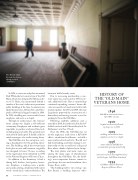
Ron Beard walks through the former dining room of “Old Main.”
In 1896, a contractor and politician named Fred Whiteside led construction of the Old Main, which was designed by Helena archi- tect C.S. Haire, the mastermind behind a number of the state’s other most prominent public buildings at the time. A cemetery was added the next year, followed by a small hos- pital in 1900 and a bigger hospital in 1908. In 1919, a building was constructed to house employees and serve as a chapel.
Through its earliest years, the veterans’ home campus was largely a self-sufficient community. Employees and residents grew vegetables in gardens and raised livestock, including pigs and cattle. The grounds were meticulously landscaped. It hardly called to mind stereotypes of a sterile nursing home.
The Old Main was the centerpiece, serv- ing as headquarters for the growing opera- tion. The building, which has two primary levels plus an attic and basement, originally was designed to house 50 men, according to the registration form submitted in 1994 to the National Register of Historic Places.
In addition to the dormitory, it had a dining hall, kitchen, food pantry, lavato- ries, fireplaces, a reading room, a parlor, and a medical wing, all adorned with native wood–mostlylarch–interiorflourishes.The
basement held a laundry room.
Due to increasing membership, a one-
story annex was constructed in 1956 to pro- vide additional beds. But as membership continued expanding, veterans’ home offi- cials saw need for a brand new facility with modern updates. In 1967 and 1969, the state Legislature approved the construction of a domiciliary and nursing care unit, across the parking lot from the Old Main.
Following multiple additions and a remodel in 2009, the modern facility has 105 skilled-care beds and 12 domiciliary beds. Its Alzheimer’s unit has 15 beds.
Since the 1970s, the Old Main has sat mostly neglected, aside from a $250,000 effort – raised from local donors – to build a new, reinforced roof and attic. The old roof had been leaking, and water damage is evi- dent today on the second-level ceiling and floor, where chunks of plaster lay in clumps.
The stray plaster and water stains are among the many signs of abandonment throughout the Old Main. Yet, the build- ing’s most important features remain in good shape: the structural foundation, door frames, floors, walls.
“The building itself is very strong,” says Ron Beard, a building inspector who’s
HISTORY OF THE “OLD MAIN” VETERANS HOME
1896
Old Main constructed to house Civil War veterans
1900
hospital constructed, followed by larger one in 1908
1919
building constructed to house employees and serve as chapel
1956
annex added to Old Main to accommodate growing membership
1970
construction of new nursing/domiciliary facility begins, Old Main abandoned
1994
Old Main added to National Register of Historic Places
50 FLATHEAD LIVING | SPRING 2015


