


Page 38 - PureMontana // 2016
P. 38
GREATER NORTHWEST MONTANA
BACKBONE OF THE WORLD
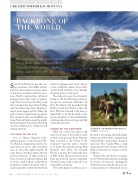
Get to know Glacier National Park, home to 25 active glaciers, bighorn sheep, and a road to the sun
Some 170 million years ago, the soar- ing mountains that de ne Glacier Park were formed when enormous bands of limestone wrinkled under the pres- sure of Earth’s ancient plates. A  ash of geological time later, miles of glaciers crept down from the north.  ey eased their way down the deep valleys, bu ng and smoothing some slopes while leav- ing the peaks jagged and raw. Today, the park’s northern edge bumps up against the Canadian border, meeting Waterton Lakes National Park to create the world’s  rst International Peace Park. Stretching out over 1 million acres of land, it’s still wild and pristine.
THE ROAD TO THE SUN
One of Glacier National Park’s de ning features is the Going-to-the- Sun Road, an engineering marvel of a road that cuts across sheer mountain faces in the park. Approximately 50 miles long, it stretches between the east and west entrances. It takes about two hours to traverse without stopping. But of course, with lookouts and pullouts and points of interest along the way, it’s nearly impossible to drive the Sun Road
without stopping at least once to take in a vista—and there’s always the possibil- ity that tra c will halt to let a friendly mountain goat cross the road.
 e road got its name from the nearby Going-to-the-Sun Mountain, which in turn got its name from a Blackfeet sun deity, Sour Spirit, who descended to the Earth to teach First Nations tribes the hunt. When he returned to the skies, as legend tells it, he left his mark on the top of a mountain so that the Blackfeet could remember his teachings and  nd continual inspiration.
CROWN OF THE CONTINENT
With one of the most diverse and intact ecosystems in the world, a swath of land encompassing Glacier National Park is known as the Crown of the Continent—and the park is known as its Jewel. An inspired George Bird Grinnell, after whom the Grinnell Glacier is named,  rst coined the term in 1901. Today, the preserved ecosystem looks just about the same as it did when Grinnell visited, with nearly all of its original  ora and fauna.
Over 1,132 plant species bloom across
the park. Come spring, the gentle alpine slopes turn yellow, white, and pink with monkey  owers, Glacier lilies,  reweed, and more.  e Garden Wall, a steep alpine area above the Going-to- e-Sun Road, is known for its summer rainbow of  owers.
Glacier Park is also home to a menag- erie of Northwestern animals, including 71 species of mammals. Endangered wolverines have made their homes here, as have members of threatened species
A memeber of the Blackfeet tribe dances in St. Mary. CONNOR WELLES
38 PURE MONTANA // PureWestRealEstate.com // 2016


