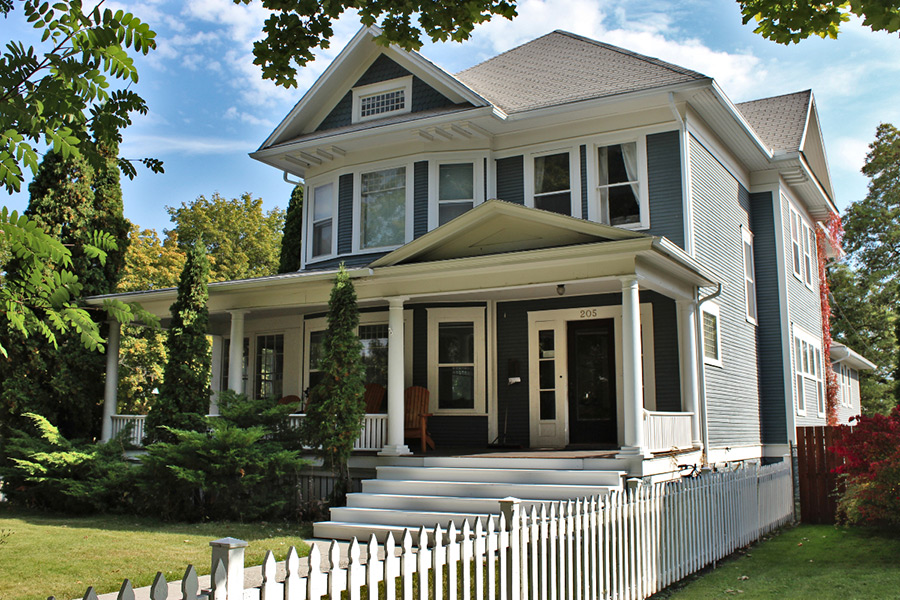
The house at 205 Fifth Ave. E. in Kalispell is a quintessential Queen-Anne-styled residence. It was built in 1910 for George McCrea, secretary of the Northwestern Lumber Company. McCrea could comfortably afford such a splendid home, as the Northwestern was the largest mill in the area at the time. Indeed, miles of logs floated down the Stillwater River along with wannigans and workers (known as “river rats”) who kept the saw blades spinning at an unrivaled pace.
For a bit of perspective, society at large was debating the merits of its ranks and the significance of “a house to call home” while McCrea was debating the architectural nuances of the home. He grappled with how to treat the tympanum of the pediment (the triangle space above the front entrance) and how to accentuate the angle of the bay windows and depth of the extended eaves with broad dentil moulding.
Meanwhile, Kalispell authorities were busy grappling (more literally) with men of a lesser lot – the hoboes, harvest tramps, and other nomadic heathens without a steady job or sense of place – and “floating” them out of town (much like logs down a river). Indeed, building a grand, Queen-Anne style home on a prominent corner lot was a landmark of achievement – and a statement about permanence and position within society at the time.
Thus, it should be of little surprise that the home was purchased in 1920 by another prominent businessman: Lew Switzer.
Notably, Switzer’s success developed much like the development of Kalispell itself. Switzer, like many other settlers, came from “back East.” He worked at a hardware store in Logansport, Indiana and came to Montana in 1888 to work for Captain T.P. Fuller, a hardware store owner – and mayor of Helena.
In 1889, Switzer took employment with the Missoula Mercantile Company. Two years later, Switzer was charged with overseeing the hardware department at the company’s branch store at DeMersville.
As Kalispell became the destined “new railroad town of Northwest Montana,” and businesses moved from DeMersville to Kalispell in 1892, Switzer implored the managers of the Missoula Mercantile to do the same. Upon his urging, a branch store was opened at Kalispell, where Switzer continued to play an important role in the company.
In 1907, like many other men of success and ambition, Switzer decided to make a name for himself, and started the Switzer Furniture Company. His success continued and at the time the Swizters moved into the home, theirs was the largest furniture business in Northwest Montana.
Lew and his wife Blanche (née Boos) are the namesakes of the house, as listed on the National Register of Historic Places. The Switzers lived in the home until 1947. Lewis unfortunately passed away in 1949, while Blanche survived him until 1961, when she too was buried at the Conrad Memorial Cemetery.
And much like the legacy of Switzer’s fair dealings, support for the Kalispell community and business achievement, their namesake house persists as well. The home reveals hallmarks of a bygone architectural style: the wrap-around porch, wide pediment entrance, hipped roof, porch columns, clapboard with contrasting fish-scale siding, a third-story garret flanked by cross-gables with pent-roofs – these are just a few of the appointments that we can still appreciate today. (admittedly, the rest outnumber the words for this article).
The Switzer House is a proud definition of the Queen-Anne style in Kalispell – built at a time when the meaning and social significance of “a home” was being defined as well.
Jaix Chaix appreciates history and architecture. Share ideas and facts with him at [email protected] or at facebook.com/flatheadvalleylandmarks.