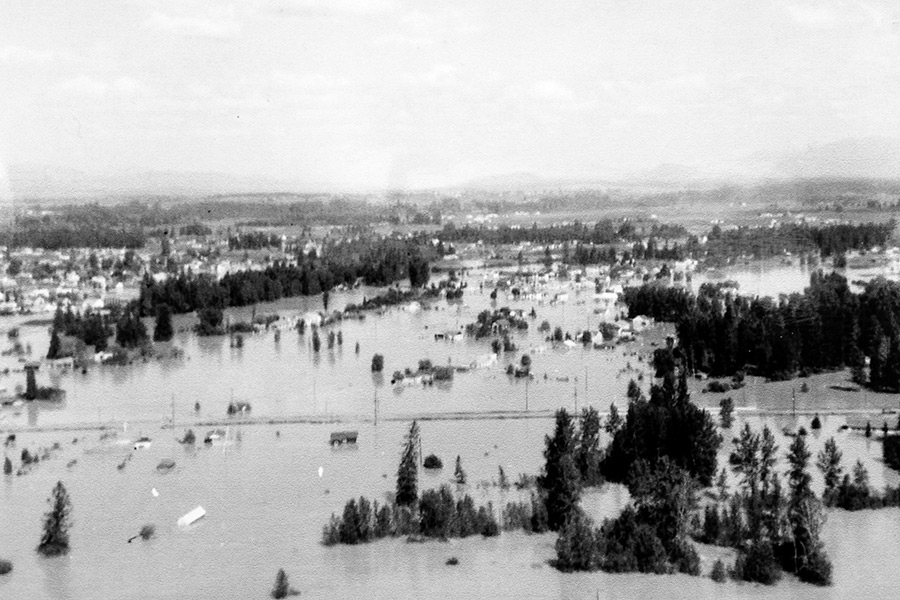
Floods have long signaled the coming of spring and summer in Montana. Every year people nervously watch the riverbanks. But regardless of how high the waters may rise, they rarely compete with the second week of June 1964.
Fifty years later, the floods of 1964 still reign as one of “Montana’s worst natural disasters,” according to scholar Aaron Parrett. In just a matter of days, 20 percent of the state had been impacted by the flood that caused millions of dollars of damage to homes, roads and bridges.
The flooding was caused, in part, because of below-normal temperatures between March and May that delayed the normal mountain snowpack melt. By June, many area streams and rivers were already high when a weather system brought heavy rains to the region. While the flood impacted communities all across western and central Montana, some of the worst hit areas were the Flathead Valley and the Blackfeet Indian Reservation.
West of the divide, the floods inflicted more than $24 million worth of damage, yet it was nothing compared to the human toll east of the divide on the Blackfeet, where at least 30 people were killed and 260 homes were destroyed. However, the devastation there was largely overlooked. The largest news organizations that were close to the reservation, in Kalispell and Great Falls, were preoccupied with the flooding in their own neighborhoods.
“We all knew what was going on here,” said Mike Billedeaux, a survivor of the flood who grew up near Babb. “But the rest of the world didn’t.”
Billedeaux was playing in the nearby hills on June 8, 1964 with his brother when the Lower Saint Mary Lake breached its banks. He recalled having to swim to their submerged house in order to save the family’s two pets, a dog named Dolby and a cat named Cat.
Another survivor, Darrell Williamson, said the flood forced major changes on the reservation and afterwards many people moved to towns like Browning and Heart Butte. Slowly but surely the Blackfeet’s relationship with the land began to change, Williamson said. The flood is something neither of them will ever forget.
“I can’t tell you what I did yesterday, but I can tell you about the flood of 1964,” Williamson said.