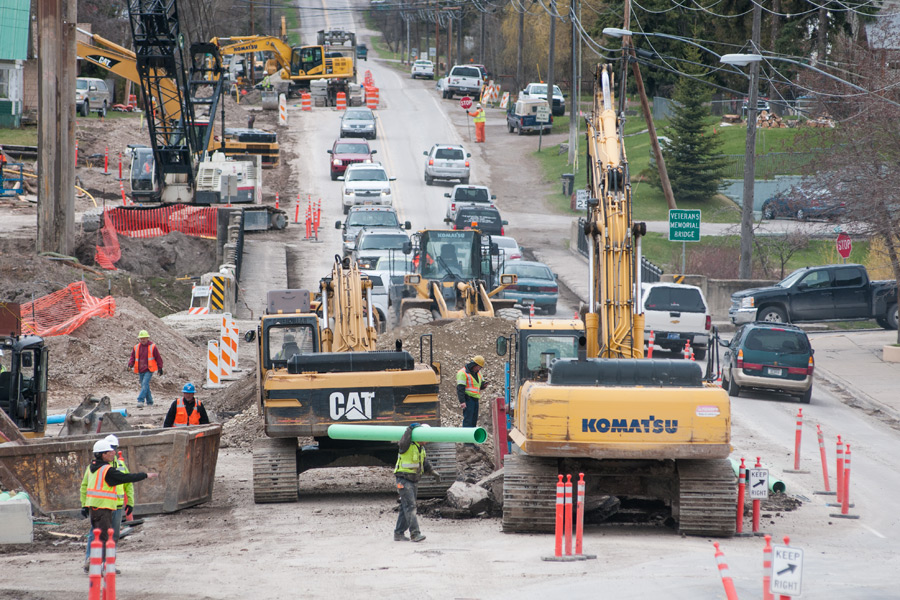
WASHINGTON — After years of stymied efforts to address the nation’s aging and congested highways and transit systems, Congress found the sweet spot for passage on Thursday — a 5-year, $305 billion bill laden with enough industry favors, parochial projects, safety improvements and union demands to gain overwhelming support.
The bill was approved 359 to 65 in the House, and 83 to 16 in the Senate. The bill now goes to the White House for President Barack Obama’s signature.
The bill boosts highway and transit spending and assures states that federal help will be available for major projects. It doesn’t include as much money or last quite as long as many lawmakers and the Obama administration would have liked. Nor does it resolve how to pay for transportation programs in the long term.
Despite that, the 1,300-page bill was hailed by industry and public officials as a major accomplishment that will halt the cycle of last-minute short-term fixes that have kept the federal Highway Trust Fund teetering on the edge of insolvency for much of the past eight years.
Republicans leaders can point to the bill’s passage as evidence of their ability to govern, and Obama can claim progress on addressing the nation’s aging and congested infrastructure, a major goal since the early days of his administration. Lawmakers in both parties praised the bill as a model of bipartisan cooperation and an important step forward.
The bill “proves to the American people that we can get big things done,” said Rep. Bill Shuster, chairman of the House Transportation and Infrastructure Committee. The committee’s senior Democrat, Rep. Peter DeFazio of Oregon, called the measure “historic,” but cautioned that “it is a starting point, not the end.”
One hallmark of the bill is the creation of new programs to focus federal aid on eliminating bottlenecks and increasing the capacity of highways designated as major freight corridors. The Transportation Department estimates the volume of freight traffic will increase 45 percent over the next 30 years.
A big shortcoming in the bill, though, is how it’s all financed. The main source of revenue for transportation is the trust fund, which comes mostly from the 18.4-cents-a-gallon gasoline tax. That tax hasn’t been raised since 1993 even though transportation spending has increased. But raising the gas tax is viewed by many lawmakers as too politically risky.
To make up the shortfall, the bill uses about $70 billion in mostly budget gimmicks, including one that would move $53 billion from the Federal Reserve Bank’s capital account to the general treasury. It’s counted as new money on paper, but is actually just a transfer of funds from one government account to another, federal budget experts said.
Other items in the bill also don’t include the means to pay for them, including more than $10 billion over five years for Amtrak and other rail programs, $12 billion for mass transit and $1 billion for vehicle safety programs. The money for those programs remains subject to annual spending decisions by Congress.
Among the bill’s losers are large banks, which would receive lower dividends from the Federal Reserve, with the savings used for transportation programs. Banking officials complained that banks shouldn’t be asked to foot thebill for highways and bridges.
The airline and cruise ship industries complained that their passengers are also being asked to pay for improvements unrelated to their travel. The bill ties customs fees to inflation and uses the increased revenue to offset the bill’s cost. It also directs the sale of 66 millions of barrels of oil from the Strategic Petroleum Reserve in order to raise $6.5 billion. The catch is the sales don’t start until 2023 — three years after the transportation bill it helps pay for has expired.
The trucking industry was able to persuade lawmakers to order the government to remove trucking company safety scores from a public website despite opposition from safety advocates. Industry officials say the government’s methodology is unfair. But safety advocates won inclusion of a long-sought provision requiring rental car agencies to repair recalled cars and trucks before renting them.
The bill also addresses several concerns raised by a deadly Amtrak derailment in Philadelphia in May. It provides $200 million to help passenger railroads install positive train control technology that accident investigators say could have prevent the derailment had it been in operation. It also raises the liability cap on total damages that can be awarded in such crashes from $200 million to $295 million. The derailment killed eight people and injured nearly 200 others.
The Amalgamated Transit Union, which represents city bus drivers, won a provision requiring the government to direct transit agencies to take steps to protect bus drivers from assault, a growing problem. The Federal Transit Administration is required to consider whether local transit agencies provide bathroom breaks and access to bathrooms for bus drivers when evaluating the safety of the agencies.
A provision sponsored by Rep. Dina Titus, a Nevada Democrat whose district includes Las Vegas, authorizes the creation of a national advisory committee made up of travel and tourism industry officials to develop a national strategy for ensuring that transportation policies address the needs of travelers. Another provision sought by the dairy industry and sponsored by upstate New York, Connecticut and Wisconsin allows trucks hauling milk to exceed federal weight limits for interstate highways in some cases.
U.S. Sen. Steve Daines, R-Mont.:
“The long-overdue passage of a multi-year highway bill is great news for Montana and a critical step forward in providing our state with the certainty needed to make long-term infrastructure investments. Our transportation infrastructure is a critical component of our state’s economy and given Montana’s short construction season, it’s imperative that communities and contractors alike have the certainty needed to move forward with badly-needed infrastructure improvement projects. This bill ends Congress’s irresponsible trend of short-term Band-Aids and temporary extensions and provides long-term support for our nation’s vast transportation network. I am proud to see this important legislation garner overwhelming bipartisan support and I urge the President to swiftly sign it into law.”
U.S. Sen. Jon Tester, D-Mon.:
“This long-term highway bill will help drive Montana’s economy by making critical new investments and create good-paying jobs that can’t be outsourced. It will provide certainty for construction workers, small businesses and local governments, and improve the safety for all Montanans who drive on our roads and bridges each day.”
Nearly 90 percent of Montana’s highway program funding is supported by federal dollars. The FAST Act will provide an estimated $2.28 billion over the next five years to Montana. Montana had 425 existing infrastructure projects that were at risk without federal support.
The highway bill, which Daines and Tester supported and helped pass, secures several critical provisions, including:
National Highway Traffic Safety Administration (NHSTA) Grant Flexibility – Provides states the option to qualify for impaired driving grants for 24/7 sobriety. The 24/7 Sobriety Program that began in 2011 after two troopers were killed by a drunk driver. Through this program over 5,000 Montana participants have tested twice a day, totaling almost 700,000 breath tests – 99.3 percent of these tests administered have been clean. For Montana, the 24/7 Sobriety Program has reduced alcohol related fatalities and is countering the culture of drinking and driving.
Electronic Odometer Disclosure – Allows states to voluntarily proceed with their own odometer disclosure programs, as long as their processes provide equivalent security to the current paper and ink process.
Wireless Roadside Inspection (WRI) System Report – Requires the Federal Motor Carrier Safety Administration (FMCSA) to report to Congress on the design and implementation of their WRI system. Montana and 39 other states already have state and private systems in place, specifically in Montana since 1998 the non-federal system saved motor carriers 340,000 hours of commercial driver time, more than 1.6 million gallons of fuel and more than 3,500 tons of emissions. This provision requires FMSCA to clarify how it is not a duplicative system and how they will safeguard another federal database of private driver and business data.
Eastern Montana Amtrak Station Report – Requires Amtrak to evaluate options for establishing additional Amtrak stops that would have a positive financial impact to Amtrak, including a potential station in Culbertson, Montana. It also requires evaluation of options to enhance economic development and accessibility of Amtrak stations and their surrounding areas.
Crop Insurance – Reverses $3 billion in cuts to the federal crop insurance program.