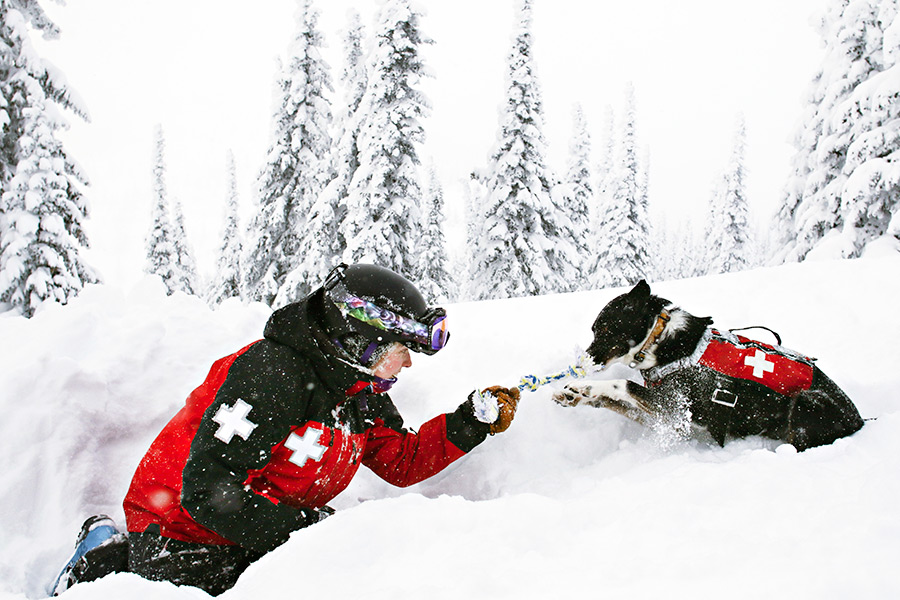
WHITEFISH – As snow whipped across the summit of Big Mountain, Lloyd Morsett walked 2-year-old Jett to the edge of the trail before releasing the black and white border collie into the powder.
Jett, sporting a red dog vest with a ski patrol cross, leaped into the snow and began searching for a victim. Moments later he ripped around a tree and found patroller Katie Atha partially buried in the snow.
“Good dog, Jett!” she yelled, “good dog!”
The excitement in Atha’s voice reminded observers that this search was just a drill; another day of training for the Whitefish Mountain Resort ski patrol’s newest member.
Last spring, Morsett started training Jett to become an avalanche and mountain rescue dog. Morsett, who joined Big Mountain’s patrol two years ago, had previously worked as a patroller for 15 years in Colorado, where he worked with another rescue dog. Riley Polumbus, spokesperson for the resort, said the ski patrol has wanted to train a rescue dog for a number of years but the opportunity never came to fruition until Morsett arrived in 2013.
Dogs have an unparalleled ability to nose out humans in snow and debris and the trait has led search and rescue teams to enlist their skills for years. In an avalanche, the scent of human perspiration can travel through the air. Morsett picked Jett, who came from a border collie rescue shelter, for a number of reasons, including his size. Sometimes, Morsett skis with Jett in his arms to get to a scene faster, and having a lighter dog means it’s a lot easier to navigate the slopes.
“I also love the work ethic of the border collie and how they search,” he said.
In order to train an average dog as a mountain’s top patrol pooch, Morsett has to tap into the animal’s “prey and play” sense. In early training exercises, Morsett excited Jett while another person held him back. Then Morsett would run away and hide with Jett’s favorite rope. At first he would duck behind a tree, but over time Morsett and other trainers have found more complex hiding spots, like in a snow pit, partially buried. When Jett finds the victim, he is rewarded with a game of tug-of-war with his favorite toy. The games help Jett hone in on his sense of smell while also training him how to find people.
“Jett never knows it’s a life and death situation,” Morsett said. “He just knows he is playing a game… We want to try and keep the training fun for him.”
Jett will not be fully trained for another season but Morsett is hopeful the dog will be certified to join the team before next winter. Search and rescue teams in Colorado, Canada and elsewhere all have certification programs that test the dog’s skills. When Jett does join the patrol fulltime he’ll be accustomed to finding people who have been trapped in avalanches or even in tree wells. Although avalanches are rare within the ski area boundaries, they do happen, most recently last winter in the Hellroaring Basin. No one was injured in that incident.
Morsett said that if a well-trained dog is brought to the site of an avalanche as soon as possible they could cut down the search for survivors by hours. In most cases, if an avalanche victim isn’t wearing a beacon, it can take many hours to use probes to search the entire debris field.
Polumbus said although the mountain rescue dog program is new at Big Mountain, resort officials are excited about the future. She noted that if Jett is successful it is possible they will hire a few more patrol pooches. Polumbus also said that the public would have a chance to meet Jett later this winter. That is, when Morsett and Jett are not busy surfing the slopes and doing training exercises.
“The mountain is doing a great job supporting Jett and I and what we’re doing,” Morsett said.