Critics Say Obama’s Proposed Gun Rules Will Have Little Impact
President announces executive actions on gun control as local manufacturers continue to grow
By Molly Priddy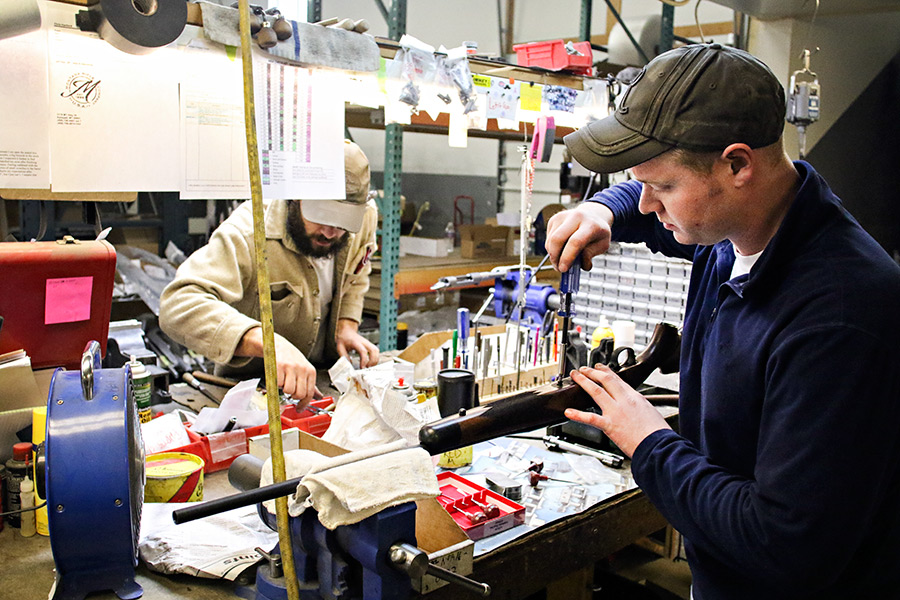
It’s a quiet, gray January day outside Montana Rifle Company, and inside the lobby it’s calm and well lit, with photos of hunters posing with fresh kills and their MRC rifles.
But any sense of tranquility disappears behind the doors leading to the firearms factory, where dozens of employees are working nearly on top of each other to craft, build, and perfect the rifles that have made this Kalispell company grow from a new operation in 2011 to winning the 2016 Friends of NRA Gun of the Year award.
In other words, business is booming.
“We’ve grown quite a bit,” Jeff Sipe, vice president of sales and marketing at the company, said. “In 2011, we had three employees. Today we’ve got 72, and I’m trying to fill 18 openings.”
Sales have also increased “dramatically” since they started the company, which prides itself on perfecting each individual rifle’s action and fit before it lands in the hands of the customers.
In 2015, sales increased 320 percent over 2014, he said. A good chunk of their business still goes to selling rifle barrels to Remington companies, but Sipe said one reason for their increased production is the return of popularity for hunting rifles. In the past few years, most gun purchases were centered on assault rifles and pistols, he said, but the hunting rifle is making a comeback.
Some increased sales can be attributed to the political climate around firearms, he said, especially if gun control is part of the conversation.
Last week, President Barack Obama announced new executive actions he said would reduce gun violence, such as improving and enforcing existing laws around background checks, adding money to the federal budget for more agents to track illegal firearm sales, marking $500 million for better access to mental health care, and working with the federal Department of Health and Human Services to remove legal barriers that prevent states from reporting information about people prohibited from possessing a gun.
In the Montana Rifle Co. workshop, Sipe said there was little in the new executive actions that would affect his business.
“All gun manufacturers and all gun stores follow those laws already,” Sipe said. “I still have faith in our country as a whole. I don’t believe that his executive actions are going to be everlasting.”
Firearms have a large role in Montana’s cultural makeup, from personal and property protection to hunting. It’s a state that enjoys bipartisan support of the Second Amendment, along with support from a majority of its residents. In the Flathead Valley, firearm manufacturing stayed strong during the recession, with many in the industry reporting increased business in recent years.
Obama’s announcement came after a year in which mass shootings were center stage. In early December, 14 people were killed and 21 injured in San Bernadino, California, in a shooting, just days after three were killed and nine injured in Colorado Springs, Colorado. On Oct. 1, a gunman shot and killed nine people in Roseburg, Oregon; in July, five people were shot dead in Chattanooga, Tennessee. Nine people were killed in a shooting at a Charleston, South Carolina church in June, six people were shot to death in Isla Vista, California in May, and three people were killed in Ft. Hood, Texas in April.
In his speech announcing his executive actions, Obama invoked the 2012 Sandy Hook Elementary School shooting in Newtown, Connecticut, during which 20 children and six adults died.
Critics, however, said that while emotional, Obama’s executive actions would likely have little or no impact on the issue of guns getting into the hands of the wrong people.
“The things the president announced in his news conference are mostly smoke and mirrors and are not going to have much impact on the street, I don’t think,” Gary Marbut, president of the Montana Shooting Sports Association, said. “A lot of the things that he talks about are things that have been in the works for executive branch agencies for a year or more.”
Marbut said his organization plans on going into the 2017 Montana Legislature with more pro-gun bills, with the main focus on eliminating gun-free zones, including on college and university campuses.
In an interview with the Beacon, Montana U.S. Sen. Steve Daines said growing up in this state allowed him to learn how to properly handle a firearm as a child, and he views firearms as “a part of who we are as Montanans.”
From his Congressional seat, Daines, a Republican, said he believes that had Obama’s executive actions been in place a year ago, they wouldn’t have stopped the mass shootings.
“My concern is that the president, as this new year began, he had a chance to set in play a narrative around how we can address these issues of violence and these mass shootings,” Daines said. “Instead, what he has done is he’s more focused on undermining the Second Amendment rights on law-abiding Americans.”
Daines said the focus of the gun narrative should be on the mental illness issues of recent mass shooters, the issue of stolen guns being used, and the existence of gun-free zones.
He said better access to mental health care “needs to be” on his own agenda moving forward, especially when it comes to providing such care for underserved communities, including a majority of Montana towns. Daines also said new laws on firearm access should focus on stolen guns and people who are complicit in the purchase of firearms that end up used in a crime.
“We need to put laws in that are tougher on criminals,” Daines said.
According to data from the Montana Incident-Based Reporting System, law enforcement reported that firearms were used in 532 crimes in 2014, including 16 murders. And the Centers for Disease Control and Prevention reported there were 172 gun-related deaths in the state in 2013, up from 171 in 2012.
Montana U.S. Sen. Jon Tester released a statement after the president’s announcement, mentioning that he is a gun owner and supports closing the “background check loophole” at gun shows.
“Unfortunately this announcement speaks to the dysfunction of Congress and its failure to tackle tough issues,” Tester said. “I’m looking closely at this to make sure that it doesn’t infringe on our Second Amendment rights or erode our western values while also protecting us from folks who would do us harm.”
At Montana Rifle Co., Sipe said he’s not particularly worried about Obama’s recent actions and is more concerned with finding hardworking employees to fill 18 open jobs. Crews are currently working to clear a six-month backlog of orders, but Sipe thinks they’ll have to add night shifts so they can have production running 22 hours a day to keep up with demand. A new building might also be in the works if they continue to run out of space.
“We still want to make sure that when somebody gets their rifle, it’s the best quality,” Sipe said.