The Life of a Newborn Lake
As new lakes created by glacial recession emerge in Glacier National Park, scientists seek to unpack their mysteries and understand the aquatic species in jeopardy
By Tristan Scott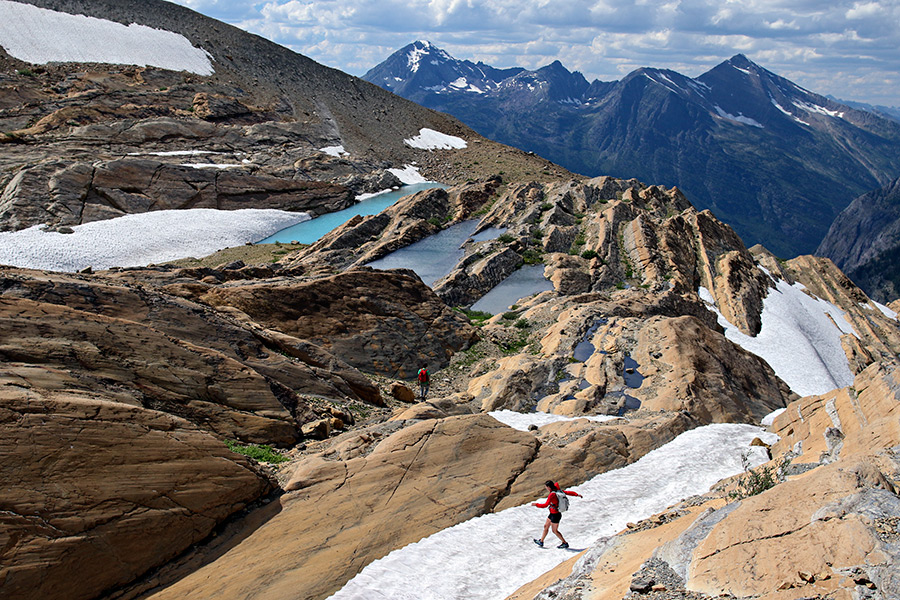
As the newly christened director of the University of Montana’s Flathead Lake Biological Station, Jim Elser spent parts of his first summer here helming the research center from high above the valley floor.
His interests in lakes are broad, both scientifically and geographically, and to gain a more familiar understanding of the entire Flathead Basin watershed he devoted one day each week last summer to visiting and collecting samples from as many lakes as possible around the Flathead and Mission valleys.
As the seventh director since Morton J. Elrod founded the biological station in 1899, Elser has taken his research beyond Flathead Lake and — like Elrod, who published the first scientific paper on Glacier National Park’s lakes in 1912 — intends to key in on the significance of established high-alpine aquatic systems, as well as nascent lakes forming as the park’s namesake glaciers retreat.
One of Elser’s lake-sampling excursions led him into the high country of Glacier National Park, where a new crop of silt-colored lakes are forming due to glacial recession, directly below streams that support rarefied aquatic species.
Along with Clint Muhlfeld, a research ecologist at the U.S. Geological Survey’s Northern Rockies Science Center in Glacier Park, and Joe Giersch, a USGS aquatic entomologist, Elser hiked over 17 miles in Glacier National Park to a newborn lake at the foot of Sperry Glacier. The researchers gathered samples from the newly formed waters at the base of the retreating glacier to determine whether food webs are beginning to form with the colonization of zooplankton.
In some cases the new lakes haven’t been named, while in others they have never been studied, and the research is pioneering science in the face of a warming climate.
“These are brand new lakes and no one really knows anything about them,” Elser said.
The lakes form in the bedrock and in scalloped depressions in the moraine, and are colored a milky-white or turquoise-blue by the glacial flour.
But even though glacial recession could lead to new aquatic life systems as the lakes take hold, Muhlfeld and Giersch say the species dependent on the cold glacial water feeding them are in jeopardy of extinction, particularly as the park’s namesake glaciers are predicted to disappear by 2030.
Giersch is lead author of a recently published study that provides the first comprehensive evaluation of the current status, distribution and habitat requirements of two rare alpine insects found only in the glacial-fed streams. The 20-year study was used to inform the species’ status review for consideration of protection under the U.S. Endangered Species Act due to climate-change-induced habitat loss.
Giersch discovered that the meltwater stonefly and western glacier stonefly have a narrow distribution and are restricted to short sections of cold, alpine streams directly below glaciers.
“Alpine aquatic insects living in glacier and snow-fed streams are adapted to very cold water temperatures and are therefore especially vulnerable to warming and snow and ice loss,” Giersch said. “Although this research is focused on two insect species, our findings apply to entire communities of alpine stream organisms, the survival of which depends on the presence of permanent ice and snow feeding the streams in which they live.”
Over the duration of the study, researchers sampled 272 alpine streams in Glacier National Park, where the insects are native, and other areas outside the known distribution throughout the Rocky Mountains of Montana and Wyoming.
The meltwater stonefly was found in 113 streams within Glacier National Park and surrounding areas. The likelihood of finding the insect increased with cold stream temperatures and proximity to glaciers and permanent snowfields, and declined with increasing distance from stream source.
The western glacier stonefly was only found in 10 streams, six in Glacier National Park and four in mountain ranges almost 400 miles southwest.
Both stoneflies were present in groundwater-fed alpine springs, which may provide refuge when alpine stream conditions decline.
This study brings to light how an obscure species could be biological sentinels of climate change because their survival is dependent on a habitat that is rapidly becoming fragmented and degraded, making it very difficult for them to adapt.
“These stoneflies are retreating up the mountain to seek out cold water, but there is nowhere to go because they’re literally at the top of the continent,” Muhlfeld, a co-author of the study, said.