McDonald Creek Homeowners Reassert Right to Build on Private Land in Glacier Park
In their opening brief to an appeals court, a California couple reinforced their position that Montana's stream protection laws do not apply on their private property
By Katie Bartlett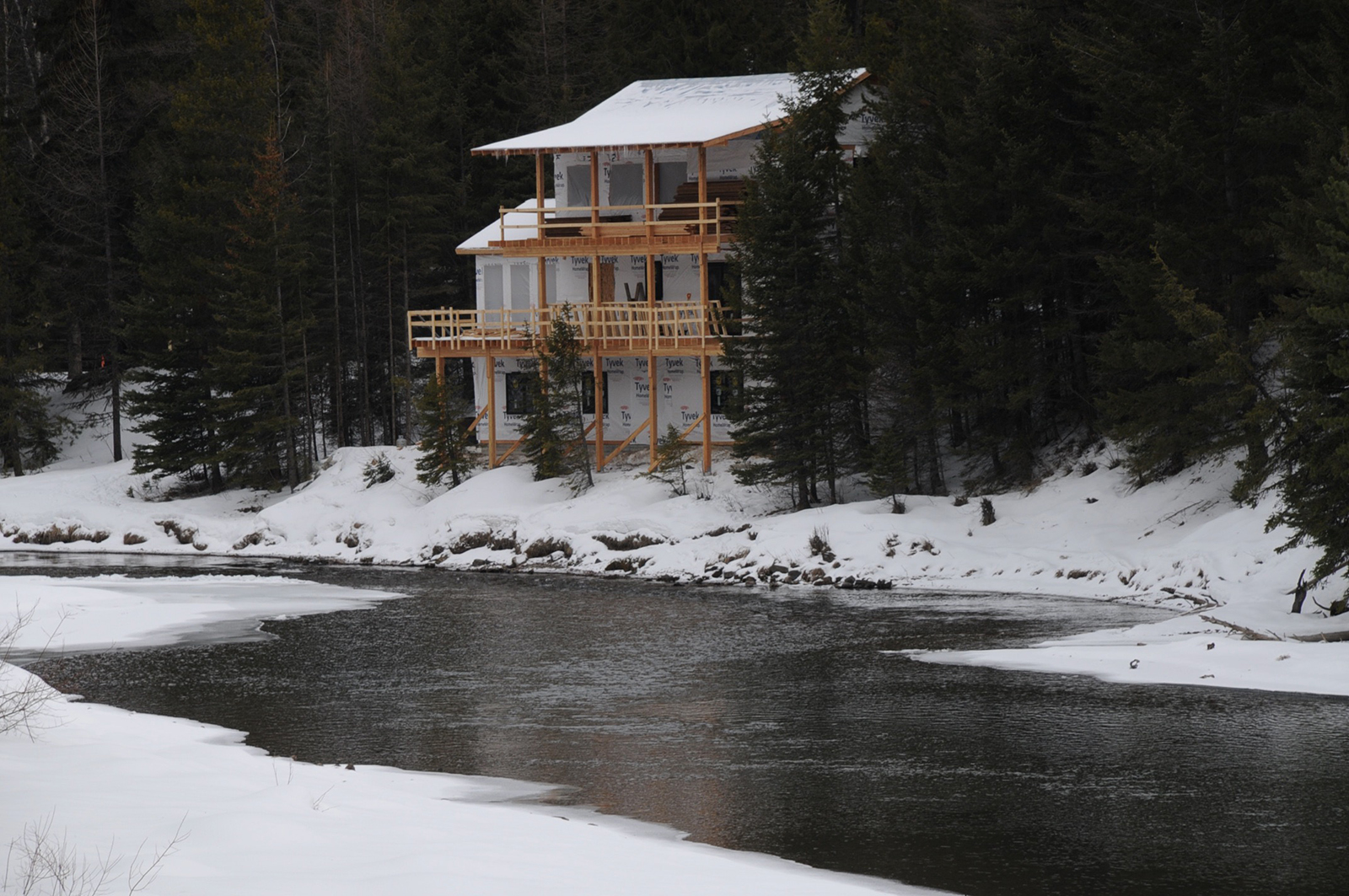
A California couple is asking a federal appeals court to confirm that Montana has no authority to enforce its environmental laws within Glacier National Park.
In a July 28 filing with the Ninth U.S. Circuit Court of Appeals, John and Stacy Ambler argued that their home along McDonald Creek does not violate Montana’s stream protection laws. A federal judge ruled in their favor earlier this year, but the Flathead Conservation District and a group of local residents appealed the decision, reigniting a high-profile dispute over who controls development on private land within federally managed parks.
The appellants, the Flathead Conservation District (FCD) and a group of West Glacier and Apgar residents known as Friends of Montana Streams and Rivers (FMSR), argued that the Amblers’ construction project violates the Montana Natural Streambed and Land Preservation Act. The 1975 statute requires any private individual proposing work near a stream that “physically alters or modifies the bed or immediate banks” to first obtain a permit from the local conservation district.
FCD cited the law when first ordering the couple to tear down their home in 2023. But Trent Baker, the Amblers’ attorney, argued in his July 28 brief that the 1975 law does not apply within Glacier National Park.
Montana passed the Streambed Act decades after the federal government established Glacier National Park in 1910. Baker cited the 1968 water rights case Macomber v. Bose, which found that Montana had ceded jurisdiction over privately owned land within the park to the federal government.
When the District Court reviewed Macomber, it concluded that only state laws in effect at the time of the cession remain applicable within the ceded area — unless the law falls under a specific exemption, such as criminal law.
“Neither FCD nor FMSR expressly invoked a specific exception but rather argues generally that when the United States accepted the cession as to Glacier National Park, it assimilated all pre-existing and future state law,” Baker wrote.
Baker also refuted FMSR’s claim that the Streambed Act was assimilated as criminal law under the Assimilative Crimes Act (ACA). He argued that the Streambed Act is regulatory, not prohibitory, because its primary purpose is to regulate and license construction near streams — not to ban it outright.
State regulations enacted after the cession can remain in force if they follow “the same basic scheme” as laws that were already in effect at the time. But Baker disputed FMSR’s claim that the Streambed Act meets that standard.
FMSR pointed to an 1897 Act that outlined “fines and jailtime for depositing debris from sawmills into streams,” arguing that it reflects early stream protections consistent with the modern act. Baker argued that the 1897 law did not regulate construction or streambed alteration, which is the focus of the Streambed Act.
He cited legal precedent prohibiting an “infinitely malleable approach” which would allow states to indefinitely impose new laws on federal lands.
“The arguments of FCD and FMSR would allow the state of Montana to continuously impose on the National Park Service to enforce new substantive laws in Glacier, so long as they generally relate to construction or streams,” he wrote. “This is an ‘infinitely malleable’ approach.”
Baker also pushed back on FMSR’s claim that the Streambed Act fills a regulatory gap left by federal law, calling it an “erroneous assertion” that federal regulations don’t apply to construction on private land.
He pointed to several regulations that do apply to private land within Glacier, including a prohibition on developing eating, drinking, or lodging establishments, and a requirement that privately owned buildings “intended for human habitation” must have water supply systems that meet state and county standards.
“The Amblers respectfully request that this Court affirm the District Court’s order holding that the FCD does not have jurisdiction over the Ambler’s [sic] private inholding within Glacier National Park and that Natural Streambed and Land Preservation Act of 1975 does not apply,” Baker concluded in the brief.
The Ambler case began in 2023, when FCD launched an investigation into the Amblers’ property after locals complained about construction work.
Investigators found that the McDonald Creek streambed had been excavated to create a pad for the home’s construction, in violation of the Montana Natural Streambed and Land Preservation Act, and the FDC subsequently ordered the structure be removed.
The Amblers, who purchased the property in 2019, filed lawsuits in state and federal courts, arguing that FCD overstepped its authority. They said that neither Flathead County nor Glacier National Park required permits to begin construction on the property.
FMSR claimed that when Congress created the park in 1910, it excluded privately owned lands from its jurisdiction. But U.S. Magistrate Judge Kathleen DeSoto rejected that argument in a Feb. 5 ruling.
“The Court is bound by Macomber, which forecloses FMSR’s argument to the contrary and makes clear that the federal government has legislative jurisdiction over private inholdings within the park, including the Ambler property,” she wrote in her Feb. 5 ruling.
FCD and FMSR filed the appeal in March seeking to reverse DeSoto’s ruling, and the Amblers have since filed court motions seeking reimbursement for more than 300 hours in attorneys’ fees. A decision in the case could shape how far state environmental regulations reach into federally managed areas across the country.