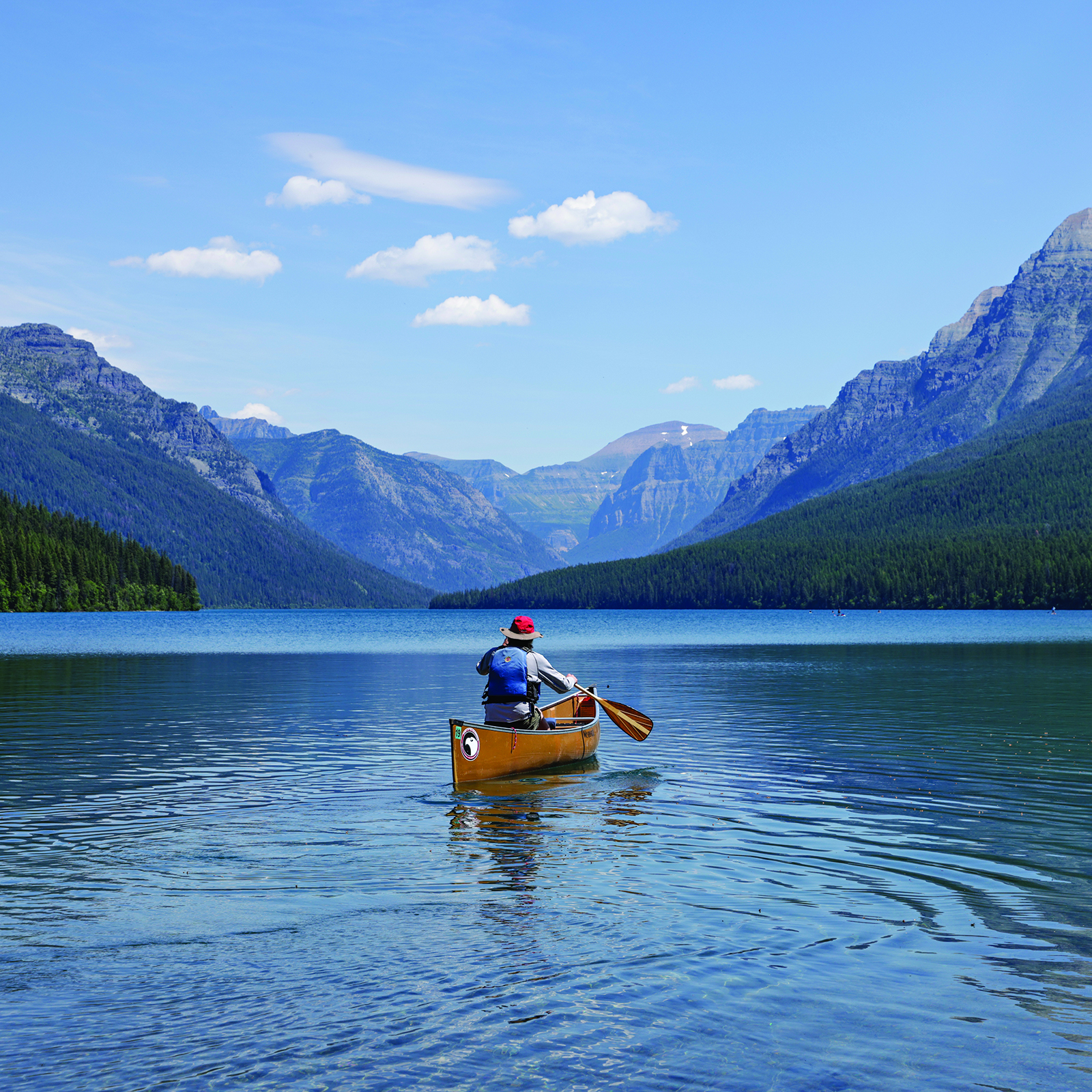
Growing up paddling the local rivers and lakes that define my home state of Minnesota, the tactile satisfaction of gliding a canoe across calm, flat water resonated with me at a young age.
I admired how water droplets sluicing down the paddle blade left only a passing trace of the boat’s trajectory, like a fugitive’s fleeting insignia. I liked how a well-executed J-stroke propelled the boat forward with an arrow’s efficiency, while an absent-minded stern pry could send the throat of the paddle clattering off the gunwale, knocking the boat out of trim and corrupting its equilibrium.
In a canoe, as in time travel, even a slight redistribution of balance or an errant paddle stroke has a ripple effect of consequences. And in solo paddling, there’s no question of who’s accountable.
For that reason, the adage of paddling one’s own canoe remains unmatched as a metaphor for self-reliance and moral ethics. I’m certainly not the first writer to draw this connection. As best I can tell, the theme first emerged in Sarah Knowles Bolton’s 19th century poem, “Paddle Your Own Canoe.” It’s since been adopted as the central tenet of instructional books by the likes of Lord Robert Baden-Powell, the British Army officer who founded The Boy Scouts Association, and as the title of a humorous memoir by “Parks and Recreation” star Nick Offerman.
But even though the phrase emphasizes independence, I’ve found that the skills solo paddling taught me also improve our ability to work effectively as a team.
After all, before Henry David Thoreau moved alone to Walden Pond to live life more deliberately, he spent a summer paddling the rivers of Maine with a guide, writing about the socio-ecological insights he gleaned from that adventure in “Canoeing in the Wilderness.”
The illusion of the paddler’s independence springs another leak when one considers that the entire enterprise of canoeing — and, therefore, the entire enterprise of life — rests on the existence of water; formless, shapeless, water.
“Be like water making its way through cracks … adjust to the object, and you shall find a way around or through it,” the actor and martial arts icon Bruce Lee said in warning against an entrenched mindset. “If you put water into a cup, it becomes the cup. You put water into a bottle and it becomes the bottle. You put it in a teapot, it becomes the teapot. Now, water can flow or it can crash. Be water, my friend.”
As storytellers, we often seek to inhabit the lives of others so that those individual experiences may resonate with a broader audience. We couldn’t do that very effectively by concentrating on the length of our own hull. As a newsroom, meanwhile, our quarterly assembly of these stories can’t cohere until we recognize that we are but a sum of our parts.
In this fall edition of Flathead Living, our reporters animated their stories by inhabiting the lives of the artists and educators working to address suicide in Indian Country by teaching acceptance and encouraging Blackfeet youth to express their emotions in healthy ways. They sat with a school bus driver in Martin City who shuttled generations of students along the Middle Fork Flathead River corridor for 42 years, mentoring countless kids on the cumulative journey of 1.2 million miles. They tapped into a generation of Montana politics when someone could get elected to nine terms in the House of Representatives while running on arts, education and the environment. And they traveled back in time to learn about a hospital that has served the North Valley for 120 years.
Along the way, we even set our paddles down to break bread and raise a glass alongside a collection of chefs, cidermakers and restaurateurs who nourish this region with quality food and drink.
So, while I may still encourage you to paddle your own canoe, hike your own hike and even mind your own business, I’d rather invite you all aboard.
After all, the water’s perfect.
Many thanks for reading,
Tristan Scott | Managing Editor
Flathead Living
Editor’s note: The fall edition of Flathead Living magazine is now available on newsstands across the valley.