Conservation District Submits Final Brief in Appeal Against McDonald Creek Homeowners
By failing to apply for permits, a California couple who built a home on a streambank in Glacier National Park skirted state and federal environmental protections, a state agency wrote on appeal to the Ninth Circuit
By Tristan Scott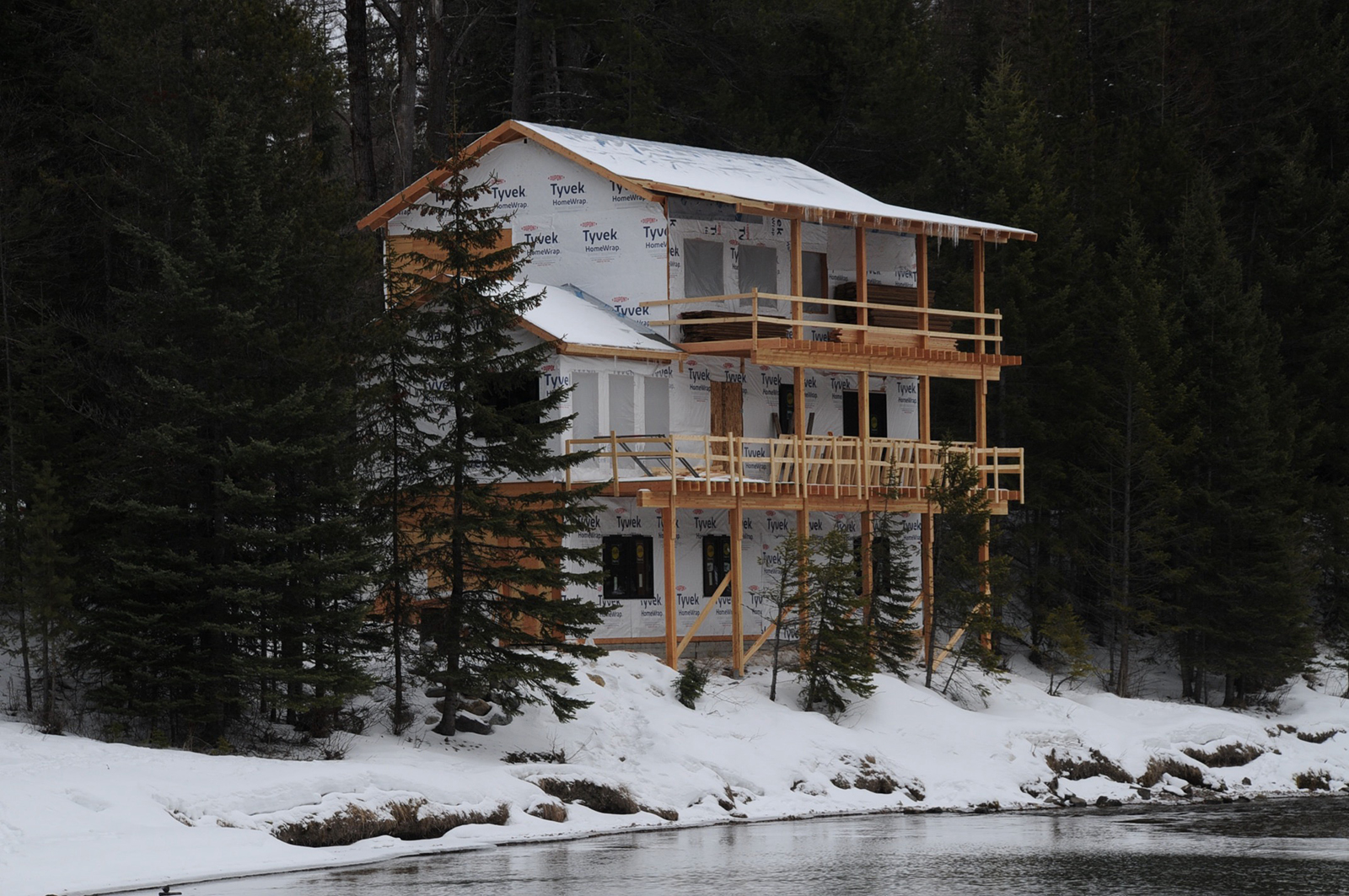
By failing to apply for any building permits, a California couple bypassed environmental review and evaded public input when they constructed a home on the banks of McDonald Creek in Glacier National Park. Rather than force the homeowners to comply, however, “the federal government has essentially abdicated their duty by failing to make and publish rules and regulations adequate for the care, protection and management of the resource on private inholdings in Glacier National Park.”
That’s according to attorneys for the Flathead Conservation District (FCD) and a group of West Glacier and Apgar residents known as Friends of Montana Streams and Rivers (FMSR), who argued that the couple’s construction project violates the Montana Natural Streambed and Land Preservation Act (NSLPA). The 1975 statute requires any private individual proposing work near a stream that “physically alters or modifies the bed or immediate banks” to first obtain a permit from the local conservation district.”
But John and Stacy Ambler sought no permit when they commenced building a three-story, 2,178-square-foot home with two overhanging decks amid a scenic creek corridor that attracts throngs of tourists each summer.
“The public, outraged by the construction on the immediate bank of McDonald Creek, filed complaints with FCD,” according to the FCD, which recently submitted its final brief to the U.S. Court of Appeals of the Ninth Circuit.
The initial round of public complaints came more than two years ago and prompted FCD officials and biologists with Montana Fish, Wildlife and Parks (FWP) to conduct an inspection of the Ambler home, leading to their discovery of an excavated, re-graded and retention-walled stream bank, as well as their determination that the property owners had violated the 1975 stream protection law, better known as the 310 law. FCD ordered the homeowners to remove the structure and remediate the streambank. The Amblers, in turn, sued the conservation district, swaying a federal judge in Missoula with their argument that FCD, a political subsidiary of the state Department of Natural Resources and Conservation (DNRC), lacked enforcement authority inside a national park.
But according to FCD, without federal regulations governing home construction on streambanks on private property in Glacier National Park, the state laws and rules administered by Montana’s local conservation districts should apply.
At the heart of FCD’s argument is that the home’s location within the park’s boundaries does not preempt the enforcement of the NSLPA. In the absence of analogous federal law, FCD attorney Camisha Sawtelle said criteria surrounding the construction of a home on a private parcel girded by National Park Service land should default to the state law’s regulatory arm.
“The federal government has essentially abdicated their duty by failing to make and publish rules and regulations adequate for the care, protection and management of the resource on private inholdings in Glacier National Park,” according to Sawtelle’s appeal brief on FCD’s behalf. “If, as the District Court held, the State of Montana is preempted from protecting their interests, the resources is not protected. This is in direct conflict with the public policy creating national parks. Due to the failure of the federal government to regulate, existing state law has and should continue to protect the health of the resource. It is the role of this court to independently interpret the statute and effectuate the will of Congress subject to constitutional limits.”
But Trent Baker, the Amblers’ attorney, argued in his brief that the 1975 law does not apply within Glacier National Park.
Montana passed the Streambed Act decades after the federal government established Glacier National Park in 1910. Baker cited the 1968 water rights case Macomber v. Bose, which found that Montana had ceded jurisdiction over privately owned land within the park to the federal government.
When the District Court reviewed Macomber, it concluded that only state laws in effect at the time of the cession remain applicable within the ceded area — unless the law falls under a specific exemption, such as criminal law.
Still, according to FCD, the couple could have resolved any jurisdictional questions by simply applying for using a single joint application for “any necessary permit prior to initiating their project.”
“This Joint Application would have allowed professionals to review the proposed project plan, to consider alternatives to the proposed plan, and to review resource benefits and potential impacts of the proposed project,” according to FCD. “The Joint Application requires all applicants to consider changes to erosion, sedimentation, and turbidity; impacts to fish and aquatic habitat; impacts to wetlands and riparian habitat; impacts to potential flooding; potential changes to water flow or to the bed and banks of the waterbody; and impacts to existing vegetation including a plan for revegetation and weed control. Experts in each of the agencies listed above would have reviewed the application, determined if any of the above-mentioned permits were required, offered alternatives, and determined if the proposed project was allowed.”
Instead, however, “the Amblers failed to apply for or obtain ANY permits.”
“By failing to submit a Joint Application, the Amblers bypassed review from concurrent jurisdictions and evaded input from experts on their construction project on the immediate bank of McDonald Creek,” according to FCD, which urged the Ninth Circuit to reverse the lower court’s decision and hold that FCD “has jurisdiction to enforce the Montana Natural Streambed and Land Preservation Act on a private inholding within Glacier National Park.”