50 Years in Flight
A flight nurse and pilot share some of A.L.E.R.T.’s most memorable moments as they reflect on the genesis of America's first rural air ambulance program, which observes a half century of service this year
By Zoë Buhrmaster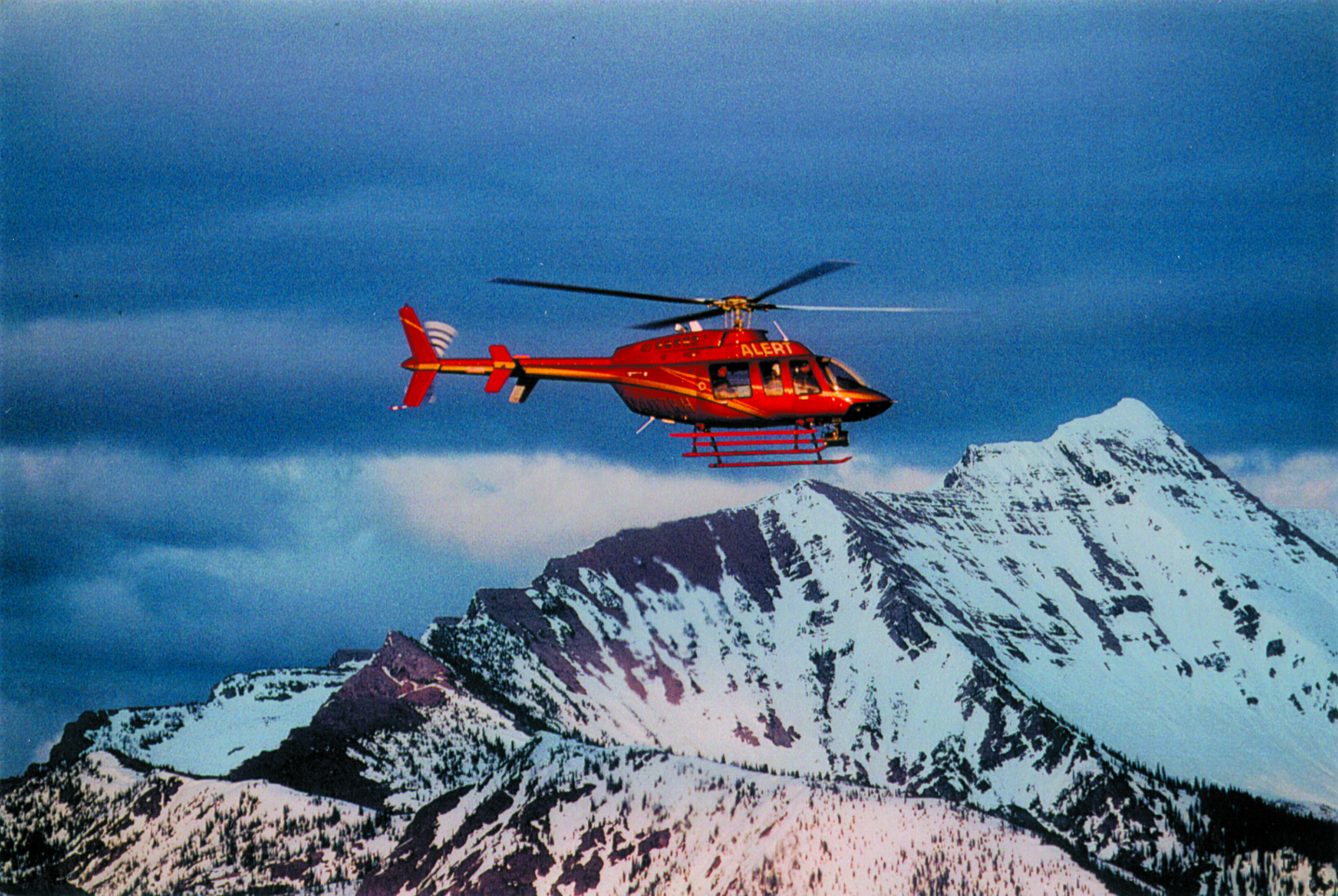
It all started 50 years ago when 27-year-old logger Dennis Buck sustained a severe injury while working out near Hungry Horse Reservoir. The rugged roads and terrain made the trip impassable, resulting in his crewmates calling for a nearby forest service helicopter. The makeshift operation took too long, however, and he died before he could reach the hospital.
The tragedy inspired a local logger, Clyde Smith, whose own son had been previously injured in a logging accident, to put up his logging business as collateral to help start an air ambulance rescue service. Smith was a co-founder of the Montana Logging Association, and he partnered with the Kalispell General Hospital, now Logan Health Medical Center, to form A.L.E.R.T. — the Advanced Life-Support and Emergency Rescue team.
To start, they contracted Mountain West Helicopter to provide flight services. Whenever there was a rescue, the pilot would take off from the city airport, picking up an available flight nurse from the hospital.
The first five flight nurses — Ruth Barber, Alvina Hix, Karen Clark, Sherrie Higgins and Vivian Beardslee — dubbed themselves “Flight Bags.” The nickname was a reference to the bowling ball bags that they originally used to carry emergency supplies onboard those first emergency helicopter rides.
Each flight carries one pilot, one flight nurse and one Emergency Medical Technician (EMT) to the site of the accident, leaving just enough room to carry back a single patient. Depending on the circumstances, flight crews have at times left behind an EMT if there were two patients in critical condition who needed an emergency airlift.

During one trip responding to a head-on collision in Browning, Marty Boehm, the first male flight nurse to join A.LE.R.T.’s program, and his pilot had to do just that. Boehm joined the program in 1975 shortly after leaving the military where he had served as an Air Force flight nurse.
It was a windy day flying over the mountains to the east side, Boehm recalls. The A.L.E.R.T. crew landed at the emergency room in Browning, which had already filled up with concerned family members and friends.
Boehm looked at the ER doctor for directions, who pointed him to two young women who had sustained head injuries by impacting the windshield.
Already there tending to them was a Blackfoot healer, near the head of the bed.

“‘Can you take the foot end, and I’ll take the head end, we’ll swap here, and I’ll do my thing on my end, and you do your thing on your end,’” Boehm recalled asking. “It worked out well.”
Once both the patients were stabilized, Boehm and the pilot loaded them up, leaving the EMT in Browning for the night. On the way to Great Falls, the pilots had to stop in a small town for gas at a crop-spraying outfit that carried jet fuel. A young man ran out to fuel the helicopter but immediately became pale and weak-kneed when he saw the patients in tow. Boehm grabbed the fuel nozzle from him and finished filling up the helicopter, handing him a credit card before taking off to the nearest neurosurgeon in Great Falls.

“I handed him our credit card and said, ‘We’ll come back and pick up the credit card on the way back,’” Boehm said.
Boehm flew as an ER flight nurse for A.L.E.R.T. for nearly eight years before taking over as program manager for another 12 years. During his tenure, he recalls an exhaustive list of tragic and traumatic accidents, reciting details from logging mishaps, impalements, bear maulings, car crashes — the list goes on.
“When I would be mentoring a new flight nurse, one of the things I’d emphasize in the training is that it doesn’t work to plan for everything,” Boehm said. “It almost never turns out, the scenario that you end up in is totally different than what you were expecting.”
He painted a picture of showing up on scene to a train derailment, with overturned cars and multiple people in distress.
“You have to have a way to deal with the unknown and the unexpected,” Boehm said. “How are you going to make this chaotic situation into a situation that provides care and hopefully saves lives and treats casualties?”

Prior to each flight, pilots on staff are asked whether they can fly under the current conditions before they are given any information on the patients or situation, so that they can make decisions based solely on flight safety.
“That put it so there was no pressure on him to possibly make a poor decision or push the envelope, where he shouldn’t be flying or it would be dangerous to fly and do it anyway,” Boehm said. “It was a group decision based on the need for that safety.”
In its 50-year history, A.L.E.R.T. has never had a fatal crash. Crews have flown more than 21,000 flights, saving around 3,000 lives. It’s the second-oldest hospital-based air ambulance program in the country after St. Anthony’s in Denver, Colo., and is the first in rural America.
The A.L.E.R.T. air ambulance program serves an area stretching west to the Idaho border, south to Missoula, east along the Hi-Line to Conrad, and north to the Canadian border. Glacier Park is one of the most frequent destinations for rescues today.
A.L.E.R.T. crews have responded to 39 bear attacks, with the last occurring in August when a visitor was injured in Glacier National Park. In the early days of A.L.E.R.T., flight crew members who had gone on flights to grizzly country would receive an ‘A.L.E.R.T. Bear Paw Society’ patch to sew onto their orange flight suits.
Ken Justus has been flying since 1988 — first for the U.S. Army, then in Alaska, then, starting in 2003, for A.L.E.R.T. For Justus, the trickiest flight he recalls was responding to a double bear mauling in Glacier National Park in 2005.
A father, Johan Otter, and his daughter, Jenna — both avid hikers from Escondido, Calif., were en route to Grinnell Glacier when they were attacked by a mother grizzly protecting her cubs. Hoisting them out of a steep, cliffed-out area that could not be safely accessed by foot, Justus and the crew short hauled the pair individually to Many Glacier, where they were able to land and properly situate Johan Otter, who was in the most critical state, inside the helicopter before flying him to the hospital.
Exactly a year later on the anniversary of the incident, Justus ran into Johan Otter hiking in Glacier National Park. Justus invited him on a hike the following day; ever since, the two have spent a week together in the park each year.
Two Bear Air Rescue, a privately funded, zero-cost helicopter rescue service based in Whitefish, has since taken over short hauls.

Today, the program has two helicopters, a fixed-wing transport plane at the airport and a ground ambulance service. A dedicated pediatric nursing staff helps with calls to rural childcare, along with a paramedic, nursing and flight staff dedicated to A.L.E.R.T. The fixed-wing plane often flies patients to specialists in Seattle, Denver and Salt Lake City, sometimes flying as far as Houston, Southern California or the Mayo Clinic in Minnesota.
What’s made the program so successful, Boehm said, are its deep community roots and financial support generated at the local level. An annual community banquet for A.L.E.R.T. provides funding for the program, totaling over $10 million in donations since 2000.
“One of the key things was the involvement of the local people in it,” Boehm said.
As a “fishbowl,” the Flathead Valley’s contained size, especially in the early days of the program meant that most people knew of someone in the area who had been picked up by an A.L.E.R.T. helicopter, “so the involvement was pretty personal,” Boehm said.
“I don’t know of any program in the country that ever matched the local involvement that was here with the A.L.E.R.T. board and the community involvement in the program and the community support,” Boehm said.

Oct. 9 Correction: An earlier version of this story stated that A.L.E.R.T. had never had a helicopter crash. The program has had helicopter crashes, but has never had a fatal crash. The article has been updated accordingly.