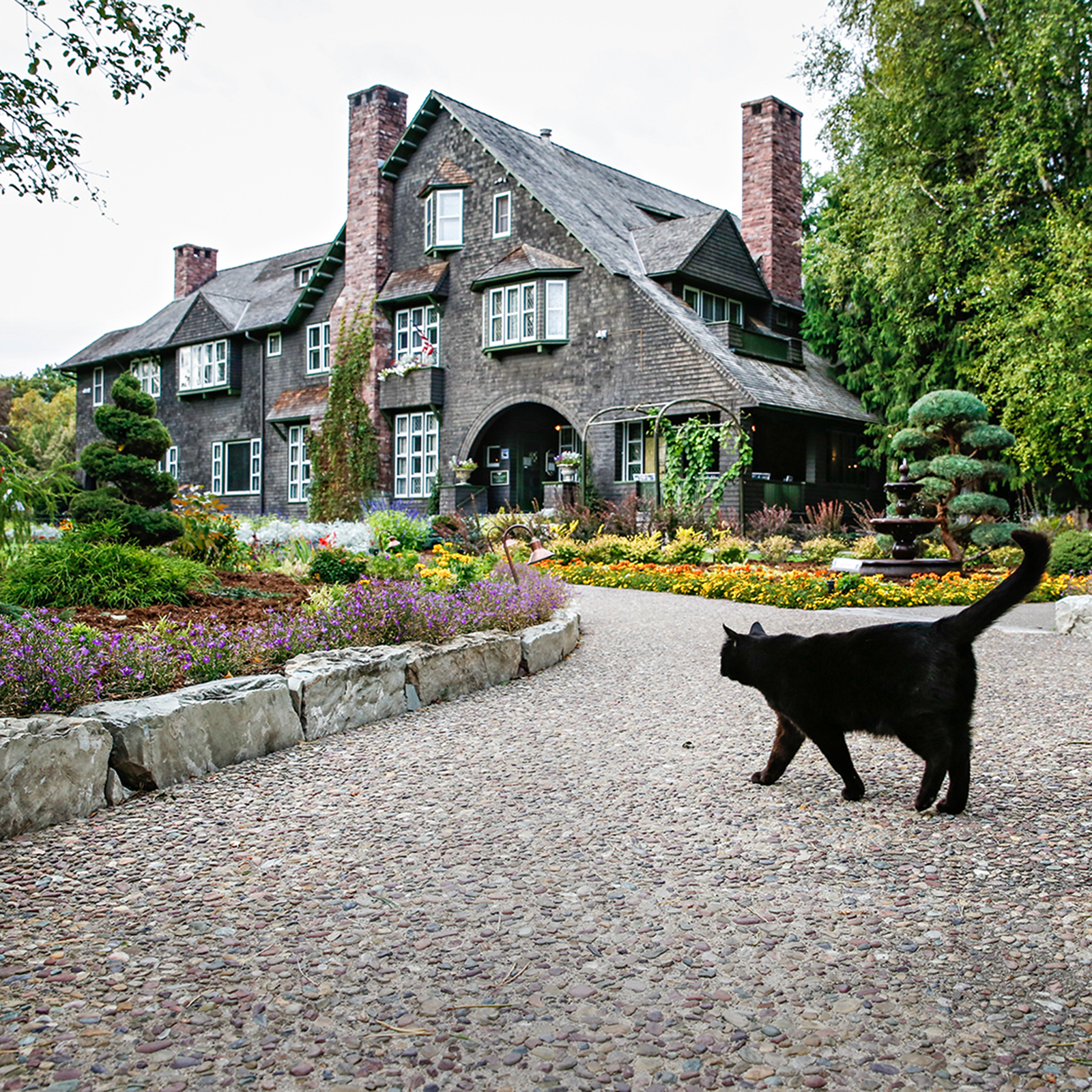
The vacuum cleaner hummed as a staff member cleaned beneath the lace-covered table in the rose bedroom of Kalispell’s Conrad Mansion. She paused for a moment, catching her reflection in the gilded mirror above the bed.
She thought she was alone.
But in the mirror, a woman stood behind her. Wearing a high-necked dress with layered skirts, she was unmistakably from another era. Their eyes met.
The staffer spun around. The woman was gone.
The brief encounter with Alicia “Lettie” Conrad, wife of Kalispell founder Charles E. Conrad, is neither the first nor the last supernatural experience reported in the couple’s Victorian-era mansion. Since their daughter Alicia donated the home to the city in 1974 — more than 50 years after her parents’ deaths — staff, guests, and volunteers have reported eerie encounters with various members of Kalispell’s founding family.
Most of the mansion’s 26 rooms have a ghost story. Lettie is frequently seen in her elegant Edwardian gown. Alicia appears as a young girl — the pitter-patter of little feet signals her presence. And Charles makes himself known through the lingering scent of cigar smoke.
Each October, Conrad Mansion invites visitors to uncover this haunted history through a Victorian Ghost Tour. As guests move from room to room — past unblinking porcelain dolls, sterling candelabras, and faded portraits — volunteer storytellers offer theatrical accounts of the mansion’s spirits.
Born in 1850, Charles E. Conrad grew up on a Virginia plantation and served in a Confederate battalion during the Civil War. As his family’s fortune dwindled after the war, he headed west in search of opportunity.
He arrived in Fort Benton in 1868 and took over the I.G. Baker Company, a major supplier transporting goods along the Missouri River. A successful businessman, Conrad diversified his ventures, building wealth through banking, real estate, and the lumber industry.
Drawn by the natural beauty and the opportunity presented by a new Great Northern Railway division stop nearby, Conrad and his wife moved to Flathead Valley in the fall of 1890. He and three railroad officials established the Kalispell Townsite Company to develop the area. Lots sold quickly.
Kalispell officially became a city in 1892, with Conrad recognized as one of its most influential early leaders. He commissioned architect Kirtland Cutter, famous for designing the Lake McDonald Lodge in Glacier National Park, to plan the family’s grand new home. Construction of the Conrad Mansion was completed in 1895.
The Conrads’ Victorian roots contribute to the home’s ghostly atmosphere. When Queen Victoria’s husband, Prince Albert, died in 1861, she entered a deep mourning period that lasted for decades and defined the era.
“Her mourning really resonated with people, and creeped into the whole Victorian period,” Conrad Mansion Executive Director Brit Clark said. “It was very macabre — people were fascinated by spirit hauntings and seances. Even today, people love a Victorian ghost story.”
Conrad’s daughter Alicia, the sole owner after her parents’ passing, donated the home to the city in 1974. She hoped to see it preserved and shared as a museum in their honor. Nearly everything inside, from the mahogany canopy beds to the porcelain floral tea set, belonged to her parents. Today, 90% of the home’s artifacts remain authentic to the period.
The restoration was underway at a time when “The Addams Family” was a weekly TV staple and soon after “Psycho” became Alfred Hitchcock’s most successful film. As pop culture cemented the image of the haunted Victorian mansion, restoration workers in Kalispell began seeing spirits of their own.
Lettie was the earliest spiritual frequenter. She seemed to oversee the workers as they cleaned and painted, occasionally nodding in quiet approval. But unlike the ominous spirits in a Hitchcock home, those who linger in Conrad Mansion are always welcoming.
“None of our spirits are evil or malicious,” Clark said. “They’re all very happy and friendly.”
When the museum first began offering ghost tours 20 years ago, it was the classic Victorian experience — a pitch-black walk through the home, lit only by candles. Since then, the tour has evolved into a hybrid haunted house, featuring dramatic retellings enhanced with lights and sound effects.
“We keep the Victorian spirit to build a unique experience,” Clark said. “It’s not a traditional ghost tour, but it’s also not a classic haunted house — there are no zombies who are going to jump out and scare you.”
The museum will hold its ghost tours during the third and fourth weekends of October. Tickets are available on the Conrad Mansion website. The tours are one of the museum’s largest annual fundraisers, with all proceeds supporting maintenance and historic preservation.
But the spirits of Conrad Mansion aren’t just a Halloween attraction. On one of the museum’s classic daytime tours, visitors step into the attic that the Conrads once used to house orphans during Christmas. Puckered-mouth baby dolls lie piled in a toy crib. A teddy bear, one button eye dangling by a thread, stares back at them.
A guest asks his guide if the house is haunted.
“Every time a door opens, and I didn’t touch it, I say, ‘Thanks, Charles,’” she replies.