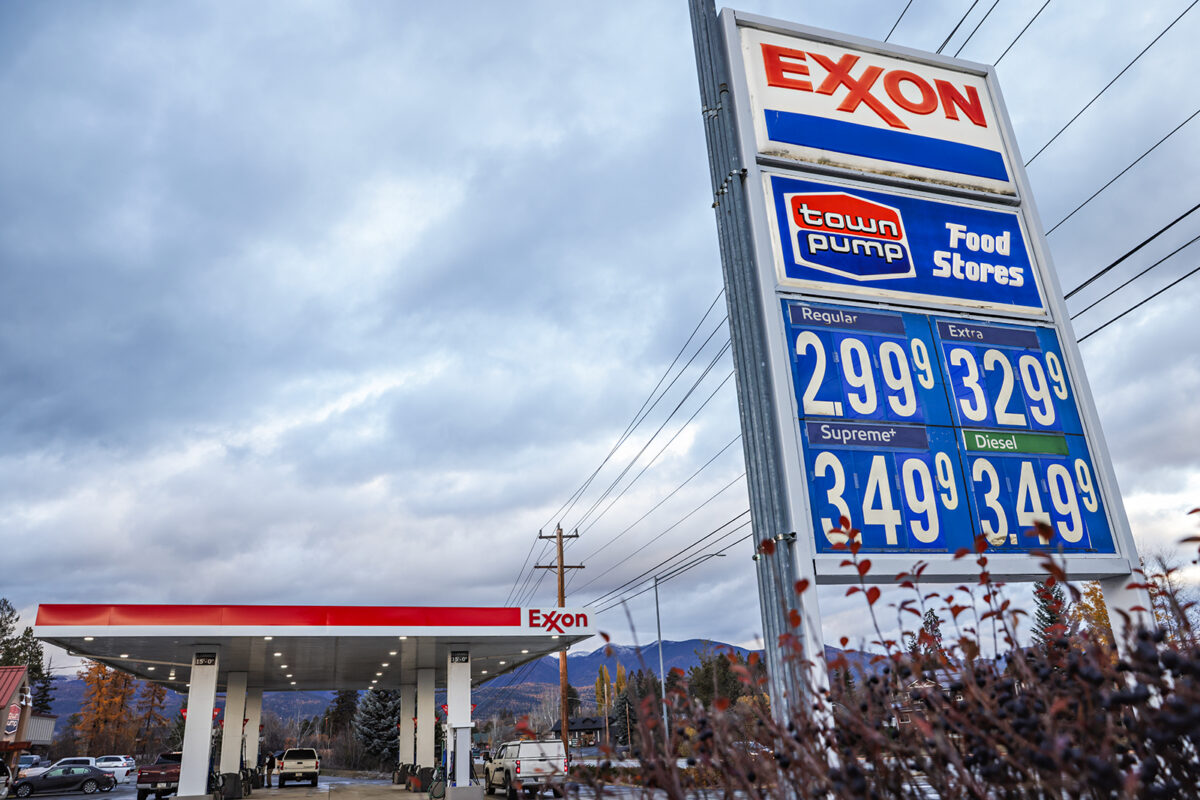
Since 1989, Town Pump Petroleum Seep a Perpetual Problem on Whitefish River
Last month, the Montana DEQ approved another work plan to test new remediation technology; water quality advocates say decades of delays akin to "kicking the can down the road"
By Tristan Scott
The mountain-framed gateway to downtown Whitefish is a fitting showcase for the resort town’s natural treasures, which function as its economic and its ecological heartbeat. But even if the views rising above the city center’s low-slung skyline command visitors’ immediate attention, the town’s true lifeblood runs beneath it.
And yet, for the past several decades an unresolved gasoline seep has contaminated the groundwater feeding the Whitefish River, even as state regulators signed off on a series of failed remediation strategies. None has been effective. Beset with delays, the cleanup plan’s sluggish progress has bedeviled a growing succession of city officials dating back to the early 2000s, while correspondence between elected leaders and state officials belies a pattern of indifference.
“No one wants gasoline seeping into the Whitefish River. But in contrast to other environmental problems in Montana, the seep is not viewed as a major public health or environmental threat,” former Montana Department of Environmental Quality (DEQ) Director Richard H. Opper wrote in an Aug. 28, 2007 letter to the city of Whitefish after its mayor complained about the contamination. “Although there have been delays in investigating the cause of the seep and designing corrective measures, this work is progressing at an acceptable rate.”
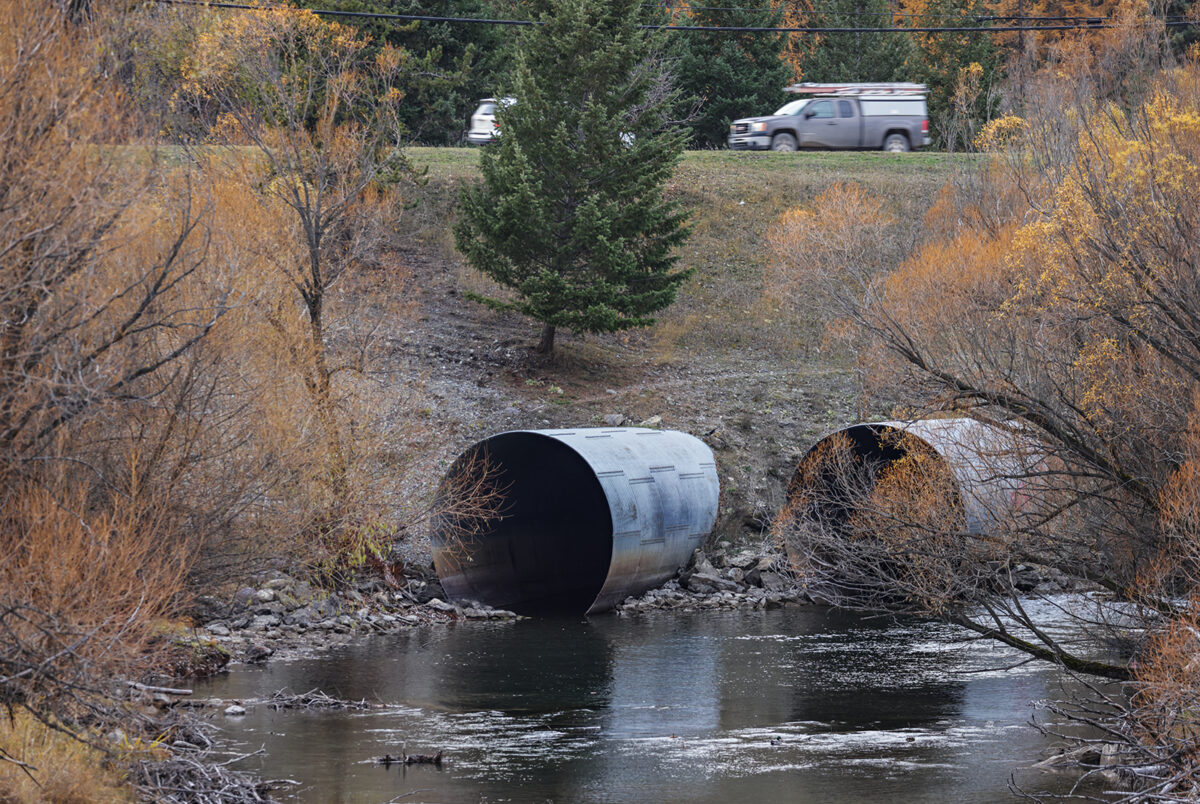
Last month, DEQ approved a new “work plan” at the source of the petroleum seep first detected in 1989 — the Town Pump property on Spokane Avenue, near where it crosses the Whitefish River above two culverts. And while water quality advocates are encouraged by the agency’s renewed attention to a pollution problem that’s been brewing for 36 years, they’re also raising concerns that state regulators — and especially the potentially responsible party — have allowed the cleanup to drag on for far too long.
“My concern remains that this issue represents the proverbial kick-the-can-down-the-road situation as evidenced by the protracted timeline of mitigation attempts,” Mike Koopal, executive director of the Whitefish Lake Institute (WLI), the nonprofit that for 20 years has worked to protect and monitor the local watershed. “The current situation of contaminant release to groundwater and the Whitefish River does not meet WLI’s vision for water quality and community health.”
The situation didn’t meet WLI’s vision 18 years ago, either, which is when Koopal first reported the release to city council and implored them to urge the state to take action.




According to DEQ, a “release” is either a natural or human-caused situation in which hydrocarbons leak from contaminated soil into the groundwater, while a “seep” is defined as a release point, such as a leaking underground storage tank. In this case, the release is from petroleum hydrocarbons (gasoline) saturating the soil and contaminating the groundwater over an area of about 70,000 square feet on the Town Pump property, with the worst concentrations near the facility’s underground storage tank basins (historic and existing) and the fuel dispenser area.
In 2007, without any clear communication from the state or the responsible party, Koopal began collecting his own water samples and submitted them for independent testing.
“I brought in a bottle of water from the contamination site and passed it around to the council members. They all threw their heads back because of that awful gasoline smell,” he said.
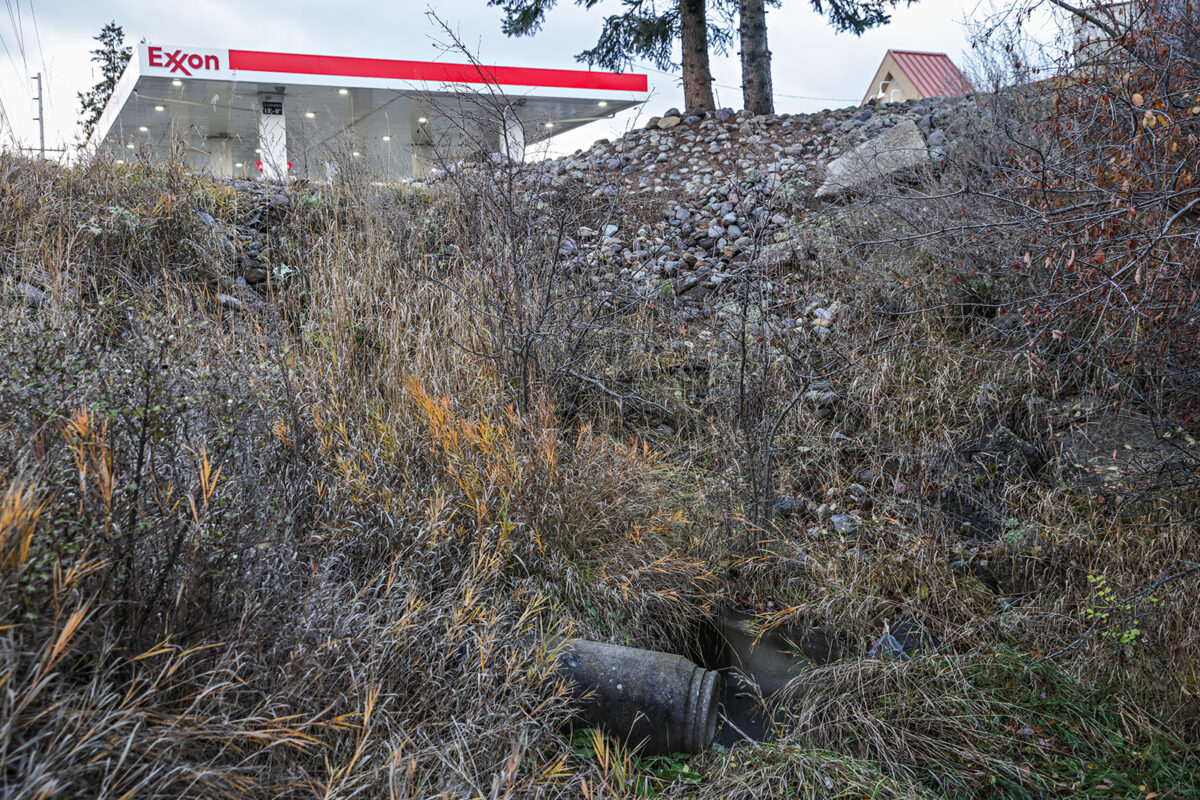
Koopal’s water-bottle stunt got the city council’s attention. So did the test results of his water samples obtained at the seep, which indicated benzene levels were 39 times higher than state and federal drinking water standards. In August 2007, former Mayor Andy Feury (who still serves on council) wrote the head of DEQ demanding the agency’s “immediate attention … in determining the source of the petroleum effluent spill that enters the Whitefish River from a series of seeps immediately below the Town Pump station on Spokane Avenue in Whitefish.”
Describing the council’s “firsthand” experience smelling the stuff, Feury wrote that “the pungent vapors from the samples quickly relayed the gravity of the situation” and added that “various recreationalists have also complained to city officials of the smell and the oily sheen as they pass the seeps.”
To sharpen his point, Feury made his demands clear: “The quality of water and the potential deleterious effect to public health is of great concern to our community. Our greatest fear is that there is extensive groundwater, surface water, and soil contamination at this site. It is our understanding that the source of the contamination is still unknown even though your department has been aware of this situation for well over a year. The city of Whitefish is requesting that you place a higher priority on this project by expediting the process of defining the source of the contamination, and developing a plan to aggressively mitigate the impacts.”
Two weeks later, Opper responded that the work was “progressing at an acceptable rate” and assured Feury that “DEQ is already addressing this pollution incident,” which the department’s remediation division had confirmed was the result of an underground storage tank (UST) system. Opper said his staff sampled the seep in August 2005 “and documented strong odors and benzene concentrations that exceeded the drinking water limit by 30 times.”
Even so, Opper dismissed the gravity of Feury’s concerns.
No one wants gasoline seeping into the Whitefish River. But in contrast to other environmental problems in Montana, the seep is not viewed as a major public health or environmental threat.
Former DEQ Director Richard H. Opper, 2007
“Given the extremely low discharge volume of the seep, natural volatilization of the petroleum constituents, dilution by the river water and the fact that no one drinks river water, the seep was not considered a significant threat to public health of the environment,” the former DEQ director wrote, explaining that further investigation in July 2006 confirmed that “the seep still did not pose an imminent threat.”
But Opper conceded that the agency-approved plans to build an “interception trench” to capture the contaminated groundwater could be challenging.
“Potential problems or delays associated with the installation of an interception trench include bank stability, the 35-foot depth of the contaminated zone that is the likely pathway to the seep, access agreements, and permits for work along the stream,” according to Opper. “Tests on the feasibility of an interception system are scheduled to be conducted by September [2007].”
Eighteen years later, in September 2025, DEQ authorized another series of feasibility tests to assess a new remediation system, this one using “high vacuum dual phase extraction technology,” according to a DEQ spokesperson. DEQ approved the work plan submitted by West Central Environmental Consultants on behalf of Town Pump Inc., which will now be “pilot tested to determine its effectiveness given the site-specific conditions.”
“Once a release is reported to DEQ, the first step is to ensure the release to the environment is immediately stopped, and then, the release cleanup process begins,” the agency spokesperson said.
Still, the treat-on-site cleanup strategy has been problematic due to the depth of contamination, while attempts to remove the contaminated soil, including excavation of 2,500 cubic yards in 1989, did not stop the petroleum from seeping into the groundwater.
“Remediation of the releases at this site have presented challenges,” according to the DEQ spokesperson, Nolan Lister.
“Upon Town Pump’s completion of pilot testing of the proposed remediation system, the results will be reported to DEQ and stakeholders for review to determine if Town Pump should move forward with full-scale implementation of the high vacuum dual phase technology,” Lister said. “If pilot testing results do not support full-scale implementation, additional remedial alternatives will be evaluated to remediate the releases.”
But since the first release (Release 192) was reported in 1989, and even after a second release was reported in 2003 (Release 4155), none of the DEQ-approved remedial plans has worked. Moreover, the DEQ’s investigation into the initial release, which the agency thought it had resolved in 1991 “based on the information available at the time,” was reopened in 2017. Since then, monitoring and sampling to “assess the magnitude and extent of contamination” has resulted in the agency “reopening the release” while “cleanup strategies such as air sparge, soil vapor extraction, hydrogen peroxide injection, and nutrient injection have been used to control and cleanup the petroleum contamination.”
According to Lister, “it is common for multiple remediation strategies to be employed at petroleum release sites.”
For DEQ’s part, Petroleum Tank Cleanup Section Supervisor Latysha Pankratz in July 2025 provided city officials with a facility cleanup chronology and assured Mayor John Muhlfeld he would “be included in future correspondences for the facility and associated releases.”
For Koopal, however, the “protracted timeline of mitigation attempts” suggests that neither the party responsible for the pollution nor DEQ has been taking the problem seriously.
“There are 1,000 underground storage tanks in the state of Montana, and this is relatively small potatoes,” Koopal said. “But these potatoes are in Whitefish and it’s our job to protect the water quality.”
Ryan Richardson, a WLI board member who works at an environmental engineering firm, said the drawn-out saga of the Town Pump seep has captured his interest more as a community member than as a river restoration expert.
“The overarching message should be pretty simple here,” Richardson said. “This has been going on for decades at a single site and the community is ready to have this resolved. It’s right in the heart of the city, and while all cleanup sites have their challenges, we should be able to reach a resolution here. The constraints are not to the point where we can’t solve this problem. And as a community member, I hope we can get there before there’s another article in 35 years when it’s my kids getting interviewed about this release.”