As Conservation Groups Rally Support for Roadless Rule, Sen. Daines Pushes for Repeal
A Senate Energy and Natural Resources subcommittee this week considered a slate of 26 public lands and wildfire bills, including a bill to permanently enshrine the decades old Roadless Rule
By Tristan Scott
Despite a growing chorus of conservation advocates calling on Montana’s congressional delegates to defend roadless wildlands through permanent protections, a bill to do so seems unlikely to advance without Republican support, including that of U.S. Sen. Steve Daines.
A Senate Energy and Natural Resources subcommittee on which Daines serves held a hearing Dec. 2 to consider a slate of 26 public lands and wildfire bills, among them a measure to enshrine the decades-old Roadless Rule into law. Re-introduced in June by U.S. Sens. Maria Cantwell, D-Wash., and Ruben Gallego, D-Ariz., the Roadless Area Conservation Act (RACA) would protect nearly 60 million acres of national forestland. Although it has failed before, its supporters say this version comes at a pivotal moment as the Trump administration moves to roll back safeguards introduced in 2001.
Hoping to capitalize on the blitz of bipartisan support that last summer helped cleave a public land sale provision out of President Donald Trump’s One Big Beautiful Bill Act — a moment when Montana’s Republican-led congressional delegation stood in uniform opposition to the sale — conservation groups this week mounted a similar pressure campaign on Daines.
“If Daines chooses to stop RACA while supporting the Roadless Rule rollback, he’ll expose how empty his public-land promises are,” according to a statement from Wild Montana Federal Policy Director Hilary Eisen. The nonprofit environmental group was among a coalition of more than 200 organizations to urge committee leadership to support RACA in a Dec. 2 letter.
The legislation would codify the 2001 Roadless Area Conservation Rule (Roadless Rule) as well as the Colorado and Idaho Roadless Rules that collectively protect nearly 60 million acres of roadless national forest land in 39 states, including Montana.
Daines and his fellow Republican delegates from the Treasure State received plaudits from the conservation community after joining ranks with a bipartisan coalition to hobble the land selloff provision. U.S. House Rep. Ryan Zinke even led the charge against the sale in the House before Sen. Mike Lee, R-Utah, revived the provision in the Senate, putting all eyes on Daines and Montana Sen. Tim Sheehy, who both stood firm and eventually wore Lee into submission.
Further burnishing his conservation credentials, Daines recently joined the bipartisan Senate Stewardship Caucus, pledging to “be [a] good steward of the land we’re blessed to live in.”
“This is his moment to prove he means it,” Eisen said. “The Roadless Area Conservation Act is a common-sense, fiscally responsible measure that protects our roadless wildlands by preventing reckless road-building and unnecessary logging, ensuring that our remote, backcountry areas remain intact for wildlife, recreation, and clean water.”
But if Daines was swayed by the political pressure earlier this year, he’s not bending to any calls for him to reverse his position on the Roadless Rule now, particularly after hailing its repeal as “another huge win for Montana and forest management.”
On Dec. 5, a spokesperson confirmed that Montana’s senior senator has not softened his stance.
“Senator Daines supports repealing the Roadless Rule,” according to an emailed statement from the spokesperson. “This action by the Trump administration is a huge win for Montana and will allow us to better manage our forests and protect our communities from catastrophic wildfires.”

The statement from Daines mirrored testimony that committee members heard Dec. 2 from U.S. Forest Service Acting Associate Chief Chris French who said the Roadless Rule has created “barriers to protecting the communities from wildland fire risk.”
“There’s more than 24 million acres of the wildland urban interface that are either within roadless or within a mile of roadless, of which we are restricted from how we treat those areas other than, let’s say, using prescribed fire access,” French said.
When pressed by Sen. Martin Heinrich, the committee’s ranking Democrat from New Mexico, about the “substantial amounts of those roadless areas being treated for fire prevention,” French clarified that the Roadless Rule doesn’t prohibit treatment, but rather “limits the type of activities that you can do” and makes fuels reduction work cumbersome and more expensive.
“Oftentimes, when you’re doing field production work, the actual value that is coming out of those materials is minimal compared to the actual cost of doing that,” French said. “So, in order for us to do more acres and create broader areas of treatments, we need to do the most efficient treatments that we can, providing access and providing the ability to get in there and do that is the way to make that happen. Otherwise, those costs for doing that work are extremely, extremely expensive.”
In northwest Montana, proponents of the Roadless Rule say that framing it as a barrier to active forest management is a mischaracterization, and that, while its value as a conservation tool is unmatched — in Alaska’s Tongass National Forest, for instance, eliminating the Roadless Rule would remove critical safeguards against logging and roadbuilding across 9 million undeveloped acres — its genesis was born of utility and agency efficiency rather than an advocacy apparatus to obstruct.
Established under the Clinton administration and enacted in 2001, the Roadless Rule generally prohibits road building and logging in all 58.5 million acres of national forest roadless areas. It makes exceptions to access non-federal land inholdings and pre-existing mineral leases, and it allows some logging to reduce fire risk, improve habitat or aid in the recovery of endangered species, including whitebark pine. The primary thrust of the federal rulemaking initiative was geared toward reining in the scale of road-building activities by the Forest Service, which maintains eight times more miles of road than the Interstate Highway System.
The impetus for the Roadless Rule tracks back to 1998, when former U.S. Forest Service Chief Mike Dombeck saw the agency’s vast and poorly maintained road system as a major environmental and fiscal problem and proposed a temporary moratorium on road construction in inventoried roadless areas across most of the National Forest System. At the time, the agency’s road maintenance and reconstruction backlog had ballooned to $8.4 billion while it received only 20% of the annual funding needed to maintain the existing road system to current environmental and safety standards.
The agency adopted an 18-month moratorium in February 1999, pending completion of an overall road management policy. Later that year, President Clinton instructed the agency to undertake a rulemaking process to provide long-term administrative protection for roadless areas. Over the next 14 months, the Forest Service conducted an extensive public involvement process that produced 1.7 million comments, with the majority favoring a strong national policy protecting roadless areas.
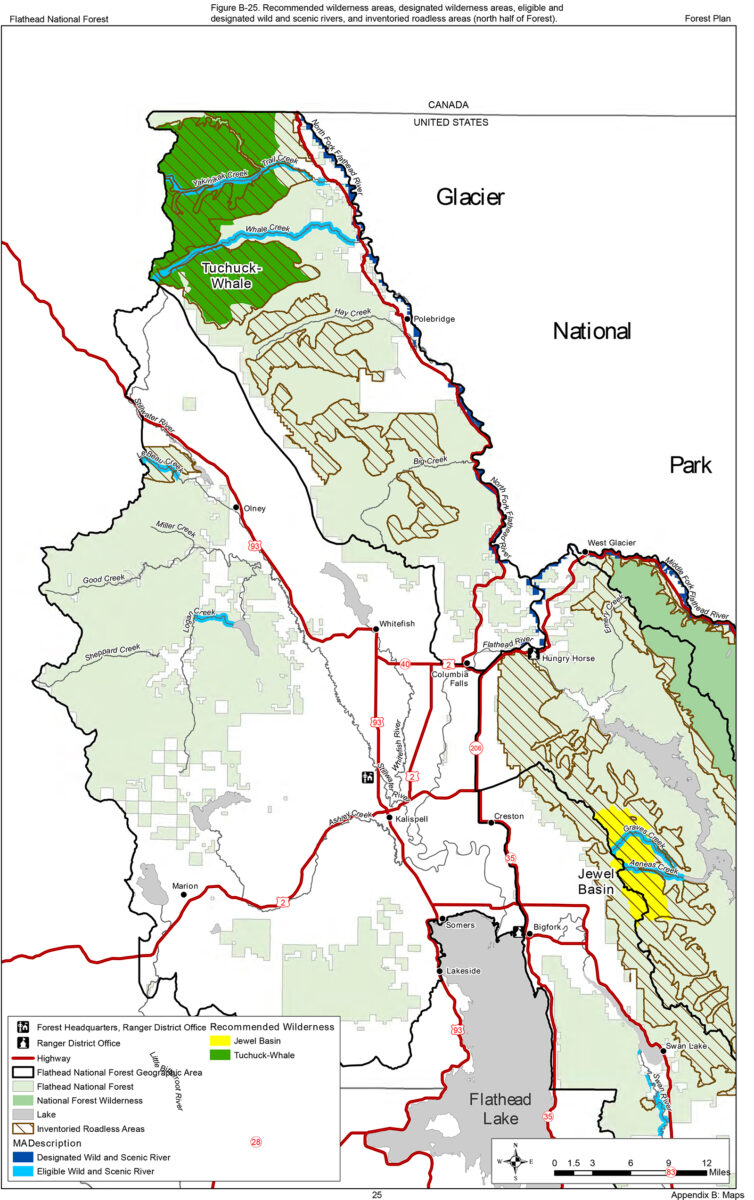
The Flathead National Forest includes an inventoried roadless area spanning 478,000 acres, mostly flanking the Bob Marshall Wilderness Area along the Swan Range, as well as west of the North Fork Flathead River in the Whitefish Range. In the Kootenai National Forest, about 639,000 roadless acres border the Cabinet Mountains Wilderness.
During the committee hearing on Dec. 2, Sen. Cantwell said the U.S. Forest Service’s support of repealing the Roadless Rule seems counterintuitive given that the agency is still struggling to maintain its sprawling inventory of roads and clear a $5.9 billion maintenance backlog.
“Instead of the Forest Service maintaining the existing system this administration wants to rescind the long-standing roadless rule to potentially build more roads that the Forest Service won’t be able to take care of,” Cantwell said.
According to French, the Roadless Rule “doesn’t compel road construction.”
“The primary driver is that there’s more than 24 million acres that are within our wildland urban interface that we can’t effectively treat right now,” French said.
Reiterating the importance of including the public in policy decisions, Heinrich, the senator from New Mexico, encouraged French to “have a robust public process before making these decisions” to repeal the 24-year-old administrative rule. At the time of the rule’s promulgation, more than 600 public hearings were held across the country and 1.6 million Americans expressed public support.
“You called the Roadless Rule a barrier. Do you know what sportsmen in New Mexico call the roadless areas that are protected in our state?” Heinrich asked French. “They call it elk habitat.”