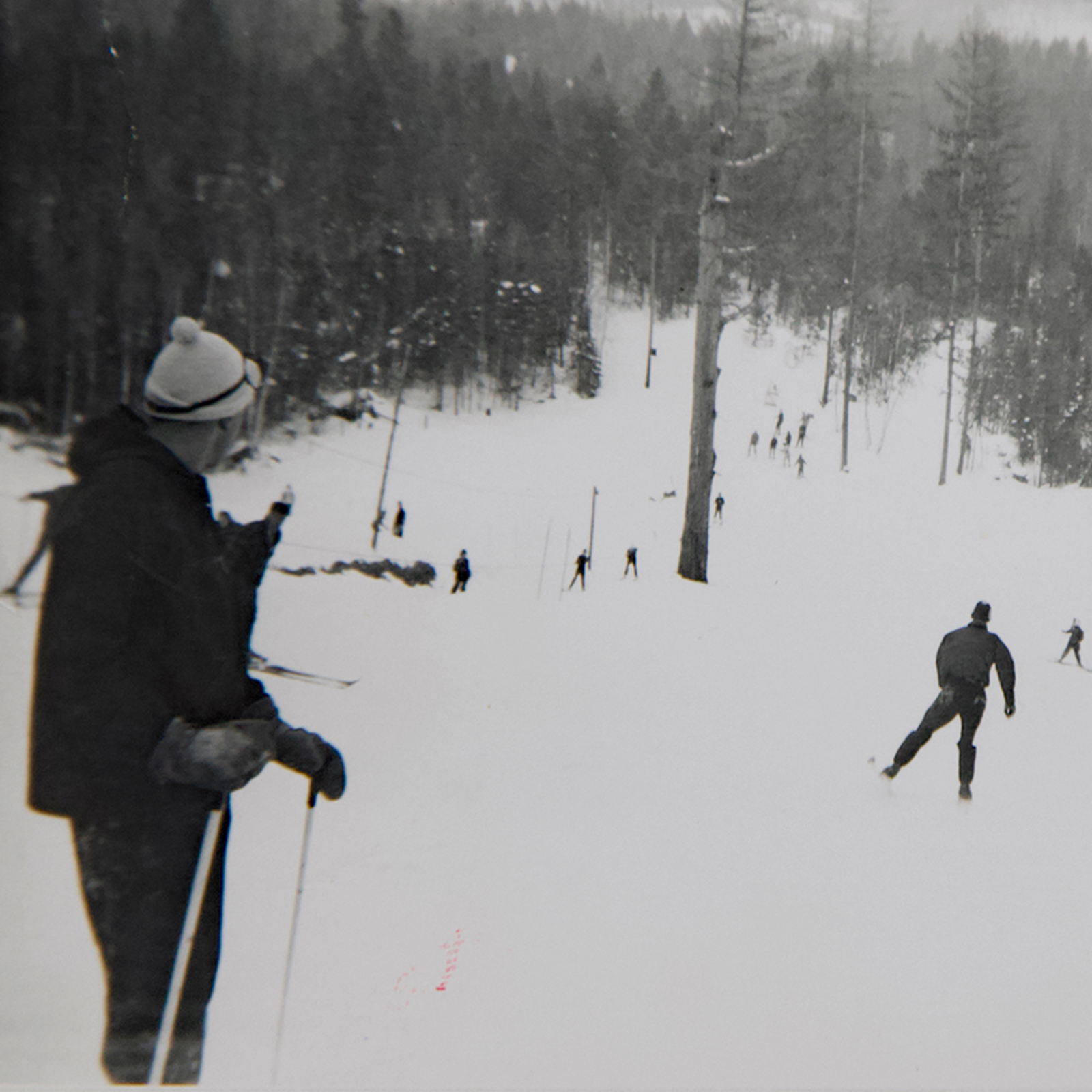
Harold Termaat was standing on the hill above his 40-acre farm in Creston with his friend and neighbor in the early 1950s, decades before the landscape became dotted with subdivisions and ranchettes. As they gazed through the trees down to the fertile land with its crops and cattle, his friend surprised him with the comment, “This would make a great ski hill.”
Even though he was talking to a farmer (who had never skied) about prime farmland, a seed was planted. Someone who loved to grow things, Termaat started to formulate a way to create a little ski course that could provide an affordable activity for local families, during a season that was a relatively slow time for the farmer.
After a visit to Sun Valley, Idaho to see what a ski area might look like, Termaat returned home and started clearing trees. It soon became a family affair, with his three daughters picking hundreds of rocks off the slope. He built a snack shop and a ski shop that was managed by his wife, Florence. Then he hauled his two tractors out to provide power for a pair of rope tows that cut down the middle of two ski runs: one a steeper slope and the other a shorter beginner hill. Harold took the tires off the rims and rigged a pulley system to transport skiers up the two hills. A safety rope at the end of the tow would disengage the tractor motor and cut the power if a skier didn’t let go at the top. Termaat hung lights to expand ski hours, as well as add an extra dimension of excitement and romance with the advent of night skiing.
They opened for business in the winter of 1953-54, offering $0.50 tickets (or $1.50 for a package that included rental equipment provided through the on-site ski shop). When snow conditions allowed, Termaat’s Ski Course was open seven days a week and some evenings.
They operated for over a decade, providing a lot of ski miles, hours and memories for local kids and their families.
Meanwhile, two more little ski areas popped up in the Flathead Valley — Silver Buckle Ski Ranch, south of Kalispell, and Frenchy’s Little Mountain at the intersection of Montana Highway 93 and Montana Highway 40 near Whitefish.
A Whitefish Pilot article published on May 17, 1962, announced the debut of the Little Mountain ski area, with founder Lawrence “Frenchy” DeVall saying, “I have no idea in competing with the Big Mountain. I’m primarily interested in kids and beginning adults who are a little afraid of the big hill. I hope they will eventually become good enough skiers to graduate to the Big Mountain, and then I’ll teach the next crop of kids and beginners.”
With humble beginnings of its own, Big Mountain’s winter sports history began in the 1920s and 1930s, when ski pioneers formed the Hellroaring Ski Club and used their own power to climb to the summit (or close to it) on wooden plank skis. This was followed by the addition of a rope tow powered by a car engine in 1940. But the gap between the burgeoning crop of mid-century community ski areas and Big Mountain (whose name changed to Whitefish Mountain Resort in 2007) widened as Big Mountain evolved, growing in size and popularity. In 1947, as post-war efforts to establish Big Mountain as a regional destination got underway, its founders opened a T-bar with $2 tickets. The 1960s were marked by the addition of two chair lifts that took skiers more quickly and comfortably to the tops of higher and longer ski runs. These additions, along with road improvements, lifted Big Mountain into the ranks of a professional ski resort, a goal not attainable (or really even desired) by the smaller ski hills in the Flathead Valley.
The small community ski courses served the purpose of offering a local, affordable launchpad for beginner skiers before tackling Big Mountain. For many, the small ski areas provided a foundation for skiing at a competitive level, while they allowed others to forge a lifetime love affair with the sport.
Randy Heim grew up a few miles away from Termaat’s Ski Course in Creston. In the summer, he helped a family friend, Harold, with haying and other small jobs. In the winter, he and his friends sought camaraderie and skiing at Termaat’s, where he recalls nearly 100 kids traversing the slopes on Sundays.
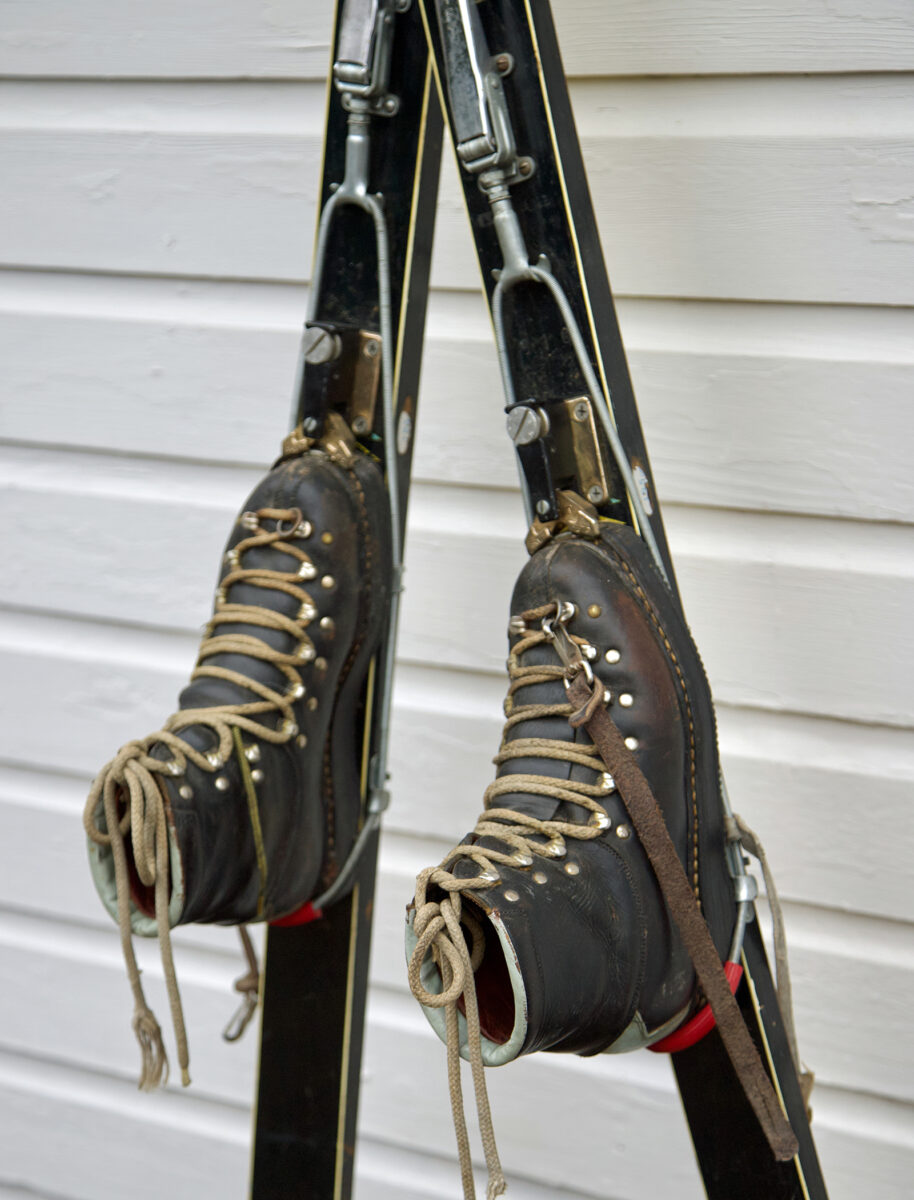
His parents bought him his first skis at Termaat’s ski shop, a pair of flimsy wood skis with metal edges that were popular at that time.
“I broke a few,” Heim recalled, admitting he was fortunate not to have broken any bones.
He remembers the “dope slope,” an easy run down front side that was also known as the bunny hill, but Heim favored the back slope, which wasn’t very long but cut straight down at a steeper pitch. He and his friends built jumps and raced downhill, which helped local kids cut their teeth before they graduated to Big Mountain.
Heim remembers skiing Big Mountain for the first time, his mom shuttling he and his friends up the hill and waiting for them at the day lodge while they skied.
“It was the big stuff, a real ski hill,” he said.
Heim became an accomplished skier and raced on the Kalispell High School ski team, and later became a ski instructor at the University of Montana in Missoula.
“Until Uncle Sam grabbed me,” he said, referring to the draft. He eventually ended up back in Kalispell, where he served as president of the ski club, raced on the men’s league and skied with his own kids.
Mick Hagestad grew up in Kalispell and started skiing at Termaat’s when he was 7 years old. He had asked for a pair of skis for Christmas and became very excited when a long, skinny box appeared under the tree. He asked his dad, “Are those skis?” His dad told him, “No, those are curtain rods for your mother.” Christmas came and as packages were being passed around, Mick grabbed the long box and started to bring it to his mom before his dad stopped him, telling him that it was actually for him – a pair of skis.
Shortly after, he strapped on his skis and went straight down the hill at the Silver Buckle. “That’s how you learned,” Hagestad said.
As a connoisseur of the small ski areas, Hagestad remembers how the Silver Buckle hill featured a little more vertical than the one at Termaat’s, but lost its snow earlier because of morning sun. Even after joining the high school ski team and competing at Big Mountain, he continued to ski the smaller ski areas for practice, even though the snow was often too scarce to anchor the bamboo poles as racing gates.
He didn’t plan on racing in college, until he was approached by the ski coach at the University of Montana who asked him to ski as an extra. So he did. At his first event, he beat everyone on his team and ended up competing in the NCAA Championships throughout his college years. Skiing remained a passion that he shared with his two daughters and through teaching the Kalispell Ski Club advanced classes at Big Mountain.
A couple years after Termaat’s opened, Eddy Nordtome established The Silver Buckle Ski Course on his ranch, located three miles south of Kalispell. In 1956, Nordtome organized work groups to prepare the ski area, offering bus transportation and credit on ski cards for students who helped on Saturdays.
The Silver Buckle had its first full ski season the following year, offering a rope tow that carried skiers to a bunny slope on the lower aspect and to a steeper hill above the ski lodge. A lift operator station was set up mid-slope and a lodge at the lower slope offered ski sales, rentals and repairs, skiwear, snacks, and a place to warm up. Night skiing was provided on the lower slope with the addition of lighting.
They advertised night skiing every evening and on Sundays ran the rope tow from noon to 10 p.m. Ski tickets were $0.75 for students, $1 for adults and $1.50 for couples. Equipment rentals including skis, poles and boots were $2. Tourist rooms were advertised for $4 per night or $20 per week with home-cooked meals.
Ernest “Tap” Tapley was hired to serve as an instructor and manager of the little ski area. Tapley had a wide range of experience that included serving as a ski and mountaineering instructor for the legendary 10th Mountain Division during World War II and as a member of an elite 10-member team that served on the Aleutian Islands. After the war he went on to be a ski patrol director at Sun Valley and a knowledgeable wilderness educator. Under Tapley’s management, Silver Buckle offered ski lessons and specialty courses, such as igloo building, along with the Kalispell Cub Scouts. He also offered ski lessons at Termaat’s.
The Silver Buckle became a hub for community ski activities. Even though the ski course was short-lived, probably lasting only a couple of seasons, they hosted ski meets and ski club events during this time, including Jaycee Ski Carnivals with slalom and cross-country races for adults and kids. The Kalispell Ski Club held meetings, premiered ski movies, offered free lessons, and hosted slalom and downhill races, as well as style and jumping competitions.
According to a Daily Inter Lake news item, Thor Hauge, president of the Kalispell Ski Club, called for a work party to build a knoll for a ski jump in January 1960. The idea was to enable skiers to make jumps between 50 and 80 feet that offered a literal launch pad for those interested in ski jumping.
The ski area proved to be a training ground for Fred Wallner and his four siblings who grew up in Kalispell and skied at Sliver Buckle Ski Ranch, which was just a few miles from home.
Four of the Wallner kids — Anita, Fred, Dick, and Kris — participated in the giant slalom races held at Silver Buckle in 1959. The Silver Buckle closed before the youngest daughter, Libby, was old enough to ski. They were required to compete in all three events — slalom, downhill and ski jump.
Fred says the lack of snow depth made it hard to run the gates. This was probably one of the reasons that the small ski areas didn’t survive as they competed with higher elevation location offered by Big Mountain. A ski report on Feb. 6, 1959, showed 82 inches at the top of the lift and 60 inches at the bottom on Big Mountain. In that same report Silver Buckle Ski area reported excellent skiing with 18 inches of new snow over an 8-inch base.
Ski equipment was still quite primitive in the 1950s. Fred remembers skiing wooden skis and the standard method of determining the correct ski length. “You extended your arm up and chose a ski that hit your wrist.” Fred learned to ski on his own, when he was 6 years old, by pointing his skis down the hill and letting gravity take over.
Bindings didn’t release, which could cause injuries, including broken legs. The first ski binding with a quick release wouldn’t be widely used until the late 1960s and early 1970s.
According to Fred, “I had one friend that broke a leg every year.”
Unlike most of his peers, he never broke a bone or had any major injuries in what turned into a lifetime sport for him.

Rope tows were created by resourceful owners using rudimentary technology, including an engine that pulled a rope that looped continuously uphill. Tow ropes were notorious for “chewing” up mittens and straining arms as they dragged skiers up the hill.
One skier was injured at Silver Buckle when his sweater was caught by the tow rope on the lower level and he was carried over the large pulley at the upper end of the first slope. According to a news report published in The Daily Inter Lake on Feb. 17, 1958, “The rope continued to carry him beyond that point, but he fell free after a short distance. His injuries are believed to be confined to bruises. [The skier’s] jacket, shirt and heavy underwear were torn loose in the mishap.”
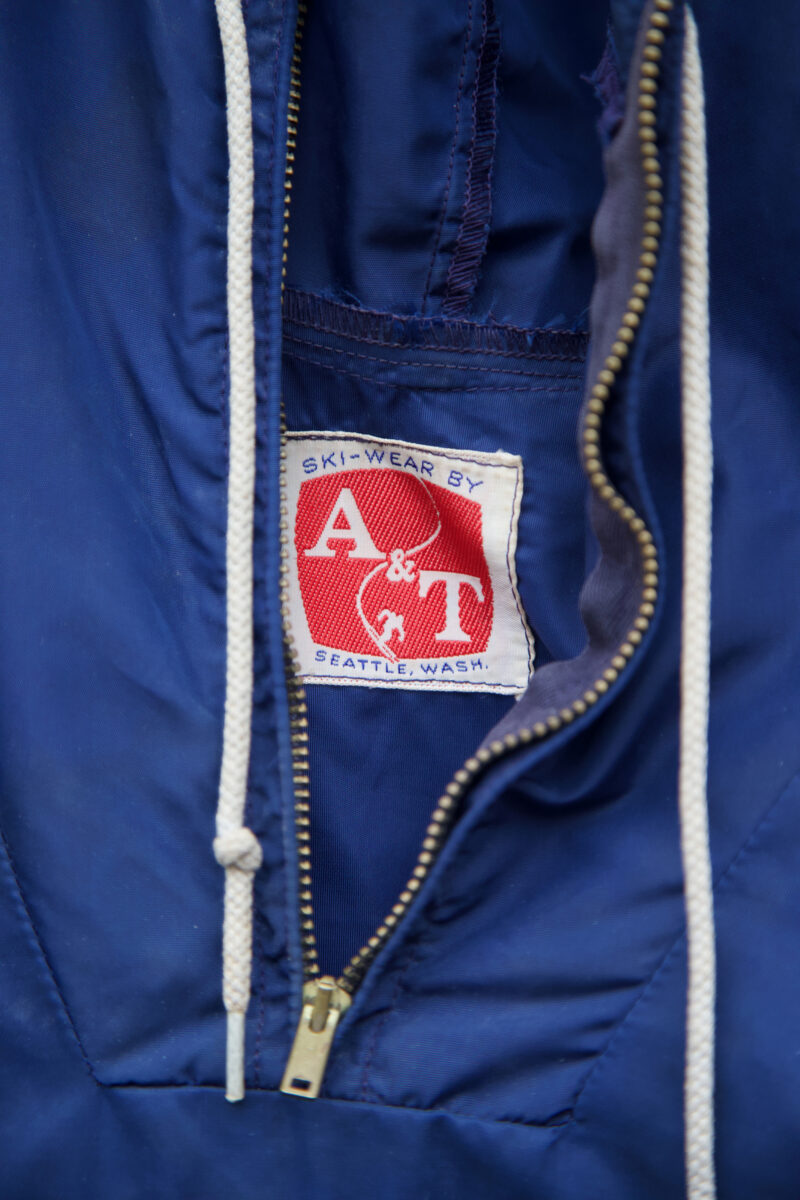
Ski equipment continued to evolve in the 1950s and 1960s with the advent of laminated plastic topsheets on skis, a binding with an automatic release, plastic boots and synthetic clothing. By 1959, the Silver Buckle Ski Ranch advertised Hauser stretch pants for $42.50 and Norwegian laminated skis with plastic tops and bottoms for $45 in 1959.
Fred’s mother, Valesca, didn’t ski but she supported her ski family by driving them to ski areas and tending gates when they raced. All became accomplished skiers and competed on the Kalispell Ski Team. Fred, Kristin and Anita Wallner competed in Junior National Ski Meets when they were in high school.
After tearing an ACL when she was 8 years old, Anita (Wallner) Garten said she vowed never to ski again. She took a few years off, but was lured back when a cute boy (who was a skier) caught her eye. She made up for lost time quickly and was competing in all the ski events in high school including slalom, downhill and jumping. She went on to ski competitively at Cornell University in Ithaca, New York. Over 70 years later, both Anita and Fred are still skiing at Big Mountain, with Fred passing on a passion for skiing to his son, Kevin.
A third ski area known as Frenchy’s Little Mountain ski course opened in 1962, utilizing a 500-foot tow rope purchased from the ski course after the Silver Buckle closed a couple years earlier. Frenchy Devall established Little Mountain across from his Chinese restaurant south of Whitefish as a place for beginners. He advertised the ski area and promoted his restaurant as a place for hungry skiers to go apres-ski. The six-acre ski hill was built at a reported cost of $14,000 and could accommodate up to 250 skiers at a time.
Frenchy installed flood lights for night skiing and offered lessons. One slope was 500 feet long and 200 feet wide, while the other featured 700 feet of vertical drop but was a mere 70 feet wide. Day tickets were available from noon to 5 p.m. and evening tickets from 5 p.m. to 10 p.m. Tickets for a five-hour session were $1.50 for adults and $1.25 for students. Hourly rates were $0.35 for students and $0.50 for adults. The ski area offered a warming chalet, lunch counter, ski lessons and rental equipment, while the ski club sponsored a Kid’s Night at Little Mountain, offering free skiing, a hot dog and coke for each child in January 1966.
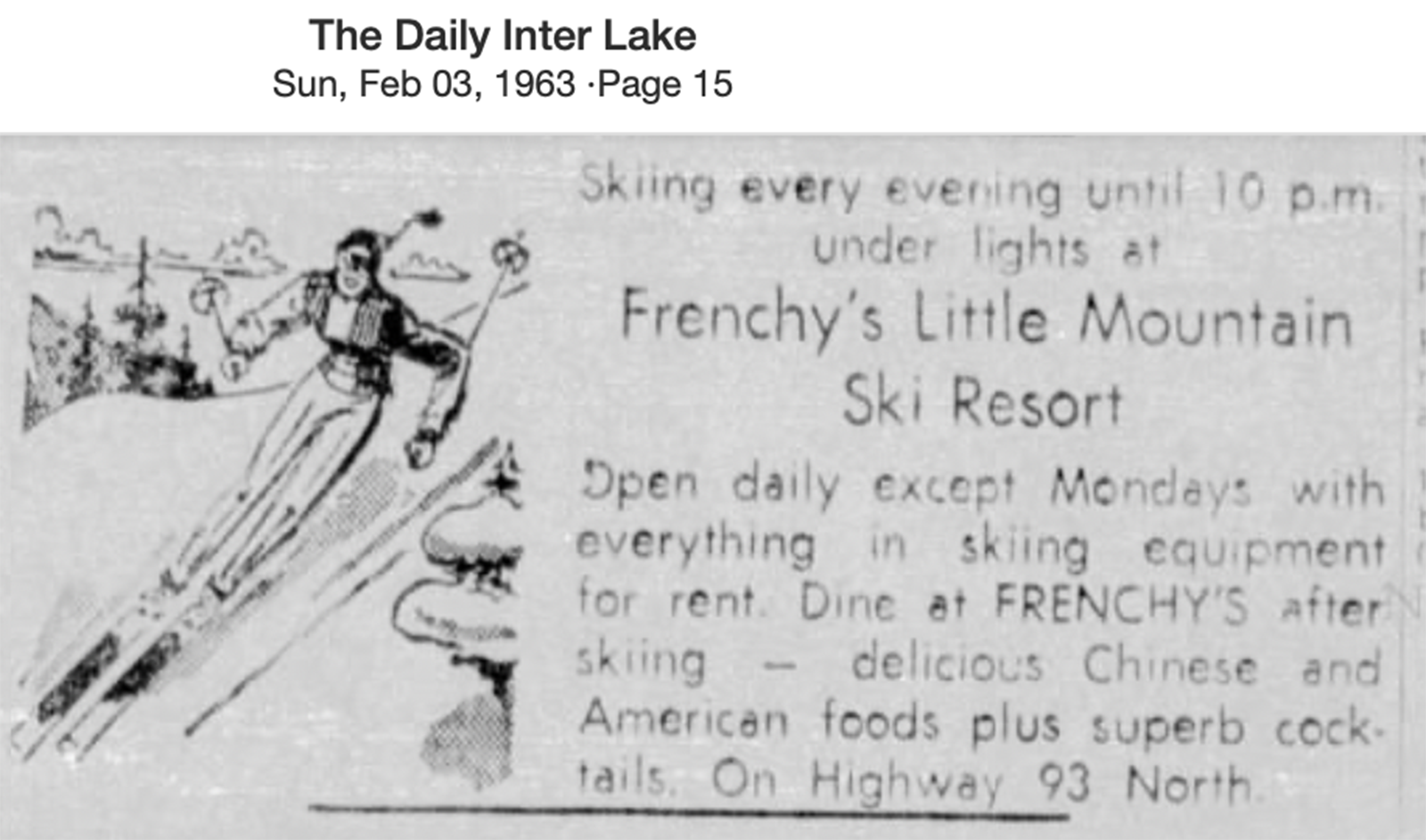
The ski area’s final season occurred in the early 1970s, marking the end of the community ski courses.
Steve Spencer, founder of Blacktail Mountain Ski Area, grew up in Columbia Falls and remembers skiing at all of the local community ski areas before his long and illustrious career in the ski industry.
“We cut our teeth on those places,” he said, explaining that his first skis were made by his Norwegian grandfather by steaming the wood slabs to form the tip of the ski. “When I started skiing at Big Mountain, I had real equipment that we bought at Montgomery Wards.”
His parents didn’t ski, but his mom would drive him to the ski areas. He and his brother skied with friends until his mom was ready to leave because they never got tired of it. Sometimes they simply hiked up the hill by their house and skied down.
He remembers the little ski shop at Termaat’s and seeing Harold Termaat in his little apron checking skis. And the tractors that ran all day. He describes the ski areas as “not for profit, with re-invented rope tows. “
Both Termaat’s and Little Mountain had a carrier wheel part way up to keep the rope from digging a trench in the track.
“You had to lift the rope over the wheel while keeping your hands out of it, or let go and grab it out on the other side. The rope was too heavy for the smallest, so they would wait for someone bigger to load in front of them to support the rope,” Spencer said. “If you fell down you needed to get out of the way. Lift operators were generally not deemed necessary, so the lift would not get stopped before you got run over… No code book was needed.”
The north slope was steep, Spencer said, probably between 150 and 200 vertical feet and covered with trees that they dodged as they made a quick descent.

He also has memories of skiing Silver Buckle and Little Mountain even though he spent more time at Termaat’s. There was also a hill at Schoenberg Park in Columbia Falls in the 1980s that served as both a skiing and toboggan course known as “Killer Hill,” a steep aspect that dropped off below the ice-skating rink, rigged with a homemade rope tow. The park included lights and a warming shed heated by a barrel stove.
“These areas were provided just to give kids a chance to get out and have fun,” Spencer said.
As one of those kids that skied the “little mountains,” it was just the beginning of a long ski legacy. He graduated to Big Mountain where he first skied as a teenager and worked off his lift tickets as a “groomer,” side-stepping up the mountain to pack the snow. He tried college, but never made it through a winter quarter. He worked as a ski patroller in Aspen, Colorado, and at Big Mountain where he went on the become Ski Patrol Supervisor and, later, Mountain Operations Manager.
In 1998, the guy who skied thousands of straight lines down the mountain, completed a full circle when he became one of the founders and owners of Blacktail Mountain, a larger and more modern version of the mom-and-pop ski areas he grew up on.
Blacktail Mountain was sold in 2021 to Washington-based Mission Ridge Resort, another small, independently run ski area whose mission statement remains the same: “Our Core Purpose at Blacktail Mountain Ski Area is to build lifetime memories and access to mountain experiences the authentic Montana way.” Steve still skis there three times a week while his daughter, Jessi Wood, carries on the family legacy as General Manager and his son, Ross, works as Mountain Manager.
Fred Wallner and his sister, Anita, ended up returning to the hill where they spent hours as children skiing the Silver Buckle. Fred moved to the property in 1983 after he and his wife, Mary Kay, along with his parents purchased 20 acres of the original ranch and built homes there. In 2000, Fred Wallner and his mother put both their properties under conservation easements with the Montana Land Reliance, protecting them in perpetuity. Anita purchased her parents’ home and started living there part-time after their passing.
Recently, while walking the steep hill of the old ski area, Fred discovered deep trenches 25 feet wide that were excavated to provide a consistent grade for the rope tow. At the top of the bench, where the excavation ends, he discovered two metal posts spaced 25 feet apart, as well as what looked like a trip wire that likely served as a safety feature for the rope tow. He said, “I always wondered what those two posts were out in the middle of nowhere. They put quite a bit of effort into all this.”
On a powder day 20 years ago, Fred packed his alpine skis to the top of the hill above his house to take a run, observing 50 years since his inaugural run down the slope of Silver Buckle. The hillside had already been handed over to nature, with trees closing the former ski runs of his childhood, so he skied a run parallel to the old ski run.
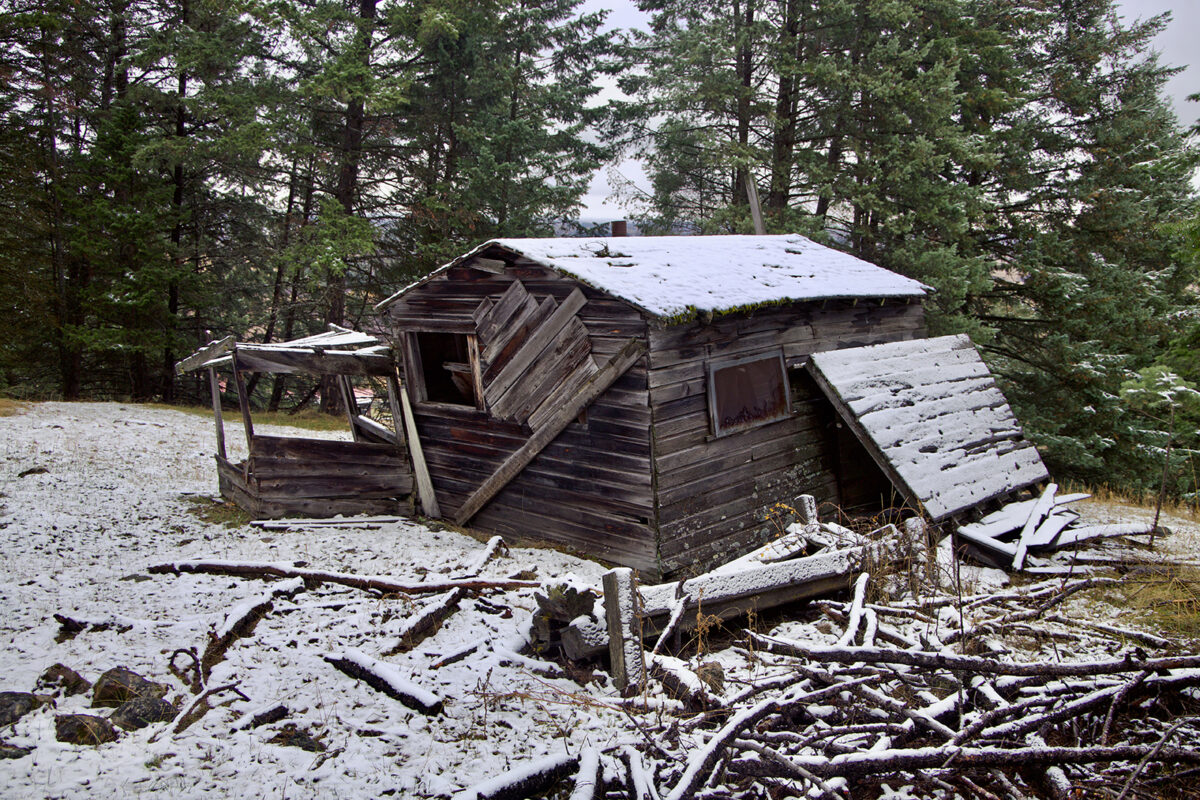
Over the years, trees have filled in the ski runs that were once filled with skiers. Some of the original buildings remain in service on an adjacent property, but the dilapidated building located mid-slope tilts in many directions as if it doesn’t know which way to fall. Boards crisscross the structure in attempts to prop up the weary building, whose wood is speckled with green lichen and sprinkled with pine needles and leaves.
It will only be a matter of time before most of the evidence of the ski area will disappear. It might be lost, but never forgotten. The Silver Buckle Ski Ranch and the other little ski areas will live on, through the legacy and tradition of skiing, carried on through the next generations. Ski areas have changed and will continue to change, but the love of experiencing the hoot-and-holler exhilaration of flying down a snowy hill will probably always be the same.