Federal Lawsuit Challenges Repeal of Montana Water Quality Standards
The Flathead Lakers, Upper Missouri Waterkeeper and Confederated Salish and Kootenai Tribes sued the EPA for adopting "arbitrary" and "reactive" standards for nutrient pollution, alleging it violated the Clean Water Act and the Endangered Species Act
By Tristan Scott
Two environmental groups and the Confederated Salish and Kootenai Tribes (CSKT) this week challenged the federal government’s approval of less stringent water quality standards for nutrient pollution in Montana, alleging in a lawsuit that the policy shift affords would-be polluters too much leeway by rolling back protective criteria that have been in place for over a decade.
The federal lawsuit from plaintiffs Flathead Lakers, Upper Missouri Waterkeeper and CSKT centers on the U.S. Environmental Protect Agency’s (EPA) decision in October to approve Montana’s new regulatory framework for nutrient pollutants, including nitrogen and phosphorus. The decision by EPA eliminated the numeric nutrient standards that have defined permitting benchmarks in Montana since 2014, and replaced them with narrative nutrient standards, which are based on subjective, site-specific criteria.
Water quality advocates described the narrative standards as “arbitrary” and “reactive” and framed the repeal as “a giant step backwards.”
“Montana’s rollback of numeric nutrient water quality standards is unprecedented; never before, in the 53-year history of the Clean Water Act, has a state adopted strong, science-based numeric nutrient standards and then reversed course due to political pressure from polluting industries,” according to a press release distributed by Upper Missouri Waterkeeper on Jan. 28 when the groups announced the lawsuit.
The policy shift was prompted by the Montana Legislature’s passage last session of House Bill 664, which repealed Montana’s numeric nutrient standards and directed the state Department of Environmental Quality (DEQ) to delete all references to them. In October 2025, the EPA approved the revised terms laid out by HB 664 as “consistent with the Clean Water Act” and its requirement to protect aquatic life and recreation. According to DEQ, the new law provides greater regulatory predictability for permittees while still ensuring that the agency applies “the best science available to protect water sources based on the agency’s understanding of local, site-specific conditions.”
A DEQ spokesperson declined to discuss the potential ramifications of the lawsuit, citing department policy that restricts what officials can say about matters under litigation. But during a House Natural Resources Committee hearing last year, top agency administrators testified in support of the return to narrative nutrient standards, calling them “a common tool relied upon by most states to regulate nutrients.” Conversely, the numeric standards were too rigid when prescribed without exception, the officials said, and had hamstrung DEQ’s ability to issue new permits to dischargers or renew existing ones.
DEQ Director Sonja Nowakowski told committee members on Feb. 26, 2025, that when the numeric nutrient standards were initially adopted in 2014, DEQ and EPA included a statewide nutrient variance rule allowing dischargers to achieve their permit limits over a 20-year period. However, Upper Missouri Waterkeeper filed a lawsuit successfully targeting that variance, rendering the numeric nutrient standards “technologically infeasible,” according to Nowakowski.
“House Bill 664 outlines one of my favorite things that the legislature is able to do … and that is time travel,” Nowakowski said in her testimony to the committee. “We are going back in time. This bill repeals the numeric criteria but it returns us to the 2013 processes that recognize and retain the flexibility of 30 years of science done by DEQ’s highly qualified staff. Montana was one of the first in the nation to apply numeric standards for nutrients statewide.”
But the state’s numeric standard was never intended to exist without the variance, Nowakowski said, describing the return to a narrative standard as “an opportunity to reset.”
“DEQ and EPA recognized that without feasible options in place these numeric standards would cause substantial and widespread economic impacts to Montana communities,” she said. “It was intended to provide a feasible approach to regulation, and where we are today is anything but feasible.”

Meanwhile, the lawsuit challenging the narrative nutrient standard alleges EPA violated the Clean Water Act when it approved Montana’s new standard “without scientific basis,” and that it violated the Endangered Species Act by failing to adequately consult with the U.S. Fish and Wildlife Service to determine the rollback’s effects on fish species, including bull trout, which are threatened by nutrient pollution and rising river temperatures.
Coby Gierke, executive director of the Flathead Lakers, said the repeal of protective standards signals a departure from Montana’s record of protecting its prized waterways. In 2014, when Montana became the first state in the country to adopt statewide numeric nutrient standards, Gierke said the decision was “based on decades of science demonstrating clear links between nutrient pollution and algal blooms, degraded fisheries, and unsafe drinking water.”
Much of that science was informed by monitoring data collected at the Flathead Lake Biological Station, which is the second-oldest biological field station in the country, serving as the “Sentinel of the Lake” since 1899. In 1977, it instituted a monitoring program that served as the first line of defense against threats to the Flathead watershed, ranging from aquatic invasive species to nutrient and biological pollution from degraded shoreline septic systems.
As a result of the monitoring program, the bio station identified phosphorus as the key nutrient causing increased algal growth in the lake, raising awareness about the need to upgrade outmoded wastewater treatment systems, which discharge high concentrations of phosphorus and nitrogen.
“Clean water is the backbone of the Flathead watershed; it sustains our economy, our communities, and our way of life,” Gierke said in a prepared statement. “It is not worth risking the famously clean waters of the Flathead — waters that generations of Montanans have relied on for drinking, swimming, fishing, and cultural connection — so that polluters can more easily meet regulatory requirements.”
EPA’s approval of the new standards, a rulemaking step required by the Clean Water Act, represents a course reversal from a previous decision to uphold numeric nutrient standards in Montana. When the 2021 Montana Legislature passed Senate Bill 358 to repeal numeric nutrient standards, the EPA under the Biden administration denied the repeal. Under the Trump administration, however, the federal agency has demonstrated a stronger appetite for deregulation.
Plaintiffs in the lawsuit said that appetite has resulted in EPA’s approval of “unscientific rollbacks” that fail to hold polluters accountable.
“EPA doesn’t get to rubber-stamp the State of Montana’s illegal water quality rollbacks for polluters and pretend there is no risk,” said Guy Alsentzer, executive director of Upper Missouri Waterkeeper, said in a prepared statement. “The law requires agencies to understand how gutting water pollution control standards would impact the state’s clean water resources, including threatened and endangered species, before making a decision. EPA didn’t do their homework before hastily approving the state government’s giveaway to polluters allowing more pollution into our waterways, which will have many deleterious consequences for Montanans.”
A spokesperson for CSKT declined to comment on the lawsuit, deferring to the merits of the complaint filed in U.S. District Court in Great Falls.
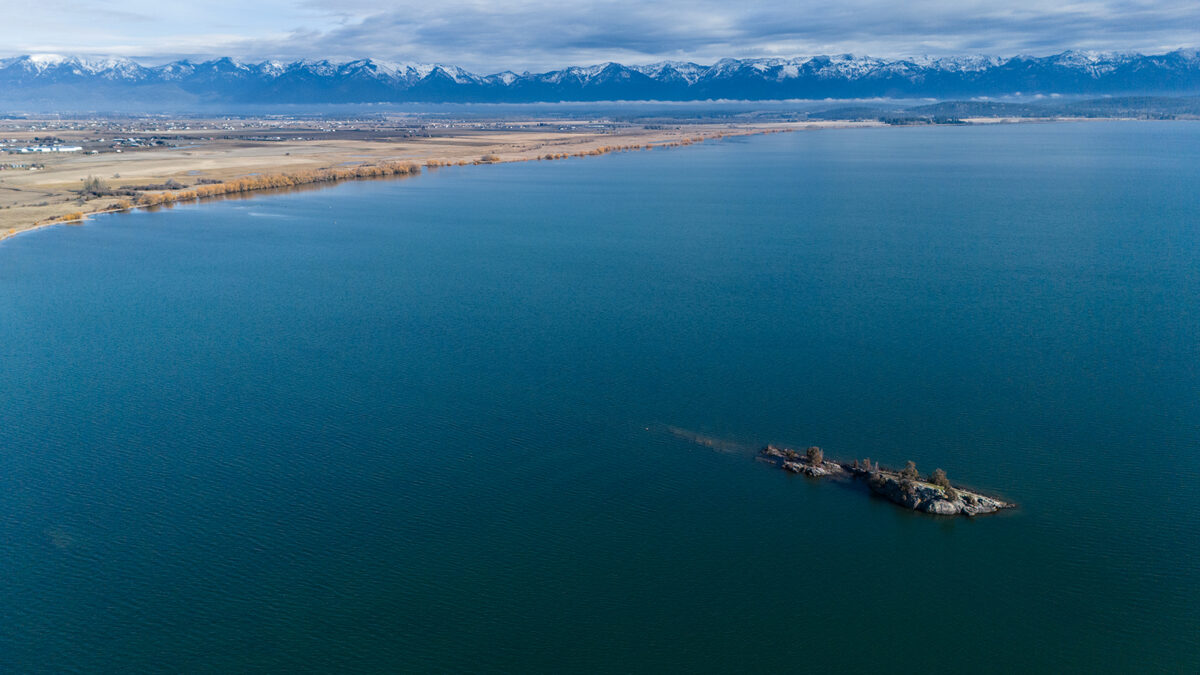
For its part, DEQ acknowledges that excessive nutrients, such as nitrogen and phosphorus, can alter the chemistry of waterways and lead to harmful algae blooms and nuisance aquatic vegetation, which imperils watershed health by reducing dissolved oxygen.
“This process creates an environment in which freshwater species cannot live, leading to migration or death in the case of fish species,” according to DEQ’s Water Quality Integrated Report published in November. “It can also deplete food resources for species dependent upon freshwater organisms for sustenance.”
In that report, which covers the 2022-2024 monitoring cycle, DEQ assessed 23,111 miles of Montana’s perennial streams, representing 49% of those under state jurisdiction, as well as 521,088 acres of lakes and reservoirs, or 74% of the named lakes under state jurisdiction. The report characterizes phosphorus as the third most common pollutant in Montana’s waterways, impacting 73,324 acres (14%) of the lakes the agency has assessed, and impairing 5,349 miles (23%) of its assessed rivers.
Agriculture and municipal point source discharges account for the most common sources of total phosphorus in Montana’s lakes, the report states.
Meanwhile, nitrogen has impacted 68,354 acres of lakes (13%) and 5,066 miles (22%) of the state’s assessed rivers and streams.
But the repealed numeric nutrient standards never applied to many of Montana’s waterbodies, according to DEQ, including Flathead Lake and the Kootenai River. Instead, they only applied to “wadable streams” and select large river segments. The repeal of the numeric nutrient standards also did not affect waterbodies with already established site-specific nutrient standards, according to an agency spokesperson.