
Columbia Falls city staff on Thursday night presented an analysis of the city’s short-term rentals that served as the catalyst for the planning commission’s first of several discussions on how to best regulate what the community has deemed a problem for years.
The city is in the early stages of crafting a short-term rental policy to manage the “known issue with an unknown scale” — a task that so far has proven difficult due to the city’s inability to dedicate a staff member solely to short-term rental regulation enforcement.
“We need to have simple and reasonable processes that are easy to understand, but also easy for us to enforce,” City Manager Eric Hanks told planning commissioners.
Short-term rentals — which is the rental of any portion of a dwelling unit for stays less than 30 days to transient guests or tourists — have been a housing issue top of mind for many communities across the state and country, especially for those with tourism-heavy economies.
A recently published report from the University of Montana’s Institute for Tourism and Recreation Research analyzed short-term rental activity around the state between 2019-2023, finding that Flathead County had the highest number of short-term rentals in the state and the second-highest number of average bookings per month.
A Columbia Falls-specific short-term rental analysis and discussion about potential regulatory policies was a top priority for the city council, especially as the city updates its land use plan and zoning to meet new state requirements under the Montana Land Use Act (MLUPA), Hanks said.
The city’s analysis found that there are 121 short-term rental permits and of the roughly 1,930 residential properties, 4.7% have short-term rental conditional use permits, according to city documents. In 2025, licensed short-term rentals amassed $3.2 million in gross revenue, which roughly translated to $96,000 in resort tax revenue for the city.
“We know there’s a lot more that are not properly licensed; they’re not paying resort tax,” Hanks said. “We had one this week that filed a permit a while ago. The fire chief did a fire inspection, failed the fire inspection, but is active on the websites renting properties.
“We have to get better at that enforcement, and code compliance has been a challenge for the city with a small staff and not having a dedicated code compliance officer.”
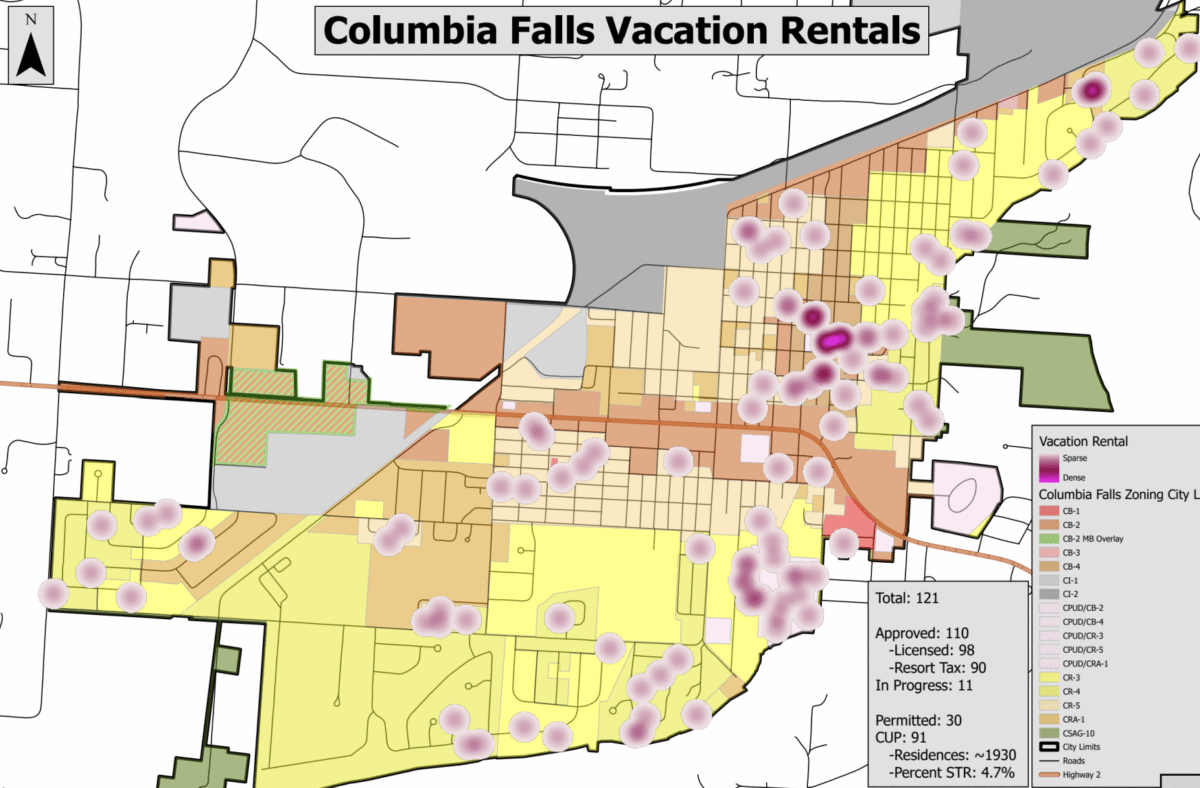
Hanks presented potential enforcement and management tools commonly used by similar communities, with city staff strongly advocating for the requirement of a city registration number on all advertisements and hosting websites, like VRBO and Airbnb. In turn, these hosting websites can help with enforcement, removing listings that lack the registration number or are in violation of the city’s short-term rental policy.
“We need some guardrails on this,” Commissioner Mark Johnson said Thursday. “If we can’t enforce it, it really doesn’t matter. But having the mechanisms to use the VRBO sites to enforce it, I mean that’s what’s caused the short-term rental boom is the flow of cash through that technology, so it’s nice to have a mechanism to kind of tap that back without shutting it off.”
Other management strategies that could be considered by the planning commission and city council include capacity controls — determining a maximum number or percentage of rentals by city or zoning type — and a tiered permit system, which would create short-term rental types, such as owner-occupied rentals versus investment rentals.
“Ultimately, the city staff and the city needs to be fair and consistent in how we do it,” Hanks said. “We can’t target individual residences. A complaint driven program is good, but we really need to create processes and have the proper regulations to hold people accountable.”
Although early in the process, many of the commissioners expressed an agreement over finding a way to effectively enforce whatever policy is created, with Commissioner Sam Kavanagh encouraging city staff to explore whether the city has the funds to support additional staff dedicated to compliance.
During Thursday’s meeting, Commissioner Justin Ping advocated for the importance of supporting owner-occupied short-term rentals, as opposed to investment properties.
“Personally, I’ve gone through this living in central Colorado for a long time before this and lost my town to STRs largely, and it was investor driven,” Ping said. “I definitely support a tiered permit system, which prioritizes owner-occupants, primary homeowners. I think that mechanism should be available to any and everyone. I definitely think we should look into any and all means of restricting commercial investment into this. I’d die on that hill.”
The importance of protecting Columbia Falls residents was repeatedly echoed throughout the discussion, with commissioners and city staff acknowledging the role short-term rentals can play in affording housing.
“I’ve talked to a dozen of residents that the only way they can afford their mortgage is to rent out for two to three weeks out of the summer, or a month out of the summer, and move into the RV,” Hanks said. “And that’s an important part of some of the housing challenges we have, and we need to be understanding of that.”