In northwest Montana, where each season heralds a new realm of outdoor adventure that rivals most deluxe destination vacations, it’s tempting to stake out our home turf and enjoy another stay-at-home sabbatical. But might we be missing something?
Sure, between Glacier National Park and the Bob Marshall Wilderness Complex, a lifetime’s worth of wilderness exploring awaits us in our own backyards. And that doesn’t account for the 2.4 million acres of public land the Flathead National Forest affords us. But even if the portmanteau “staycation” was invented for this corner of the state, it can’t hurt to expand our worldviews by a few dozen miles and see what’s happening around the next bend.
Here are five getaways and micro-excursions in the region that are worth adding to your 2026 backyard bucket list.
Hot Springs Time Machine
The community of Hot Springs is just over an hour away from Kalispell, but it’s about a half-century and a cell tower removed from the modern world, which makes it the perfect grounds for a weekend retreat.
Hot Springs was incorporated in 1929, replacing the originally platted town of Pineville, on the Flathead Indian Reservation along a stretch of eastern Sanders County dotted with hot springs, created by subsurface geothermal activity. These waters, considered to be among the most mineral-rich in the world, are known for their healing properties and are at the heart of the town’s enduring motto: Limp in, leap out.
Long before trappers and traders began enjoying the area’s waters, traditionally known as the Camas hot springs, American Indians sought out the springs’ healing powers. By the early 20th century, the area had become a highly sought destination for visitors of all kinds, who arrived to both soak in and drink the water. A businessman named Fred Symes constructed the Symes Hotel in 1930 to host the hordes, and the hotel expanded through the 1940s. Then in 1949, the Confederated Salish and Kootenai Tribes held a ceremony to dedicate a newly constructed bathhouse that towered over town. State and tribal officials attended the ceremony, along with famed Olympian Jim Thorpe.
The bathhouse highlighted a boom period for the town. Its population soared above 1,000, and at various times there were multiple grocery stores, a sawmill, a car dealership, six bars, a hospital and a movie theater. But when the tribes shut down the bathhouse in 1985, the economic fallout proved severe at a time when other core industries like ranching and timber were struggling. The abandoned skeleton of the bathhouse fell into disrepair and stood as a haunting reminder of better times.
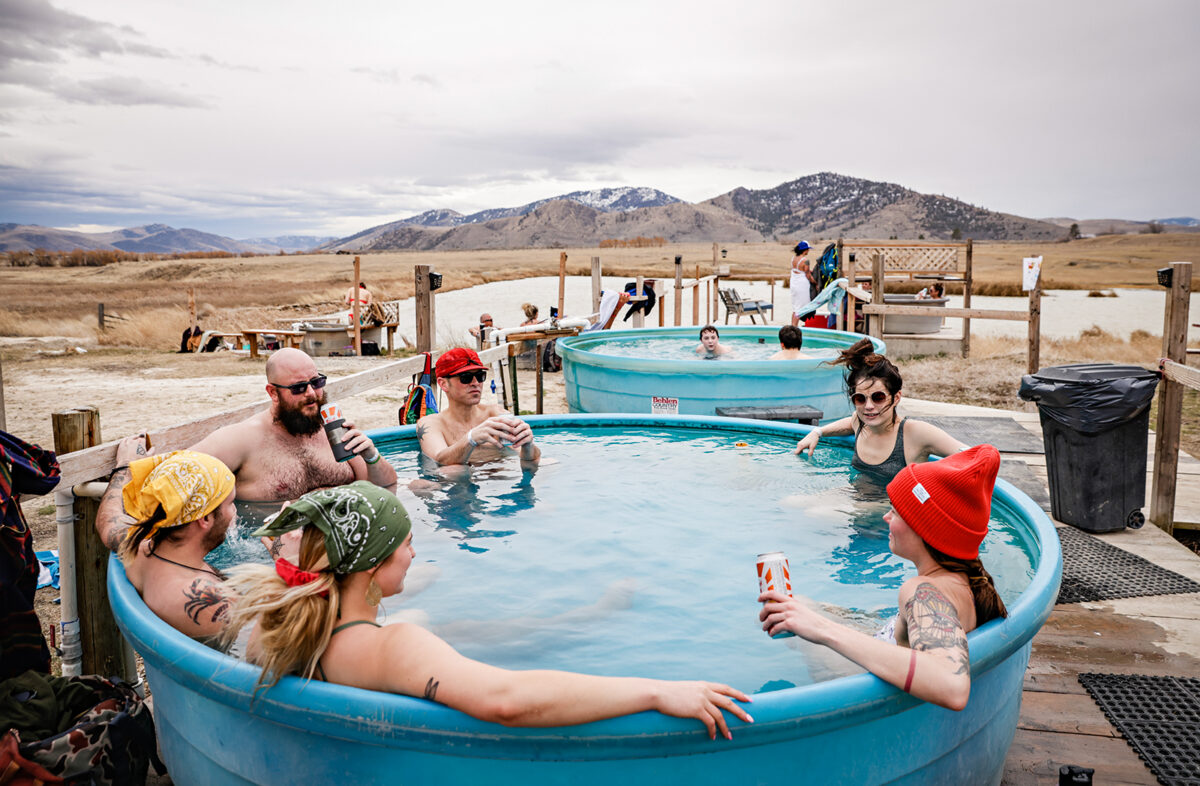
That’s how Leslee and Daniel Smith found the town in the mid-1990s. While on a road trip from Washington, they passed through and saw a “for sale” sign at Symes. The couple fell in love with the hotel, purchased it in 1996 and then conducted a series of renovations. Today, Symes has three outdoor soaking pools, indoor jacuzzis and private bathing stalls, and its lobby houses an espresso bar and various art exhibits, though most of the hotel looks unchanged from the 1940s. The 31 rooms and 10 cabins have no telephones; guests and locals can use the hotel’s pay phone. For more information, visit symeshotsprings.com.
Though Symes Hot Springs Hotel and Mineral Baths is the centerpiece, several other places also offer excellent soaking opportunities, harkening back to the town’s heyday before the bathhouse closed nearly three decades ago.
Quinn’s Hot Springs
For the luxurious soaker, Quinn’s Hot Springs outside of Paradise is the only way to go. The built-out resort has seven large pools ranging from 100 to 106 degrees as well as a frigid cold plunge. Two of the pools are salt treated and maintained at a slightly cooler temperature range to accommodate swimmers of all ages. Quinn’s is best enjoyed as an overnight guest, which allows for late night and early morning soaking. The resort has two lodges and more than two dozen river-side and canyon-view cabins, as well as a restaurant and tavern. For more information visit quinnshotsprings.com.
Wild Horse Hot Springs
Located just north of Hot Springs, Wild Horse is powered by the Mother Dragon artesian geyser that was supposedly discovered by the daughter of Montana’s third governor, Robert Smith. Two hot water wells feed into 14 different pools, or “plunges,” that range from 95 to 128 degrees. The plunges consist of in-ground concrete pools and large horse troughs, and each features a hot water valve allowing guests to control the temperature. For a lingering experience, there are several cabins on the property that can be rented for the night. For more information visit wildhorsehotsprings.com.
Alameda’s Hot Springs Retreat
Alameda’s offers a combination of traditional hotel rooms and private cottages, featuring 18 unique units with original 1930s-era style, each with its own tub. Prices range from $85 to $141 per night. Devlin says some customers request specific rooms or a particular tub style, like a jacuzzi or clawfoot. Most rooms have a kitchen and a water closet-style bathroom that complement the vintage décor. One unit has a linoleum floor that resembles an Oriental rug. For more information visit alamedashotsprings.org.
Catch a View of Kootenai Falls
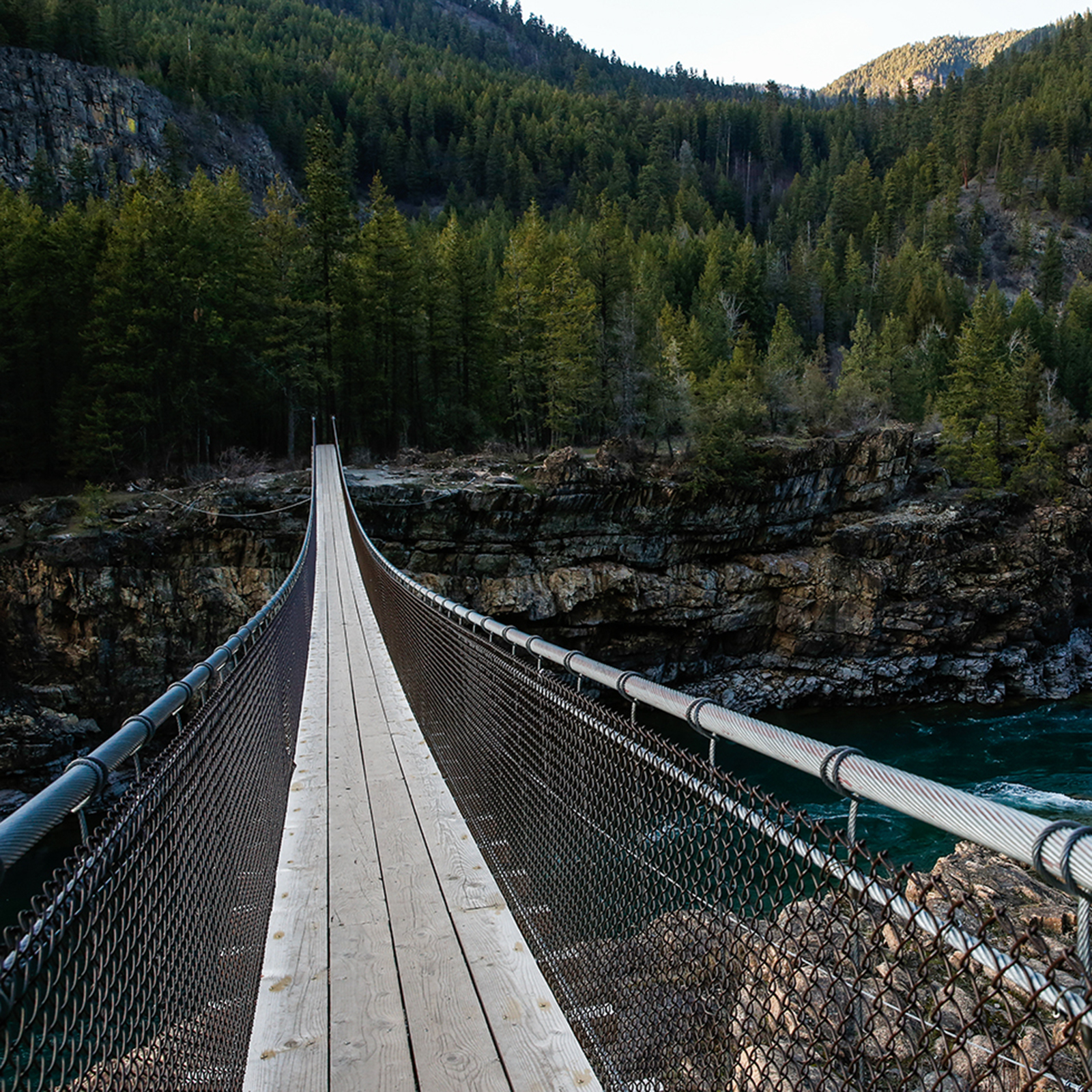
The largest undammed falls in Montana are truly a sight to behold. The breathtaking views and awesome power of the river make for a great afternoon adventure for the whole family. Watch as the water surges through China Rapids and over the falls, dropping 90 feet in less than a mile. Be sure to take the brave trek across the swinging bridge that hangs 30 feet above the river as it crosses from bank to bank. Located in Lincoln County about seven miles northwest of Libby, this sight is considered sacred to the Kootenai Indians whose ancestors inhabited the region. Famed explorer David Thompson, a Canadian who worked for the North West Company and was among the first white men to witness the area in the early 1800s, traveled the river before running into the massive falls and portaging. Leonardo DiCaprio’s character in “The Revenant” was not so fortunate.
Explore the Route of the Hiawatha Trail
It was once considered one of the most scenic stretches of railroad in the country and now it’s one of the most spectacular hiking and biking trails. The scenic views are remarkable, but the most unique aspect of this 15-mile trail is its 10 train tunnels and seven sky-high trestles. Greatest of all, the St. Paul Pass Tunnel, also known as the Taft Tunnel, stretches 1.66 miles through the pitch-black heart of the Bitterroot Mountains at the state line of Montana and Idaho. The trail, named to the Rail-to-Trail Conservancy Hall of Fame, is downhill from east to west, making it family friendly. Shuttles are available for those wanting to go one way, while others make it a round trip. The trail is open from late May through September. Trail passes, shuttle tickets and bike rentals are available at Lookout Pass Ski Area, 12 miles east of Wallace, Idaho.
Paddle the Flathead Lake Marine Trail
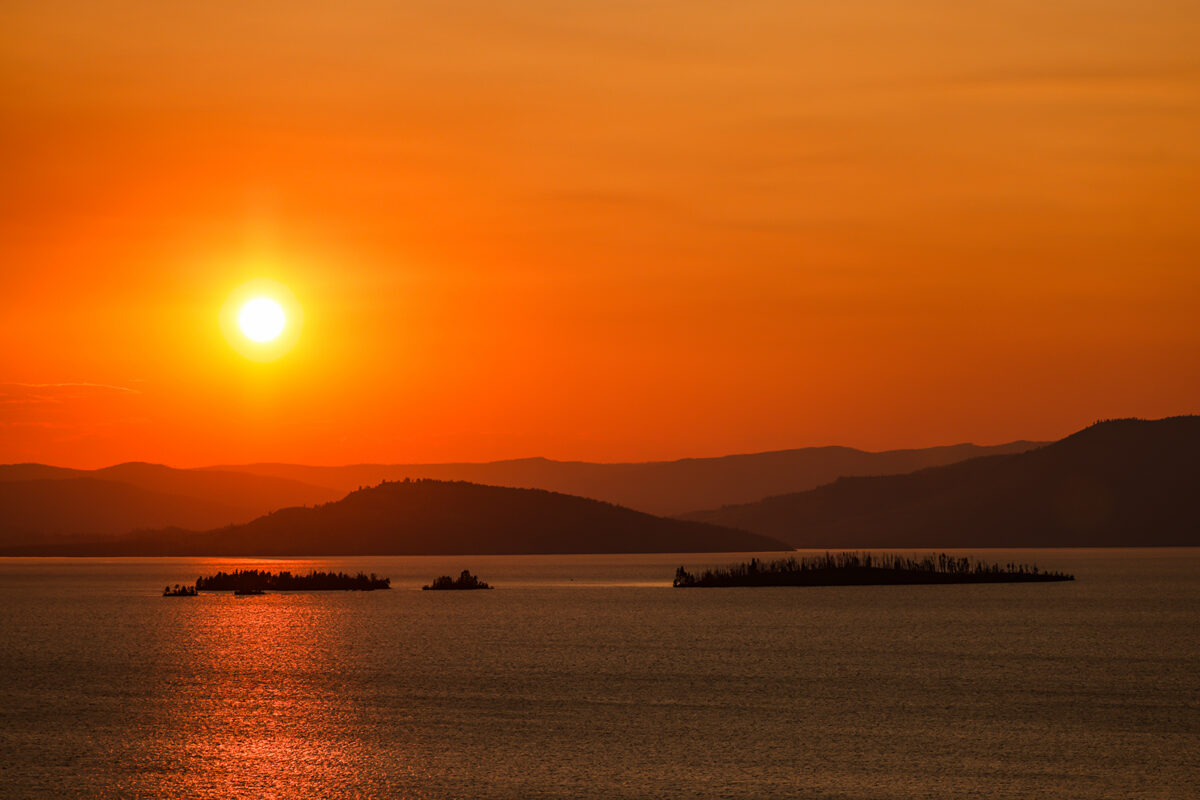
Not every trail traces the dirt labyrinth of mountains. About two decades ago, Jerry Sawyer, the manager of the state parks on Flathead Lake at the time and an avid sea kayaker, devised a concept that encouraged paddling adventures on the largest natural freshwater lake in the West. Sawyer crafted the Flathead Lake Marine Trail, envisioning a network of access points, stopovers and campgrounds along the vast shoreline, which stretches 120 miles all together. The idea is to offer watercraft users a detailed roadmap for exploring all the outdoor amenities on the lake, including the six state parks, fishing access sites and other worthy destinations. It also includes routes to three public islands — Wild Horse, Cedar and Bird. Camping is allowed at Cedar and Bird islands, while Wild Hose is day-use only. Remember, Flathead Lake is big — 30 miles long and as wide as 15 miles with 180,000 acres of ripples. Weather can change rapidly, and everyone is required to have personal flotation devices when out on the water. Because Montana’s Flathead Lake marine trail is conceptual, there’s an almost infinite number of routes and access points. However, a map of the water trail is available at flatheadtrails.org.
Find Yourself at Lost Trail
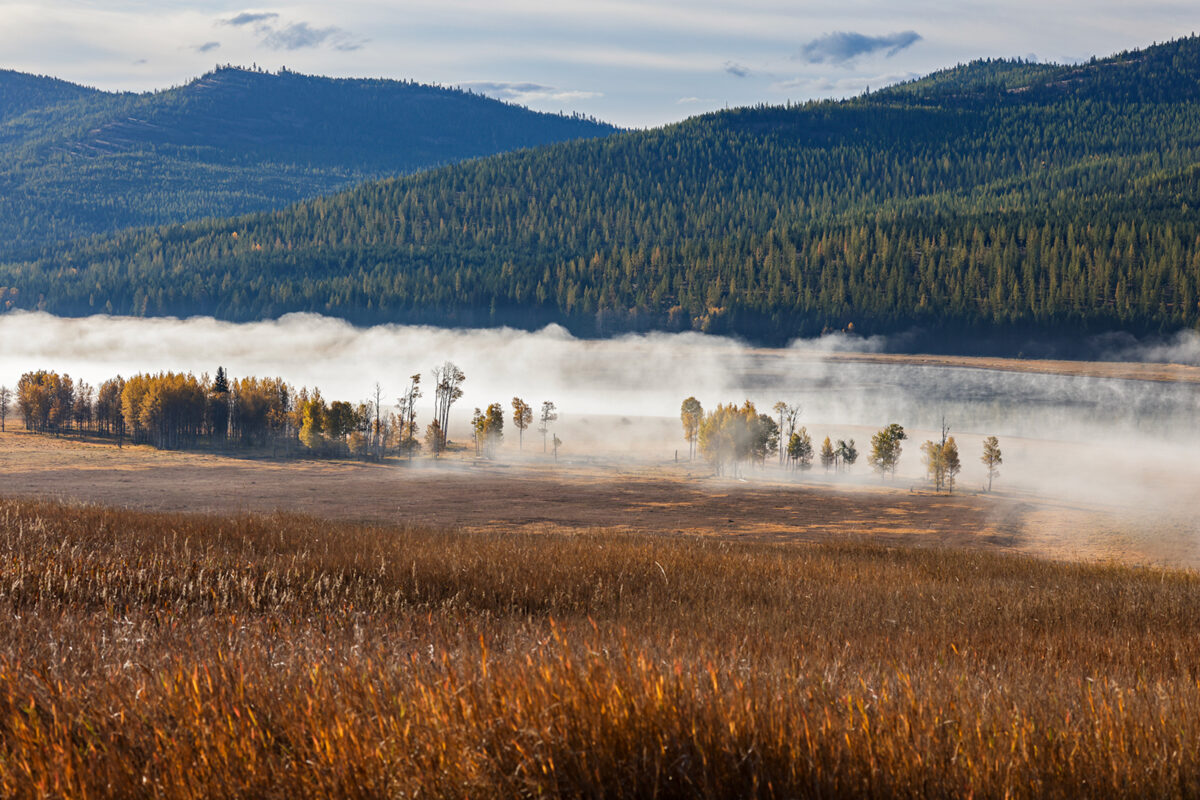
In the Pleasant Valley floodplain and flanked by rolling foothills, the Lost Trail National Wildlife Refuge is located west of Kalispell in the Salish Mountains, near the unincorporated community of Marion. Nearly 30 years ago, the 8,000-acre Lost Trail Ranch was purchased by the Montana Power Company, which transferred ownership to the U.S. Fish and Wildlife Service (FWS) as part of a mitigation deal to offset wildlife impacts and habitat loss resulting from Seliš Ksanka Qĺispe Dam (formerly Kerr Dam) and its damaging effects on the wetlands surrounding Flathead Lake.
In 1999, the property joined the roster of federally managed lands under the National Wildlife Refuge System and was officially designated the Lost Trail Wildlife Refuge.
While the transition from ranch to refuge was a heavy bureaucratic lift, the mass restoration of an entire ecosystem — the rewilding of a landscape — presented another complex set of eco-engineering challenges, including a large-scale effort begun in 2017 to restore drained wetlands.
Located near the tiny community of Marion on U.S. Highway 2, the glacially carved refuge cuts a dramatic expanse. Its high mountain ridges subside to low-bottom wetlands of browsing moose and sweeping prairies of creeping coyote. Its centerpiece is Pleasant Valley Creek, which drains a watershed that spans 53 square miles, originating in the Salish Mountains to the north. It is joined by Meadow Creek, which drains from Dahl Lake, and eventually meets the Fisher River at its headwaters.
How to get there: Heading west from Kalispell on U.S. Highway 2, drive approximately 20 miles to Marion. Turn right at Marion onto Pleasant Valley Road. After approximately 1.3 miles, the blacktop road will fork — stay right. The blacktop road eventually turns to gravel. Continue on the main gravel road approximately 13 miles. The refuge headquarters will be on the right approximately 4 miles from the east entrance.