‘I’m Home:’ Paralympic Snowboarder Brenna Huckaby Finds Community in the Flathead Valley
The three-time gold medalist made the move to Kalispell nearly four years ago and has since leaned on her newfound “village” as she prepares for her third Winter Paralympic Games.
By Lauren Frick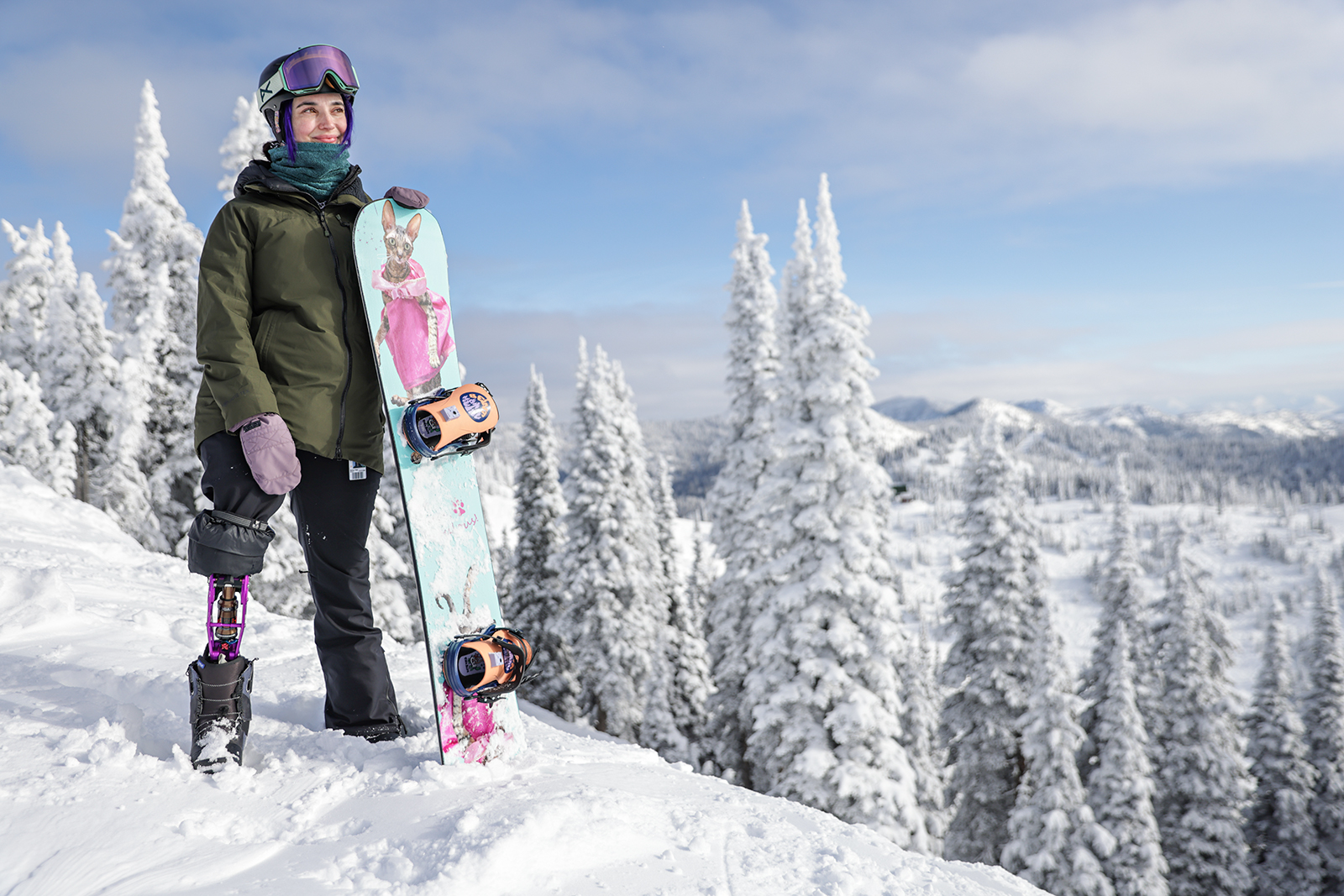
Growing up in Baton Rouge, Louisiana, close proximity to the mountains wasn’t something that even made Paralympian snowboarder Brenna Huckaby’s priority list. In fact, being a short distance to somewhere indoors — preferably with a balance beam or a springy gym floor — would’ve been top of mind for the competitive gymnast.
But when Huckaby at age 14 was diagnosed with osteosarcoma, a rare bone cancer, that ended with her right leg being amputated, her priorities shifted.
Still in search of an outlet for her competitive drive, Huckaby about a year later got on a snowboard for the first time and never looked back, switching out balmy summers and her Louisiana State University Tigers for some higher elevation.
Ever since, peaks have never been too out of reach for the now three-time gold medalist. She and her husband, who is a snowboard coach and instructor, have lived in mountain towns across the country, from Maine to Utah to Wyoming — and now Montana.
While living in Jackson Hole, Wyoming in 2018, friends of Huckaby’s introduced her and her husband to Kalispell, and after quickly realizing it “checks all the boxes,” they made the move following the 2018 Paralympic Winter Games in Beijing.
“I’ve lived in so many different places, but I’m really, really grateful to call Kalispell home and raise my family here,” Huckaby said. “I don’t foresee myself going anywhere.”
Although more than 2,200 miles from her hometown, Huckaby has already found the same tight-knit community bond here in the valley.
“We moved into our house in 2023 and immediately our neighbors came over, introduced themselves, invited us to dinner and we just started building a neighborhood community friendship,” Huckaby said. “When I lived in other places, that wasn’t really a thing. But that’s a big thing in Louisiana where I’m from. For me, I was like, ‘Oh my gosh, I’m home.’ It’s just been so welcoming.”
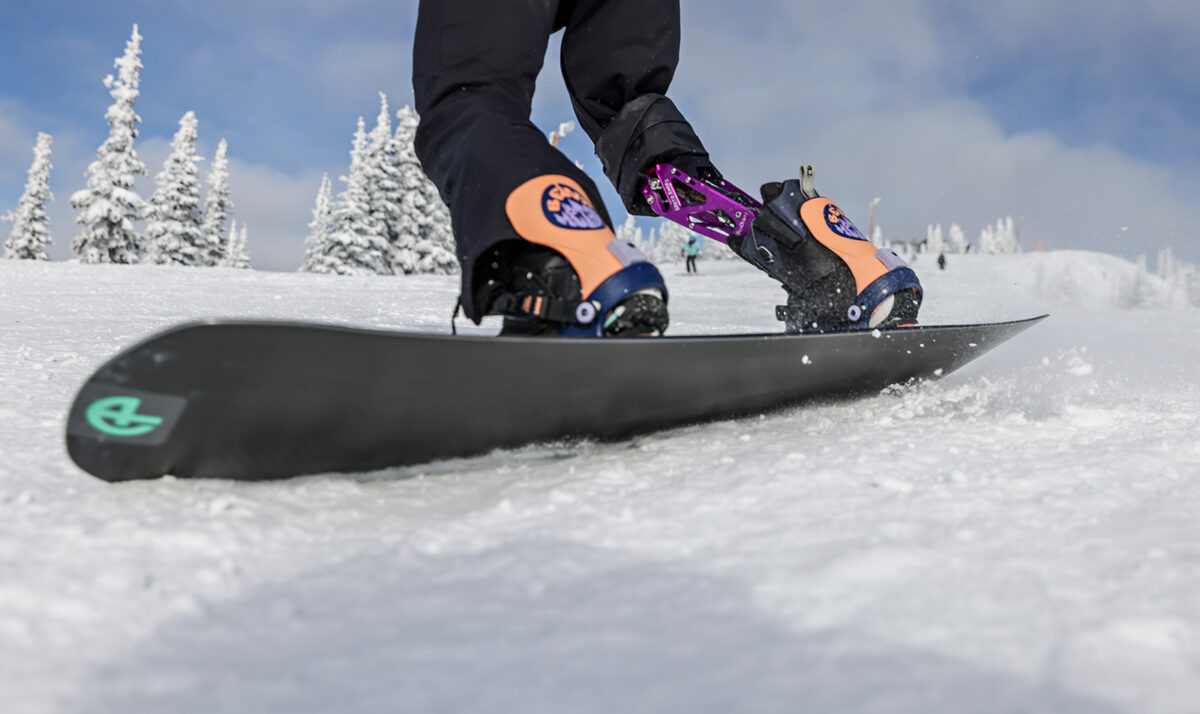
Building community has been key for Huckaby and her husband as they navigate training, careers and raising their 10-year-old and six-year-old daughters, especially with no other family members living in the valley.
The support has also been critical as Huckaby’s move from Salt Lake City to Kalispell has meant a significant shift in her training environment.
“In Salt Lake City, that’s where my club team trains. I have a coach. We have a state-of-the-art facility in Park City that I could train at in the offseason,” Huckaby said. “So I was definitely giving up my professional training in Salt Lake so that I could be in a better place to raise my family.”
But it’s her new-found community at Kalispell’s Fuel Fitness and Whitefish Mountain Resort that has stepped up and provided a new team of her own to train with, Huckaby said.
“I have everything I need here; I just have to get a little bit more creative with getting the specific things that I need,” Huckaby said. “But living here and just having the lifestyle that we have here was worth sacrificing my training for, for sure.”
“We’ve kind of made our own village,” she added. “We have our neighbors who help out with the kids when they can, and we also help out with their kids when we can. Our friends at the mountain, they’ve stepped in to help out. Again, I’ve lived in different places, but the type of people here really are different.”
Staying up on her training has been especially important as Huckaby has prepared for her third Paralympic Winter Games in Italy this year.
Already a four-time medalist, including three golds, Huckaby admits it would be great to win another gold, but said one of her biggest goals is a mental one: stay present and enjoy the full experience the Games have to offer.
“[In 2018], my youngest wasn’t born yet and my oldest wasn’t old enough to really know what she was experiencing, and then 2022 nobody was able to go, so I just feel like this games, with having them there, is just like a big celebration of all the work that we’ve accomplished together,” Huckaby said. “I do truly feel like this is a family job, and it’s the first time that they get to see something come out of it.”
Huckaby’s mental health journey has been just as important as her physical progression in the sport.
“Before I lost my leg, I was a highly competitive gymnast; I had dreams of going to college on scholarship and that was all I knew,” Huckaby said. “So when I lost my leg, I lost a huge piece of my identity, then that’s when I found snowboarding.
“Snowboarding gave me the same feelings gymnastics did, but once I started competing in snowboarding … it was all about proving that I was better than my disability. If I could be the best snowboarder, if I could be as close to people with two legs as possible, then I’m not disabled, and that was how I based my early part of my career.”
But after winning two gold medals at her first Games in 2018, Huckaby had a realization: “nothing about me changed.”
“It didn’t give me a new leg; it didn’t fix anything with my mental health that I was suffering through; it didn’t prove to anyone that I wasn’t disabled,” Huckaby said. “That’s when I started therapy and started to just deconstruct my beliefs around disability and society and how I fit in.”
Heading into the 2022 Games, Huckaby’s mindset was all about proving that she was enough as is — no matter if she won a gold medal or not — and identifying more with disability, understanding that it doesn’t take away from her a person either, she said.
Now, after adding a sports psychologist to her routine therapy regime, Huckaby in 2026 is only focused on the here and now.
“The last four years has just been fully embracing every present moment and not defining anything,” Huckaby said. “One of my favorite mantras is, ‘It’s not good or bad. It just is.’ Not everything needs a reason. Not everything needs to be defined. It can just exist.”
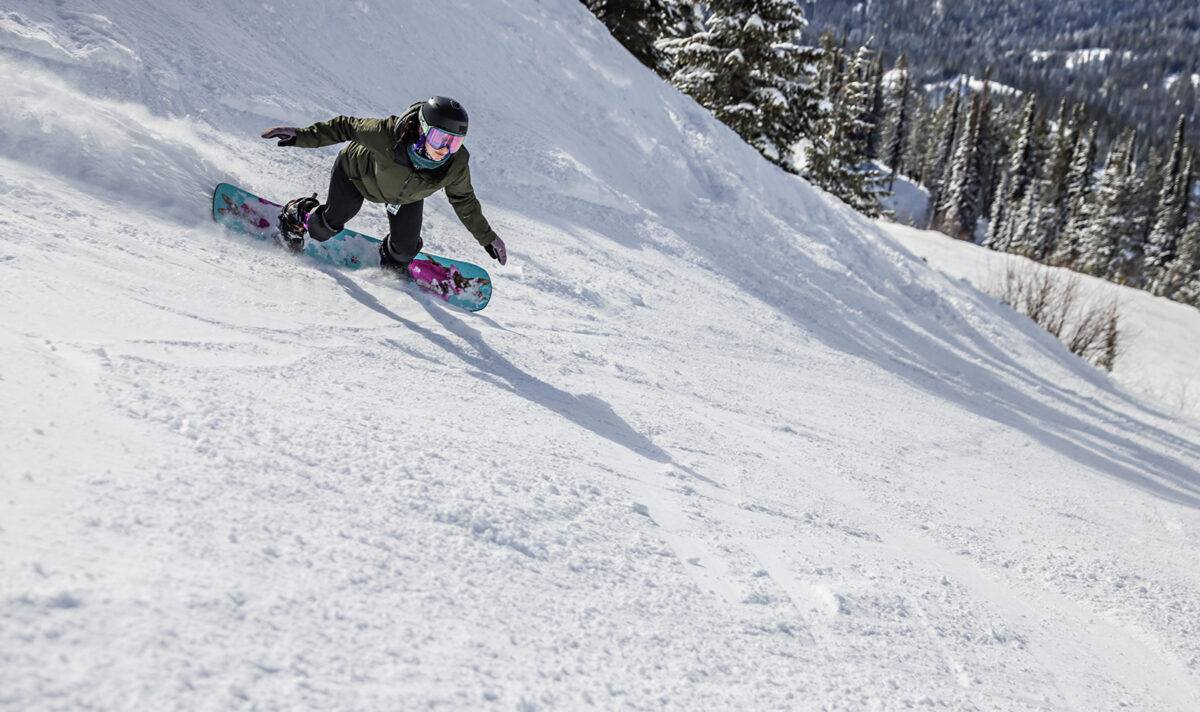
Homing in on her mental game hasn’t been the easiest of processes, especially as Huckaby has faced obstacles off the mountain.
In para-snowboarding, there are three main classifications for competitors: SB-UL (upper limb; athletes with impairments in one or both arms); SB-LL1 (lower limb; athletes with significant impairment in one or both legs, such as above-the-knee amputations) and SB-LL2 (athletes with lower-limb impairments that have less impact on functionality compared to LL1, such as below-the-knee amputations).
At the 2018 PyeongChang Paralympics, SB-LL1 and SB-LL2 field enough competitors to necessitate separate events at the Games. After some women in the SB-LL1 classification retired, the International Paralympic Committee (IPC) ahead of the 2022 Games eliminated two events in Huckaby’s SB-LL1 class — in turn eliminating her ability to compete. Huckaby asked to compete in the men’s SB-LL1 category or the women’s SB-LL2 category but was denied, causing the issue to go to a German court.
“Myself and another woman who was the other LL1 with me at the time, we hired a German lawyer because World Para Snowboard, nor the IPC, could give us a reason why we couldn’t compete,” Huckaby said. “So because of that, the only reasonable reason must have been the basis of disability. I’m too impaired to compete, and that is discrimination, so that’s what we sued on.”
The court ruled in Huckaby’s favor, meaning the SB-LL1 and SB-LL2 women combined for competition in 2022. Huckaby took home a gold in Banked Slalom and bronze in Snowboard Cross in the SB-LL2 classification.
In 2026, the events will remain combined, with Huckaby saying she will be the only woman competing with an above-the-knee amputation.
“Having two knees in snowboard cross and slalom is massive,” Huckaby said. “There’s a reason that the classifications are separated. Because it is a challenge.”
“It sucks, but I just really try to lean into, this is the hand that I’ve been dealt. These are the cards that I’m playing with. I am at a disadvantage … but I also know there’s still growth and I’m a competitor. I’m not going to give up just because it’s hard. Though, sometimes I really want to,” she added with a laugh.
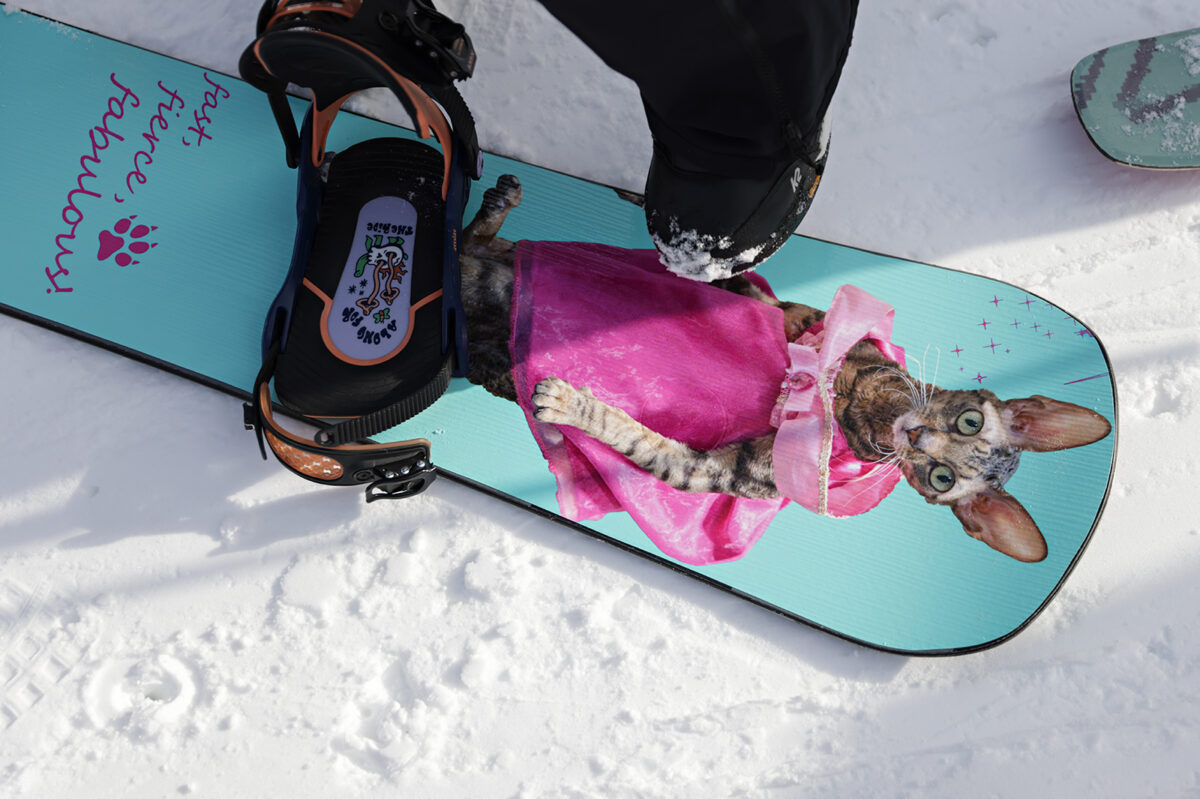
Huckaby’s disability and para sport advocacy extends far beyond the courtroom, however.
Over the last two years, Huckaby — along with other para athletes and Paralympians like para nordic skier Dani Aravich — have developed a media collective that aims to change the narrative around Paralympic and adaptive sports by spotlighting para athletes’ stories and brands.
The media collective’s name, Culxtured, comes from the group’s mission to share the culture of para sports by highlighting the stories para athletes want to be told — to be portrayed as athletes, “not just inspirations,” Huckaby said.
“We have our own unique culture that you really only experience in para sports,” Huckaby said. “Because, yes, it’s highly competitive. Yes, we’re the best at what we do in our sports, but there’s this level of connection and community that I don’t think traditional able-bodied sports have because we’re connected through something so deeply impactful.
“Whether you were born with a disability or you acquired it, there’s just something there that changes you, so we have that connection. So we were like, OK, we want to share this culture with the world.”
Through Culxtured, Huckaby wants to push for Paralympians and para athletes to transition from simply striving for representation to demanding inclusion.
“For me, doing Sports Illustrated Swimsuit was one of the first times where I understood the power of representation,” Huckaby said. “I was, like, no, 14-year-old me would probably like to see somebody with my disability viewed in a way that’s not something to hide or to not embrace. At a time like that, just representation, seeing people with disabilities was the focus.
“But it’s almost 10 years since that had come out, so I feel like we’re beyond simply seeing representation now I want to see inclusion. I want to see like disabled athletes just existing because, like, we’re here. It’s not like an anomaly, truly.”
With the right exposure and by telling the right stories, Huckaby believes para sports can see the same viewership and engagement boom as women’s sports have seen in recent years.
“It is something that people care about; it’s just something that hasn’t been seen in a way that’s empowering,” Huckaby said. “How many times have we talked about women’s sports in the past, and it’s like, ‘Oh, nobody cares,’ ‘it’s less than’ or ‘they’re not as good as the men, so what’s the point of watching?’ But when you actually take a second to watch women’s sports, you realize we have our own strengths.”
“We never would have seen that if we never gave them the chance, and I feel like para sports is the same way,” she added. “I know that it can get there and it will get there, but it’s just like, when is the next question. That I don’t know, but we’re not giving up.”
The Milano Cortina 2026 Paralympic Winter Games begin March 4, with the Opening Ceremony commencing March 6. Para Snowboard competition will begin on March 7.