Stargazing in Big Sky Country is how Daniel Baca first fell in love with space.
“My brother used to tell these stories of Greek mythology, and I thought it was so cool,” Baca recalled.
He ripped out a poster from a National Geographic magazine — an iconic image of the first human to float freely in space, astronaut Bruce McCandless — and stuck it on the wall of his childhood home in Kalispell. He dreamed of having a job in the realm of spaceflight.
Meanwhile, Jeremiah Hall was discovering his fascination with aerospace as a fifth grader at Bissell School in Olney. For a Flathead County Science Fair, Hall designed a project that played with lift (the force that holds aircrafts up) by hooking a hairdryer up to a small weighing scale. His project won second place, Hall said.
“I was blowing at (the scale) to try and see how the lift would change,” Hall said. “After that, I was just totally hooked on flight and lift and airflow.”
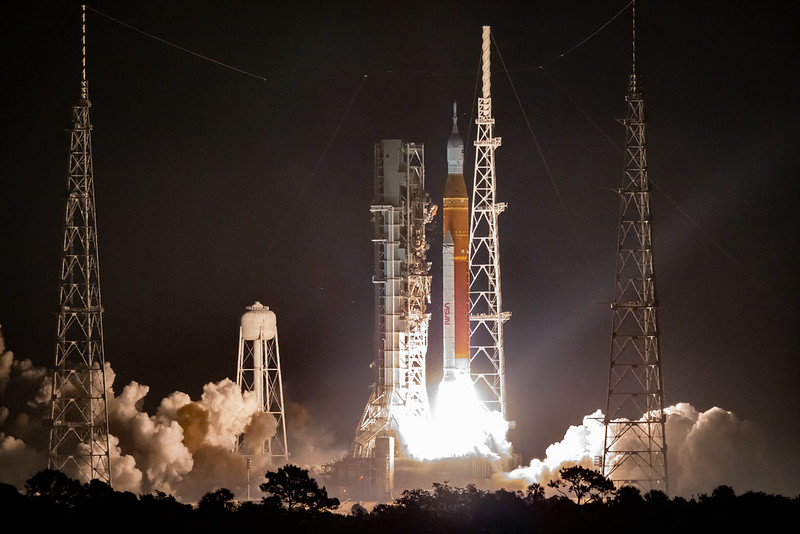
As NASA’s Artemis II launched Wednesday afternoon, the pair of aerospace engineers shifted their gaze upwards, watching those childhood dreams become reality.
It’s the first time NASA astronauts will travel to the moon since Apollo 17 in 1972. The four-person crew includes pilot Victor Glover, the first Black astronaut on a moon mission, and mission specialist Christina Koch, the first woman to do so. While raised in North Carolina, Koch was living in Livingston, Montana, when she was selected for the Astronaut Corps, according to her NASA profile. Koch was not available for comment due to preparation for her flight.
The moon mission is the second in a series of flights incrementally testing the capabilities of Orion, the next generation of NASA’s deep space spacecraft. Artemis I launched in 2022 for a successful 25-day unmanned mission to test the spacecraft’s systems.
“Now we’re at Artemis II launching … which is the very first launch where we have humans on board,” Baca said. “And then it also happens to be the very first time we’re sending a woman to the moon and, more importantly, we’re bringing her back.”
Artemis II is set for an approximately 10-day test mission where the foursome will fly around the moon and return to Earth. Artemis III, which Hall and Baca are already working on, is a future manned mission to test commercial landers, potentially made by SpaceX or Blue Origin. Artemis IV is set to launch in 2028 for the first Artemis lunar landing.
Ultimately, the Artemis mission hopes to lay the groundwork for future missions to Mars, starting by returning to the moon.
“Fun fact, the International Space Station orbits the Earth at about 200 and 250 miles above the surface,” Baca said. “If you get in a car and drive straight up, that’d be like the distance from Kalispell to Butte. That’s it. Whereas the moon is almost 250,000 miles away, so it’s like 1,000 times further and completely different physics when we try to go out that far and, more importantly, when we come back.”
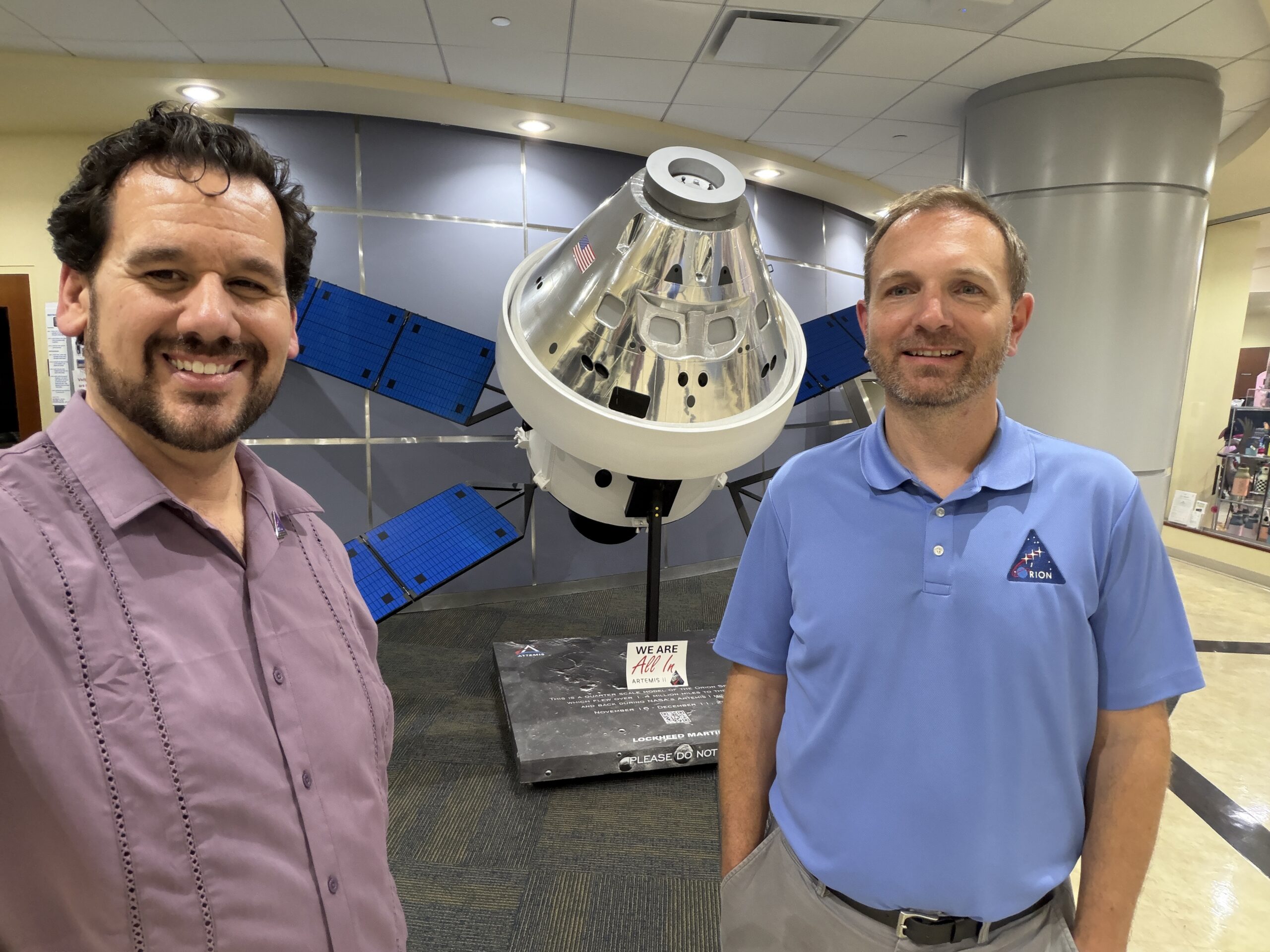
Baca recalls sitting through classes at Flathead Valley High School, where he struggled to focus and maintain good grades. He found his footing at Flathead Valley Community College, and completed his prerequisites there before transferring to the University of Montana. With bachelor’s degrees in mathematics, computer science and astrophysics, Baca studied aerospace engineering in grad school at the University of Colorado Boulder. There, he met Hall and his wife, another engineer on the Artemis mission.
After failing to make it into the Air Force Academy after his graduation from Whitefish High School, Hall attended Montana State University where he majored in mechanical engineering. With his sights set on aerospace, Hall attended CU Boulder for a master’s degree.
In 2006, NASA selected Denver-based defense and aerospace contractor Lockheed Martin to design and build the agency’s next manned flight transportation system Orion for the Artemis mission series. The company subsumed much of CU Boulder’s graduate aerospace engineering class, including Baca and Hall, who were both eager to continue living in Colorado.
“I was excited that we could stay in the mountains and still do fun stuff and aerospace at the same time,” Baca said.
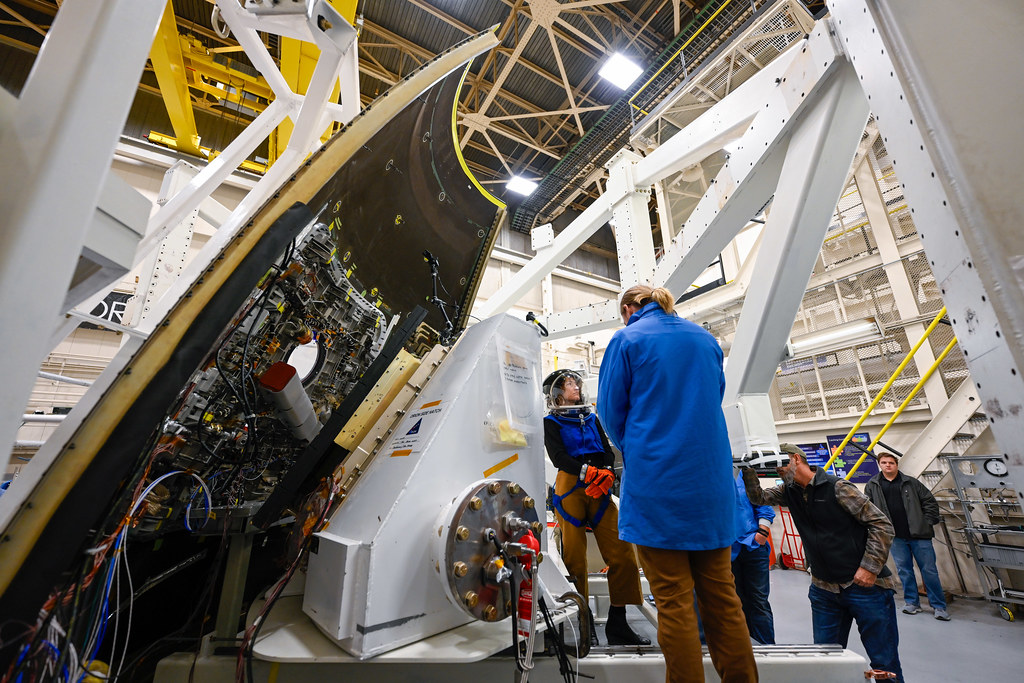
Hall works with a thermophysics group on the Orion spacecraft, serving as a fluid mechanics analyst. He’s worked on the ignition over pressure for the board motor and testing panels that deploy. Lately he’s been the lead on purges, vents and drains in the spacecraft, though Orion has few drains, he noted.
“Venting is about allowing the air to get out,” Hall said. Controlling the vents, the engineers can manage the pressure in the spacecraft as it flies from Earth’s pressurized atmosphere into space’s vacuum and back.
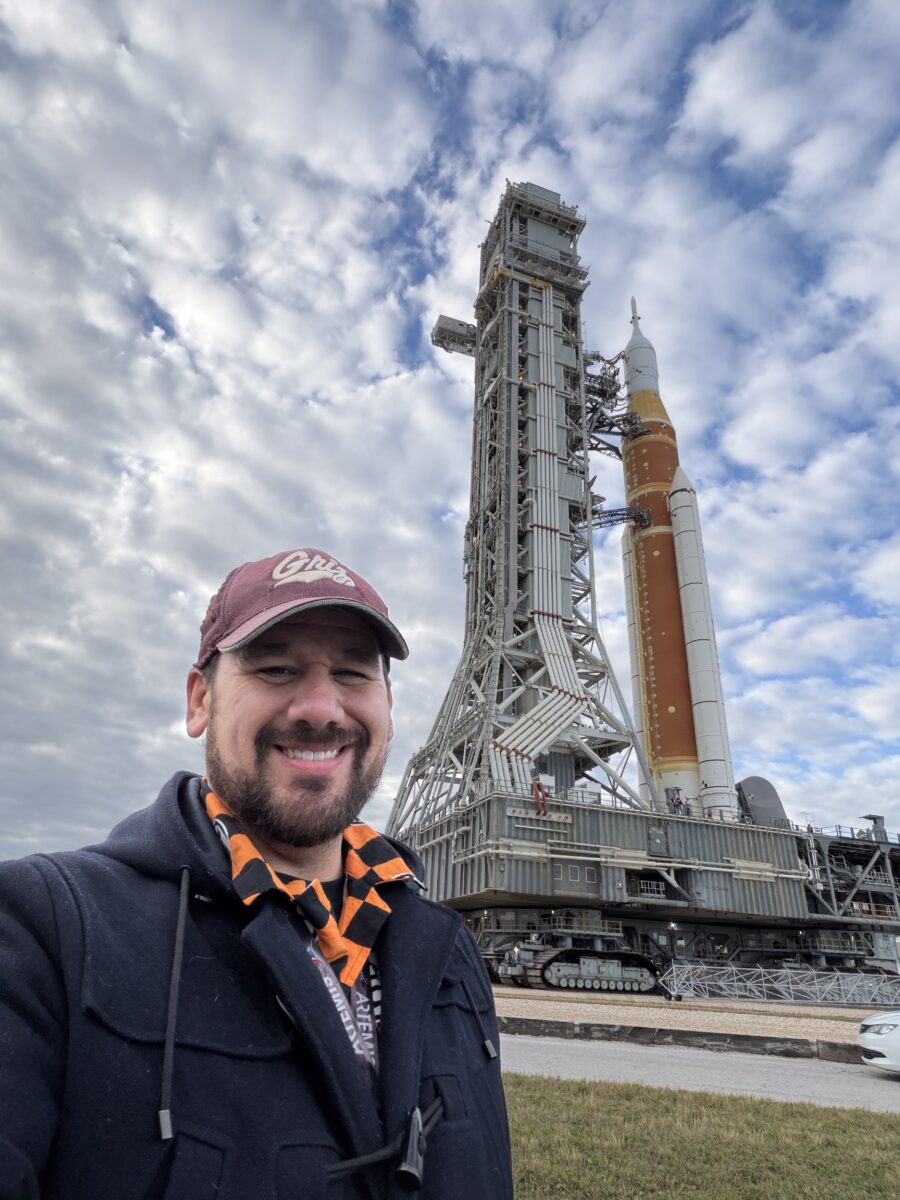
Purging helps keep the Florida humidity and other contaminants in the environment out of the spacecraft while it waits on the launch pad at the Kennedy Space Center, Hall said.
“The total amount of time that it sits exposed to the elements is quite large, and we’ve got very delicate systems inside that have to be protected,” he said. “So, the purge is effectively like HVAC — heating, venting and air conditioning — but to keep everything safe. We’re trying to keep humidity out, contamination out.”
Baca has worn many hats for Lockheed Martin, including working as a lead on the failure mode team responsible for mapping out and creating plans for worst-case scenarios. He currently serves as a lead for the European Service Module, the spacecraft’s powerhouse. The system, designed by the European Space Agency, provides the spacecraft with electricity, propulsion and thermal control in space, in addition to holding the astronauts’ water and oxygen.
Baca’s team is responsible for integrating the system into the spacecraft and ensuring that all the module’s components are aligned.
“There’s a bunch of tuning that has to go back and forth to take all of those consumables between the crew module and those gas tanks,” Baca said. “We’ve got to be able to go through the environmental controls with all the oxygen and nitrogen, make sure we’re getting the mixtures right and we’re not over oxygenating anybody or anything like that.”
On a phone call with the Beacon the day before the launch, Baca and Hall depicted an “excited confidence” in the air — with some cautiousness.
“We’ve got a sticker in the console that says, ‘caution: do not show any signs of optimism,’” Hall said with a laugh.
“I think that just kind of gets at the attitude that we have to maintain,” Baca followed. “We’ve had to do everything that we can possibly think of, and more as other random things pop up, that you know we’re very optimistic and very confident in what we’ve done.”
Reflecting on his trajectory from Northwest Montana to NASA, Hall said he feels humbled.
“Thinking back to the 12-year-old version of me, it’s hard when you’re in Montana,” Hall said. “All of this stuff seems so far away. It’s hard to imagine it’s really happening and that you could even get involved.”
“I was just this little punk skateboarder riding all over Kalispell,” Baca said. “My teachers now know that their time was not wasted.”
Baca still visits the Flathead, and said he’ll be back in the area this year to stop by for some Moose’s pizza.