Restoration Project Begins at Salish Point Park
The project, a collaboration between the Confederated Salish and Kootenai Tribes and the city of Polson, will improve the site’s dynamic equilibrium beach. The beach absorbs the energy from waves using layers of gravel.
By Zoë Buhrmaster
The Confederated Salish and Kootenai Tribes (CSKT) and the city of Polson are collaborating to restore the popular Flathead Lake waterfront at Salish Point Park.
CSKT and Polson officials first came together in 2008 to recover the Flathead Lake waterfront, an area used and subsequently abandoned by the industrial boom of the 1900s. They removed wood piled up along the shoreline, brought in gravel, and built a dynamic equilibrium beach, a way of designing shorelines to help prevent erosion. The Tribes constructed the area below the high-water mark and the city worked the land above it.
Barry Hansen, CSKT fisheries specialist and the lead on the Salish Point Park project, called the 2008 restoration a “milestone” for collaboration between the the tribal and municipal authorities.
“It came together very nicely to make that project happen, and we’re building off of that,” Hansen said. “Two agencies, Flathead Lake, environmental effects of shoreline operation, opportunities to work together — it all sort of comes together here in this project.”
Dynamic equilibrium beaches comprise layers of gravel and cobble stone that vary in size along the exposed shoreline’s gradient. Starting with pea-sized gravel at the beach, the beach slopes down into rocks that become progressively larger with the increasing depth of the water. Hydrogeologist Dr. Mark Lorang, from the Flathead Lake Biological Station, designed the beaches to absorb and disperse energy from waves, helping to prevent shorelines from washing away. Montana Fish, Wildlife and Parks has installed beaches at Woods Bay Fishing Access Site, Yellow Bay, and Somers Beach State Park, while other private lakefront property owners have also begun using the erosion control method.
“There is erosion all around the lake, not just at Salish Point,” Hansen said. “There tend to be two approaches — building a concrete seawall or building one of these beaches.”
Around the corner from Salish Point is Sacajawea Park, facing the west. Protecting the park from Flathead Lake’s swells is a high seawall. While the park is host to shade trees and a grassy, outdoor space bordering the lake, the high seawall doubles as a barrier for recreationists looking to access the water.
“Ecologically and aesthetically, we strongly prefer the beaches,” Hansen said.
He noted that Salish Point isn’t the easiest place to build one of the beaches. In 2008, crews had to bring in a large amount of artificial fill to transform a steep drop-off into a gradual slope.
“Because other sites around the lake are much easier, I tend to view this as a demonstration of how beneficial this method can be,” Hansen said.
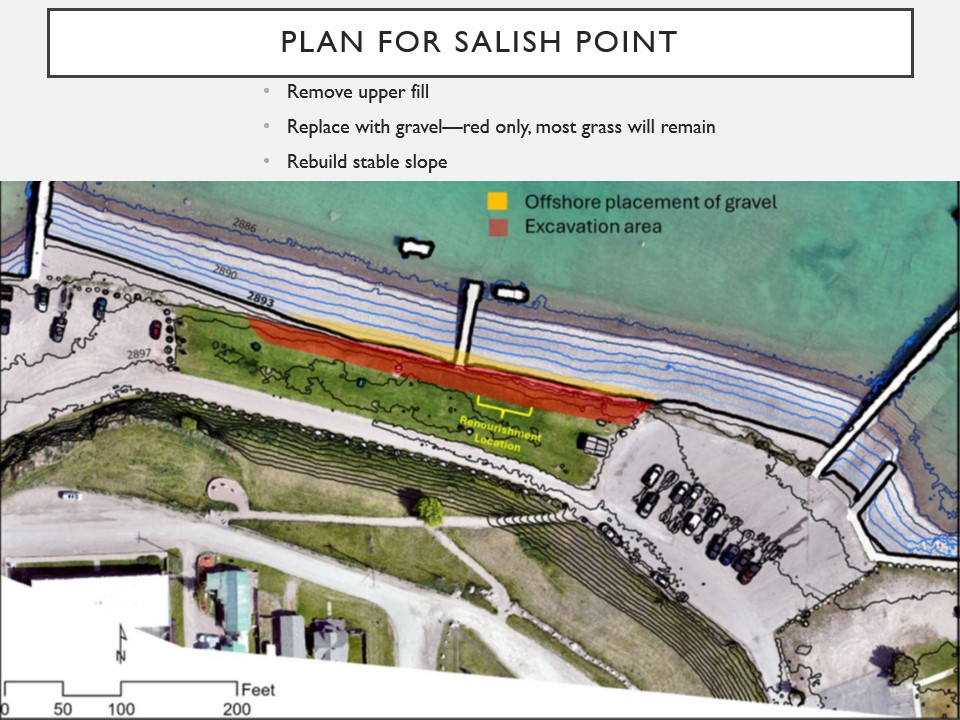
Salish Point Park faces the north. Over the last nearly two decades, wind and waves coming from the northeast or northwest have pushed gravel to the sides of the beach. To remedy the problem, Hansen said they plan on extending the slope of the beach inland to create a crescent shape.
Crews have already begun working on the project. The narrow window for developing the gravel beach is dependent on the currently low lake level, which is expected to rise in the coming weeks. Restoring the beach should take about two to three weeks, Hansen said.
During construction, recreationists can expect dump trucks and heavy equipment in the area, with temporary delays and limited access.
Part of the day-use area will be closed to the public. The CSKT and Polson city officials said they will work to minimize disruptions to perch fishing, which is currently in full swing. The boat launch and marina slips will remain open.