FWP Lays Preliminary Plans for 20,854-acre Stimson Timberland Conservation Project
The proposed easement would protect timberland in Lincoln, Mineral and Sanders counties. It is part of a broader 230,000-acre effort to conserve Stimson's inland timber base in Washington, Idaho and Montana.
By Tristan Scott
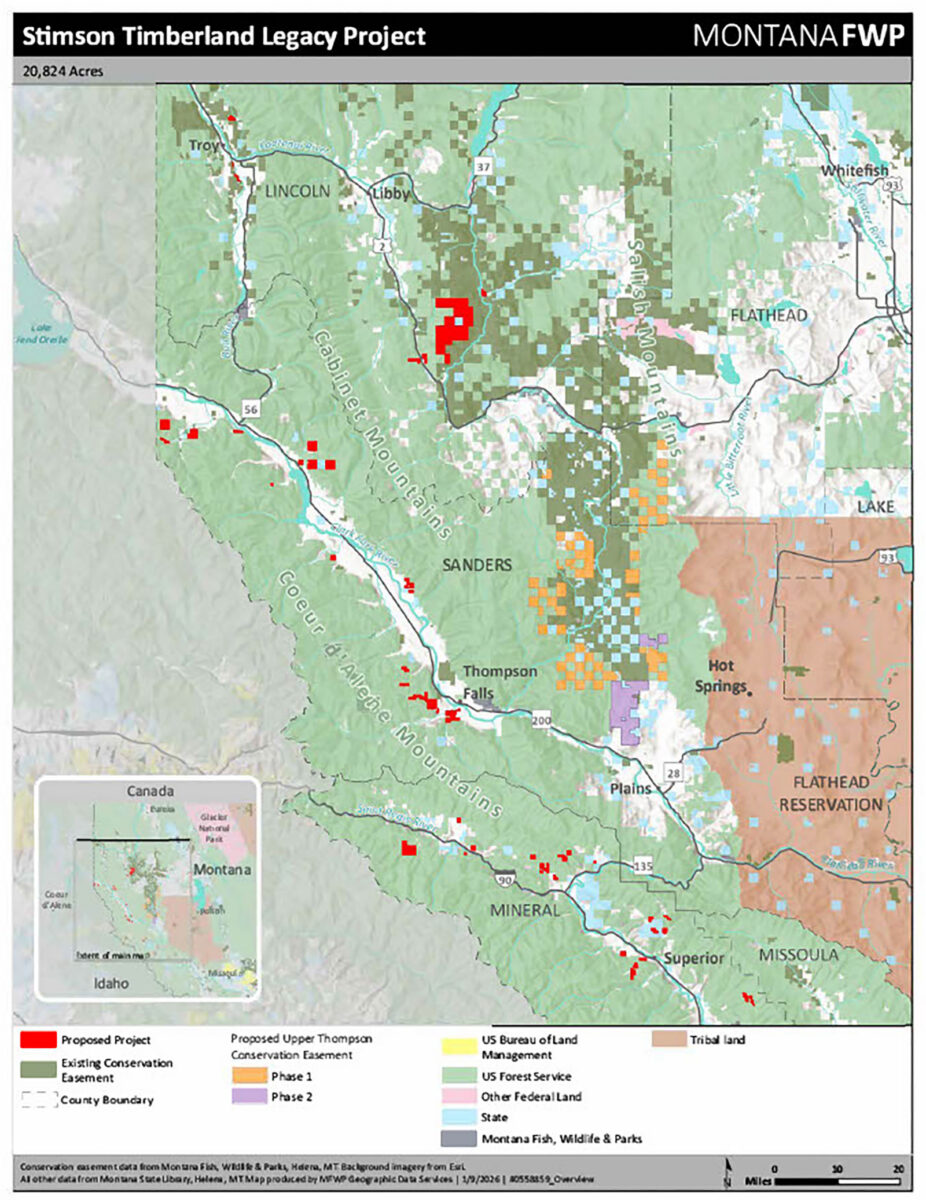
The Montana Department of Fish, Wildlife and Parks (FWP) is laying the preliminary groundwork on a proposal to purchase a conservation easement in Lincoln, Mineral and Sanders counties that would protect 20,854 noncontiguous acres of timberland owned by Stimson Lumber Company.
The proposed conservation easement, which last year was awarded a $10.2 million grant through the U.S. Forest Service’s Forest Legacy Program, is part of a broader 230,000-acre effort to conserve Stimson’s entire inland timber base in Washington, Idaho and Montana.
If approved, the easements would ensure the land remains in timber production, guaranteeing public access while restricting development rights.
“This multi-state effort will ensure that these lands continue to be managed for sustainable forestry and support the viability of regional mills through the 1.5 million board feet of merchantable Sustainable Forestry Initiative-certified timber it produces per year and generates $2.1 million,” according to the project description.
The work will connect productive timberlands, ensuring wide-ranging fish and wildlife can continue to move unimpeded through a vast forest landscape, according to the proposal, which adds that the property “will be permanently accessible to the public to enjoy hunting, fishing, hiking, biking, and snowmobiling.”
FWP is planning to prepare an environmental analysis on the project. The state agency is working with the nonprofit The Trust for Public Land (TPL) and Stimson Lumber Company to protect what it characterizes as “highly productive timberland.”
“The proposed conservation easement, to be held by FWP, would ensure the opportunity for landowners to sustainably harvest wood products, preclude residential or commercial development of these timberlands, protect important wildlife habitat and associated key landscape connectivity and provide permanent, free public access to the incorporated affected property,” according to FWP’s scoping notice.
Funding would come from the U.S. Forest Service Forest Legacy Program, as well as grant funding initiatives through TPL.
The project would conserve year-round wildlife habitat and protect a migration corridor for elk, mule deer, white-tailed deer, and moose. It would also preserve critical habitat for bull trout, grizzly bear and Canada lynx — all species listed as threatened under the Endangered Species Act.
FWP project leader Leah Breidinger said in the scoping notice that the conservation easement “would preclude the human-wildlife conflicts that come with residential development of properties within wildlife habitat, especially those with grizzly bears, black bears and mountain lions.”
The property, which is broken up into checker-boarded parcels ranging from Libby to Superior, currently provides over 6,000 days per year of public hunting access that would be secured in perpetuity under the conservation easement proposal. The project shares 115 miles of border with U.S. Forest Service and state lands, as well as 15 miles of border with other privately conserved lands.
A 30-day comment period began on April 1. Comments must be submitted, either in writing or by email, by April 30. They should be sent to: Montana Fish, Wildlife and Parks, Leah Breidinger, Habitat Conservation Biologist, Re: Proposed Conservation Easement 490 N. Meridian Road Kalispell, MT, 59901; or by email to [email protected].
Comments received from the preliminary evaluation will help FWP determine public interest, identify potential issues that would require further analysis, and may provide insight for refining the proposal or for developing and analyzing one or more alternatives. Upon completion of the preliminary evaluation, FWP will determine next steps, which may include conducting an environmental analysis with additional opportunity for public input or taking no further action on the proposed project.
Anyone with questions regarding the project or preliminary evaluation process, please contact Breidinger at (406) 751-4573 or via email at [email protected].