Columbia Falls Continues Assessment of Water and Wastewater Treatment System to Plan for Growth
Representatives from local engineering firms on Wednesday night presented findings on the current water and wastewater systems, future infrastructure needs and constraints, and proposed improvement projects
By Lauren Frick
Engineering firms on Wednesday night continued to lay out a path forward for Columbia Falls’ water and water treatment infrastructure as the city navigates aging systems, population growth and future development in its state-mandated 20-year planning process.
Representatives from local firms WGM Group and Morrison-Maierle at an open house Wednesday night presented their findings regarding the city’s current water and wastewater systems, future infrastructure needs and constraints, and proposed improvement projects.
The findings are from the city’s Water and Wastewater Preliminary Engineering Reviews (PER), which are a requirement of the Montana Land Use Planning Act (MLUPA). The 2023 legislation requires 10 cities across the state, including Columbia Falls, Whitefish and Kalispell, to plan for its projected population over the next 20 years by adhering to a series of requirements, including adopting a new land use plan and updating local zoning and subdivision regulations in accordance with MLUPA.
Through separate studies of the respective systems, the engineering firms so far have come to similar conclusions: the city will need to undertake a series of improvement projects across each system in order to effectively keep up with projected population growth — and in the case of water, to bring the current system into full compliance with Department of Environmental Quality (DEQ) criteria.
“The city needs to meet these requirements, some of which are not met for current conditions,” said Stephanie Reynolds of WGM Group, which has been studying the city’s water system for the last seven months. “Since current conditions require improvements to the existing water system, we want to plan the infrastructure upgrades to take the future conditions into account.”
The firms’ findings for each system are based on a growth rate of 2.3%, which results in a projected population of about 9,000 people in 2045 based on the current population of roughly 5,700 people. This 2.3% growth rate allows for more wiggle room than the 1.8% used in the city’s land use plan efforts.
As each firm begins wrapping up their reports in the next month, a key next step will be further defining proposed improvement projects and, most importantly, identifying estimated costs.
“We will have engineers preparing a probable cost for each of the projects that we identify,” Reynolds said. “We will use that as a basis to go after funding opportunities, so that becomes pretty critical.”
Water system projects that WGM Group will look at fleshing out include adding new wells, adding a new tank and upsizing existing mains, Reynolds said. These projects will help address supply capacity and storage capacity issues, as well as fire flow deficiencies, which relates to the volume of water available at a specified residual pressure, typically 20 psi, for manual firefighting operations.
As part of its report, WGM Group studied five potential locations for a new water tank — three for ground level tanks and two for elevated tanks — ultimately deciding a ground level tank near the current tank northeast of town would be the best location.
“The current storage tank was installed in the ‘90s,” Reynolds said. “Within the 20-year planning timeframe, it will need some rehab, and that rehab means it needs to come offline, and unless you have another tank to serve the need, that’s not going to happen. So I think that further emphasizes the need to invest in tank infrastructure.”
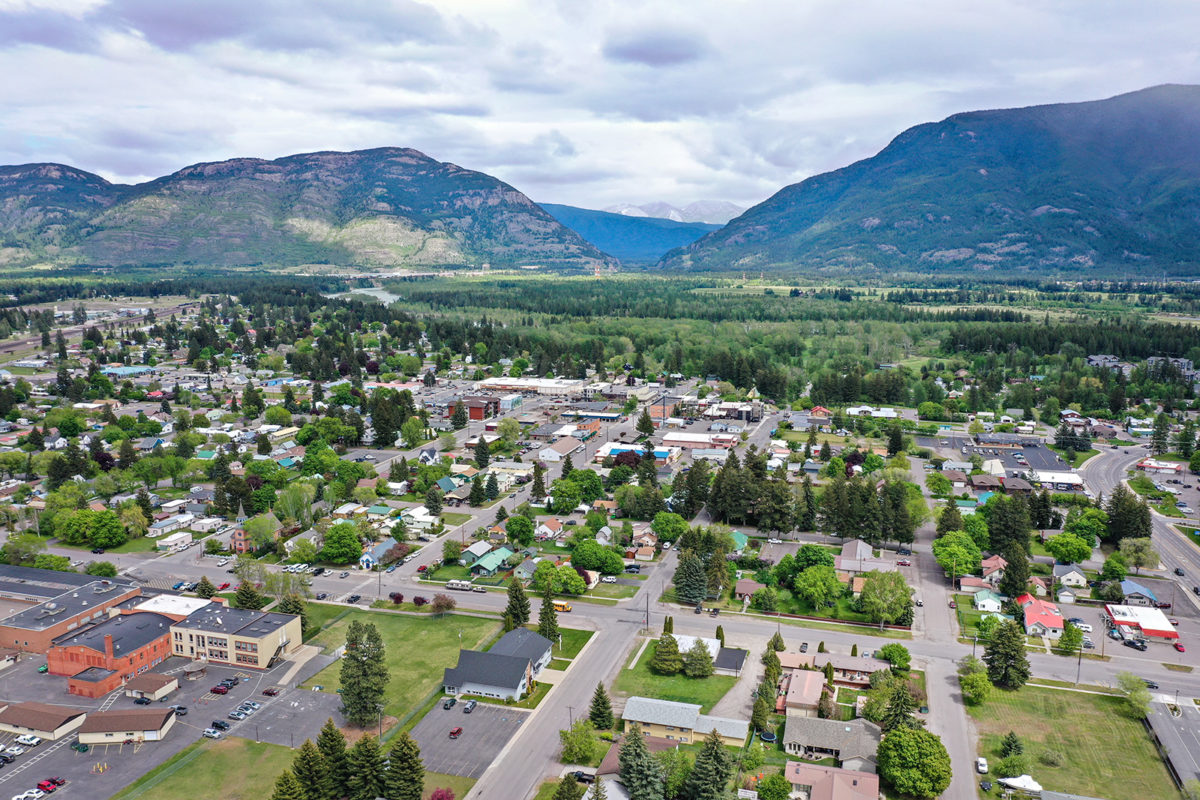
Heading into Wednesday’s open house, it was the wastewater treatment plant that had stirred up the most discussion since the first public utility infrastructure meeting in November.
Earlier this year, city staff, the planning commission and city council began working through the realization that the city’s current wastewater capacity for a population growth of roughly 1,894 people would be short of the more than 2,000 people accounted for in approved and current/near-term development applications.
Exceeding the wastewater treatment facility’s maximum capacity would hamper its ability to remove nitrogen and phosphorus from the material — not its handling of liquid content. Limited availability for nitrogen removal as the city grows is still cause for concern, however, since the city’s wastewater plant discharges directly in the Flathead River, meaning it’s held to a high standard by the state on its nitrogen discharges.
To address the discrepancy, city councilors in January agreed with a path forward approved by the planning commission, which includes prioritizing infill development, as well as multifamily housing and townhomes, and preserving reserve capacity for future development opportunities.
But while the councilors’ direction addresses the problem in the short-term, the city is now working toward a permanent solution through its MLUPA process.
In the Wednesday update from Morrison-Maierle, representatives presented 13 projects ranked on a priority scale that engineer Rika Lashley said was based on a mix of factors, including cost, risk and urgency.
“As we go down the list, urgency, priority and risk starts to drop,” Lashley said. “All of them address needed things. None of them can just be postponed indefinitely.”
The project ranked at the top of the list by the firm is a capacity study for the roughly $4 million bioreactor expansion project that was completed in the fall and aimed to increase its capacity to treat nitrogen in the water. City officials have already expressed the city’s plans to complete the study after the first year of operation for the bioreactor, which City Manager Eric Hanks said was roughly four times better at nitrogen removal than the engineering model had predicted.
“You design these things, and you have design values, then you have the real plan, and it’s typically different,” Lashley said. “Luckily, in a lot of places, I’ve seen it perform much better, which is good for you guys. That might mean you have a little bit more time before you need to add on an expansion, but that capacity study can determine that. So it’s pretty important to figure out how soon the next step towards adding a second bioreactor needs to happen.”
On the firm’s project list, the addition of a second bioreactor was paired with an upgrade to the Supervisory Control and Data Acquisition (SCADA) system, which provides centralized, real-time monitoring and control of geographically dispersed assets like pumps, sensors and treatment processes. The combined project ranked fourth on the firm’s suggested priority list.
“The reason they’re sitting so high is because they have a high cost and because planning for how this cost will be covered is going to have to start right away,” Lashley said. “Essentially, they might be needed in two to four to five years, and it typically takes that long to get this much funding in place, so it’s important that they are being looked at right away. That doesn’t mean they’re going to get paid for and constructed right away.
“They’re also high, for the bioreactor one, because that is the capacity piece. We don’t want to end up with Columbia Falls having to have a moratorium on development because there is no treatment capacity. That is why the risk category is rated high.”