Whitefish to Host Open House for Potential Railway Crossing Improvements
Residents can go to City Hall from 5 to 7 p.m. on May 20 to provide feedback on a range of projects, including a potential overpass at East Second Street, aimed at addressing safety and access limitations at railway crossings in the city.
By Lauren Frick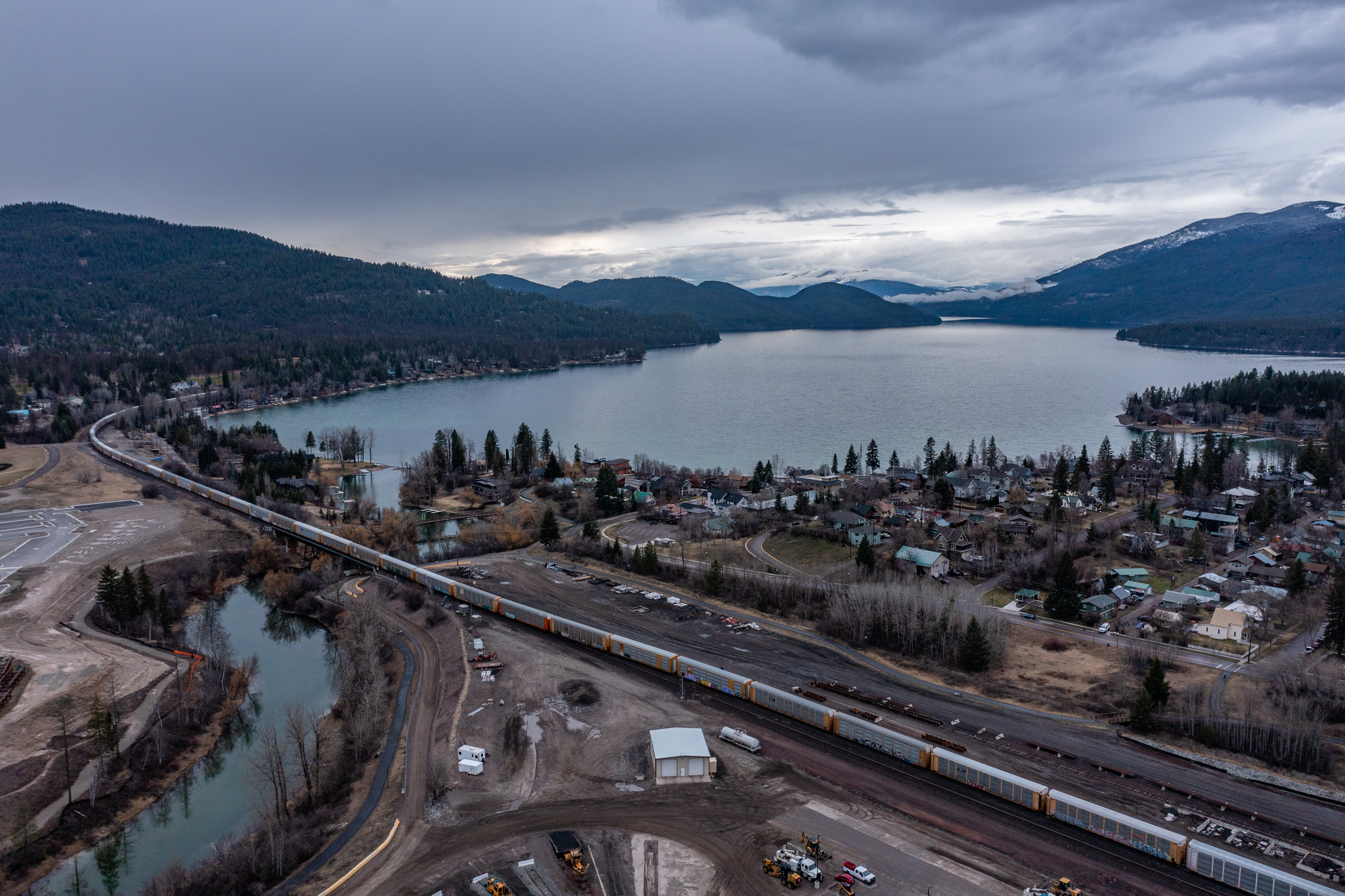
The city will host an open house next week for community members to give feedback on a series of proposed designs for short and long-term improvements at railway crossings throughout the city.
The open house, which will be from 5 p.m. to 7 p.m. on May 20, will serve as one of the final steps in a nearly year-long process to identify barriers to emergency services and wildfire evacuation, as well as mobility and access limitations the city’s rail crossings may pose to businesses, housing, education, and recreational areas.
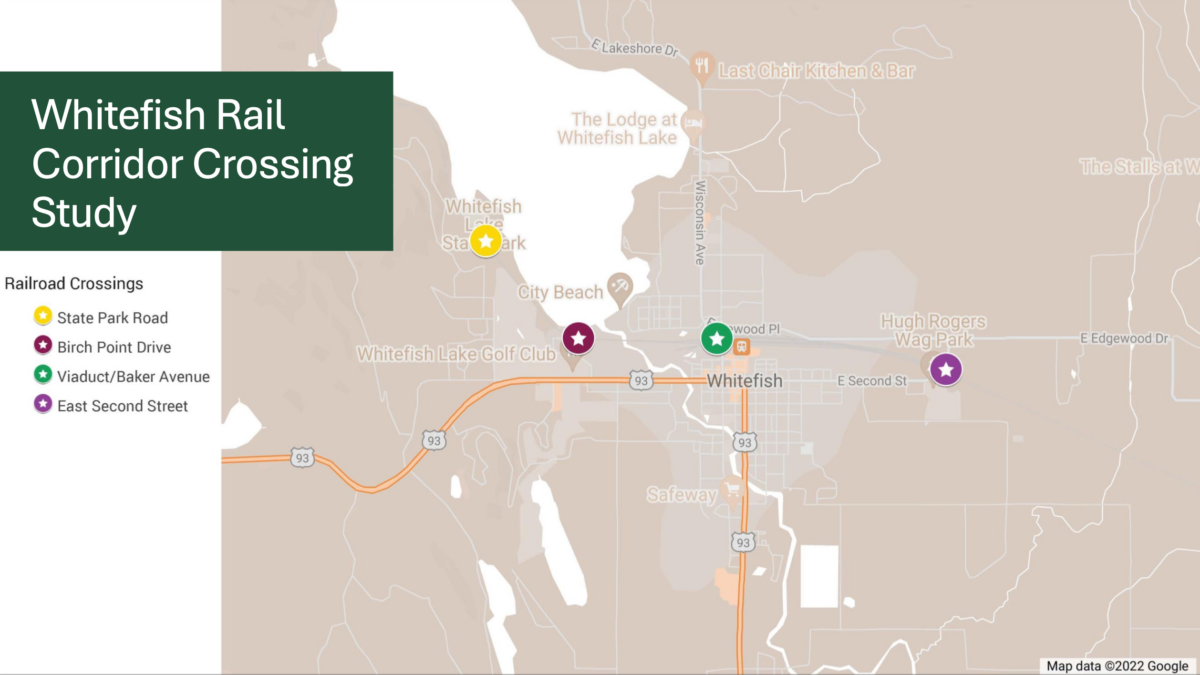
With the help of a $400,000 grant from the Federal Railroad Administration (FRA), the city in partnership with HDR Engineering narrowed the study to focus on four prominent railway corridors in Whitefish: Birch Point Drive, State Park Road, East Second Street and the Baker Avenue Viaduct.
As part of the study, the firm surveyed 102 residents between Feb. 2 and March 2 to better understand community member’s perception on the safety and accessibility of each railway crossing, as well as what should take priority when planning for improvements.
The survey found that Baker Avenue and East Second Street receive the most use, with roughly 55% of respondents saying they use Baker Avenue daily and 31% of respondents indicating they use East Second Street at least weekly. More than half of respondents said they use State Park Road and Birch Point Drive “rarely.”
Survey results also indicated that “reducing train wait times” was overwhelmingly the priority for improvements at both East Second Street and Baker Avenue. Improving bike and pedestrian opportunities ranked highest for State Park Road, while “no improvements” ranked highest for Baker Avenue.
Now, the city and engineering firm are looking for public feedback one more time before concluding the final report, namely looking for input on potential improvement projects since “budget and resources do not exist to implement all of the design concepts.”
“Rail crossings are an important piece of infrastructure supporting both commerce and daily travel within our community, and we are seeking the public’s input on how to potentially improve these crossings for enhanced mobility, connectivity and safety,” Public Works Director Craig Workman said in a press release. “We encourage all area residents to attend the open house to learn more about these rail crossings. Your input and comments have the potential to shape future projects and planning.”
The design proposals for each crossing were evaluated for potential improvement based on a variety of criteria including delay times, environmental impacts, drainage, ease of construction, emergency services access, bike and pedestrian access, and cost, the firm said in a press release.
The potential improvements recommended by the engineering firm include a range of scales and costs, from low-cost maintenance, “no-build” improvements for Baker Avenue and State Park Road, to installing a roadway overpass at East Second Street.
In a brief discussion about the recommendations by the city council on May 4, some councilors emphasized the importance of focusing on the completion of easier, “low hanging fruit” types of projects; however, the much larger task of an East Second Street overpass still loomed over the conversation.
While the overpass concept and design is still in its early stages, the project is estimated to cost around $30 million, Workman told councilors. The city will likely be responsible for about 10-20% of the cost, depending on if the burden can be split with BNSF. This, however, is also dependent on federal funding, with key application deadlines approaching in June, he added.
“Ultimately, if we want a crossing to be separated at East Second Street, now is our opportunity to talk to [the Federal Railroad Administration] and BNSF because I think some of those funds are going to dissolve here quickly,” Workman said.
Councilors agreed that a major improvement to East Second Street and an additional way to get over the railroad tracks is something that’s needed — especially when planning for the next several decades of projected growth — but acknowledged it could be a challenge to package the project in the right way to get residents on board.
In the engineering firm’s survey, 35% of respondents agreed the East Second Street crossing should be the priority for improvement. Additionally, 53% of survey participants said they’d support a local bond issue and local funding opportunities if grant funding is not secured for the series of improvements.
“Yes we need it, but how do we sell it?” Councilor Andy Fuery said at the May 4 meeting. “And ultimately, how do we fund it?”
The Whitefish Rail Crossing Study Open House will be held on Wednesday, May 20, from 5 to 7 p.m. at the city council chambers in City Hall, 418 E. Second St.