Can Glacier National Park Crack its Congestion Crisis by Scaling Up its Shuttle System?
Park administrators have shelved a post-pandemic vehicle-reservation pilot program in favor of a new plan to expand parking and grow its shuttle network. But without any guaranteed federal funding, some stakeholders worry they're moving forward without fallback plan.
By Tristan Scott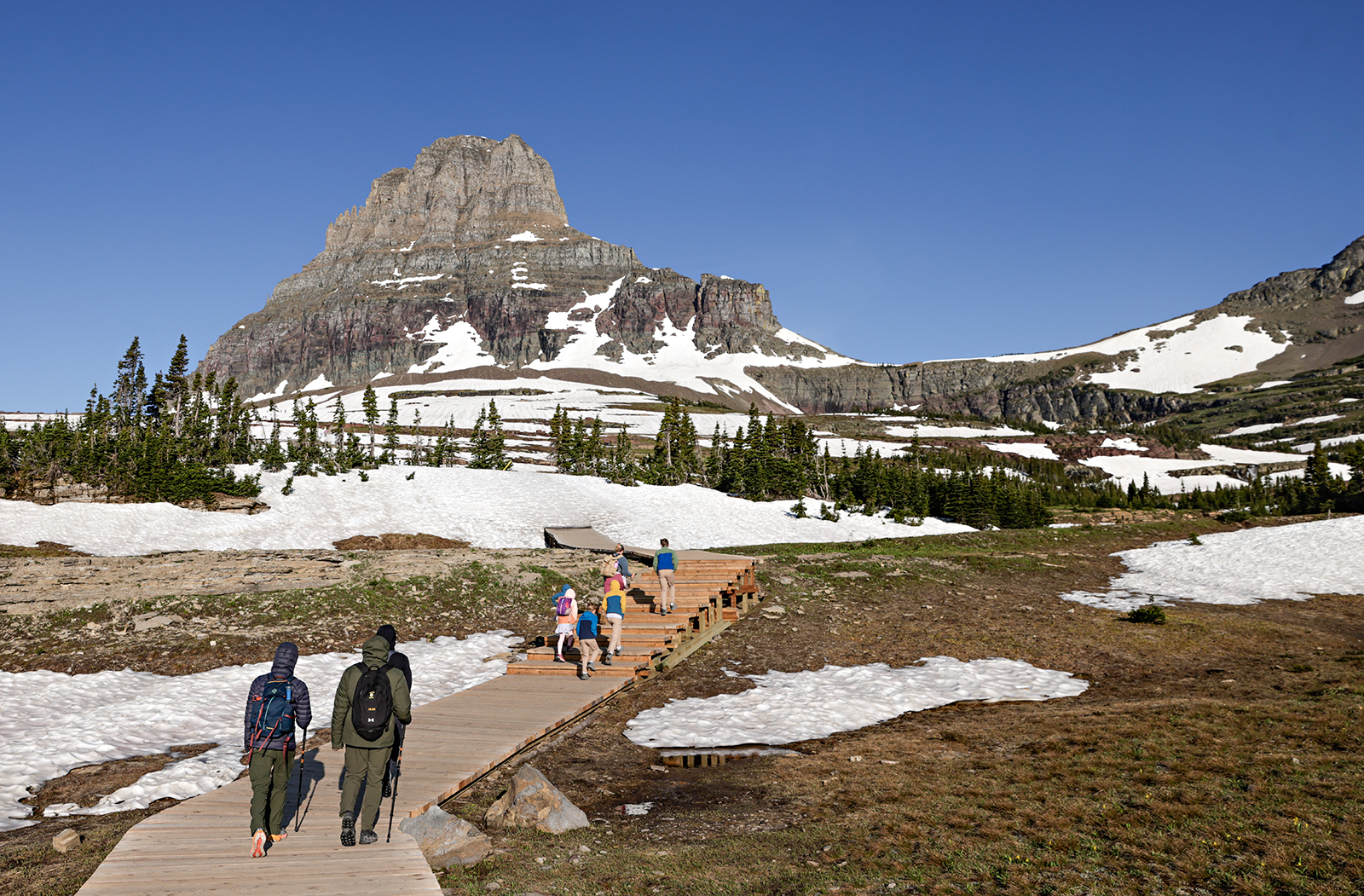
As Glacier National Park administrators scuttle plans for a vehicle-reservation system they’ve been beta-testing since post-pandemic crowding reached a tipping point in 2021, they’re crafting a long-range strategy that doubles down on an untested proposal to shore up the park’s overburdened shuttle network and expand parking in the Going-to-the-Sun Road corridor.
Visitors will encounter a silhouette of that proposal this summer when, for the first time in a half-decade, they can drive through all of the park’s entrances without a vehicle reservation. But they’ll confront other changes in 2026, including parking restrictions at Logan Pass and a new reservation-only shuttle system.
Still, with the rollback of vehicle-reservation requirements, which took a slightly different shape each summer as park officials refined a strategy to manage congestion and break up gridlock, Glacier National Park Superintendent Dave Roemer said the long-term goal balances parking predictability with resource protection, and visitor experience with visitor capacity.
“I think it’s fair to say that most people in the community would like us to graduate from piloting different methods of access and instead provide a long-term predictable solution for access to key destinations in the park,” Roemer said at a recent community meeting in Kalispell. “And I think my staff would agree with you. It’s a lot of work each year to be wrapping up summer and already feeling the pressure of trying to lock in our system for next year. Well, we’ve been talking about this for a while. And it all leads us to where we are now.”
For the park’s planning specialists, “where we are now” looks a little like where they’ve already been. But to hear Roemer and his team describe the path forward, it’s where the park is going that’s important.
The new proposal, which magpies elements of a pre-pandemic transportation plan while drawing from a deep well of community input, could be approved as early as next winter, with phased implementation beginning next summer. In addition to signaling a total departure from the vehicle-reservation system the park has been optimizing over the past half-decade, the new proposal would restrict personal vehicles in the park’s alpine reaches by setting a three-hour time limit at Logan Pass while implementing a lottery for longer-term parking. Critically, it would scale up an outmoded shuttle network to ferry visitors between the park’s most popular destinations while adding hundreds of new parking spaces at key locations near park entrances and in outlying valleys. And it would establish a bicycle-only season during which personal vehicles would be prohibited.
Without any guarantee of federal funding, however, stakeholders worry they’re moving forward without a fallback plan.
Glacier Park launched its current fleet of 36 shuttles in 2007 to mitigate congestion during the rehabilitation of Going-to-the-Sun Road, the park’s only alpine thoroughfare connecting its east and west entrances. With an annual operational cost of $1.7 million, the shuttles are funded through visitor entrance fees, which, according to Roemer, “is not very sustainable for us.”
“While people have loved the shuttle system, they’ve also found a lot to not love about it,” Roemer said, including long wait times, a narrow schedule and unreliable service. To improve the system, park officials are proposing adding between 540 and 600 new parking spaces at strategically located “hiker hubs” near the east and west entrances. From those hubs, visitors would be served by a reservation-based “alpine delivery system,” Roemer said, as well as by lower-elevation “circulator shuttles” available on a first-come, first-served basis.
The park would also add 150 park-and-ride spaces in outlying valleys such as Two Medicine, East Glacier and Many Glacier, where Roemer noted the park recently added 170 new parking spaces to the Swiftcurrent area, with a total of 339 spaces available this summer. (The park currently has approximately 2,250 spaces.)
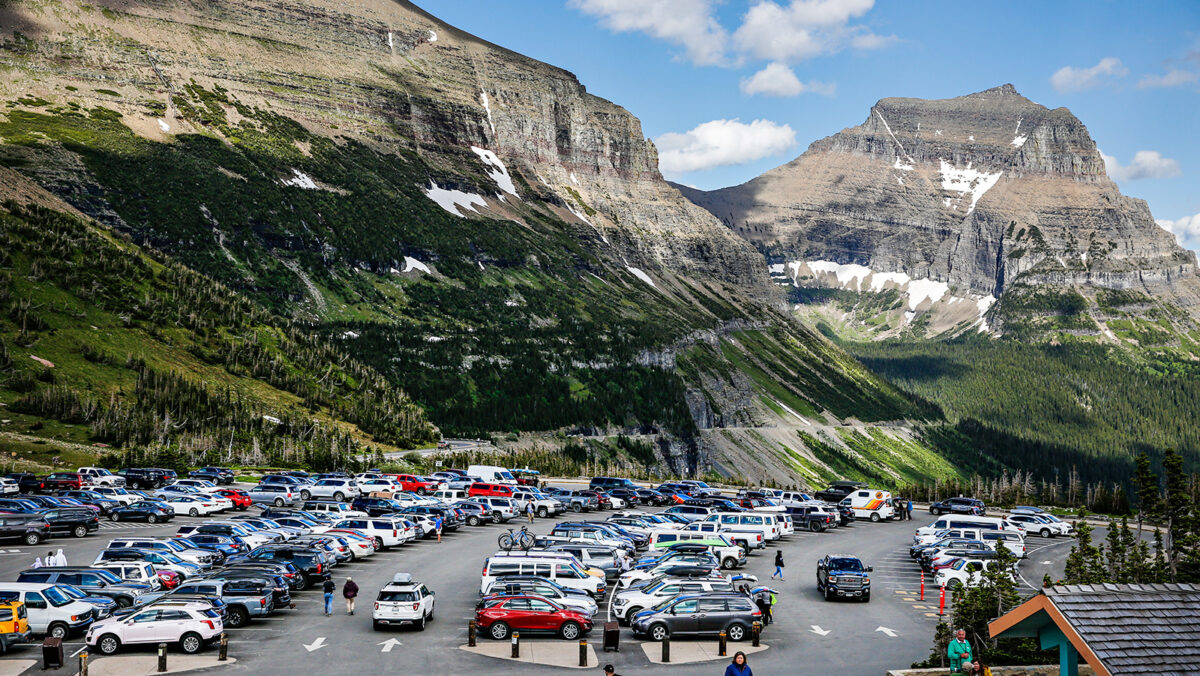
Meanwhile, half of the parking spaces at Logan Pass Visitor Center would be available through a lottery to accommodate personal vehicles that require parking for more than three hours, while the other half would be available on a first-come, first-served basis under a three-hour time limit.
Park officials will test the three-hour Logan Pass parking limits for the first time this summer. Although Roemer was reluctant to discuss the details of the park’s enforcement plans, he warned that “scofflaws” could return to their vehicles to find them immobilized by a parking boot.
“I have heard that scofflaws are planning to take advantage of our ability to enforce the time limit, and to that I would just say that it will take a commissioned ranger to put a boot on a car, and it will take a commissioned ranger to take a boot off a car,” Roemer said. “And it’s not unreasonable to model a day on Logan Pass in which a ranger puts a boot on the car and then gets called away for multiple hours. That could be a real bummer.”
The park currently has the transportation infrastructure to “deliver somewhere north of 780 people” to Logan Pass per morning, which matches the threshold for management action on the Highline Trail, the park’s most popular alpine hiking route that begins at Logan Pass. It’s also the same daily average use the Highline Trail received in 2017, when the park set its all-time record for visitation with more than 3.3 million people. In July 2017, visitation hit more than 1 million people in a single month. In the past decade, the park has recorded more than 3 million visitors five out of the 10 years.
“So, knock on wood, if everyone who gets on a shuttle to Logan Pass is a Highline hiker, then we will have piloted just about the perfect system for the Highline for any summer in Glacier Park, now and for future years,” Roemer said. “By adding between 560 and 600 parking spaces at hiker hubs on the east and west sides, we’ll also be able to deliver people to other alpine areas; not just the Highline, but at some other stops along the way, like Siyeh Bend.”
“We’re trying to work backwards from what the right capacity is for those destination trails, and then build the transportation system so that people can arrive at the park’s hiker hubs, reliably find the transportation they need to do their thing, and then go do it,” Roemer said.
WHAT DO THESE CHANGES MEAN FOR NORTHWEST MONTANA?
We’re committed to highlighting our great outdoors and the policies and conversations shaping it. And you can help! Become a member to support more reporting on public lands and keep you and your neighbors in the loop and on the trails.
But some stakeholders worry that, by working backwards, the park is overlooking an essential step toward moving forward: funding.
On Thursday, after months of warning from park advocates across the country that national parks are in dire need of financial support, a U.S. House of Representatives subcommittee rejected dramatic cuts proposed by the Trump administration. Instead, the House Appropriations Subcommittee on Interior, Environment and Related Agencies maintained funding at $2.9 billion, which represents a 1.3% overall reduction to the National Park Service budget.
Even as park advocates commend Congress for rejecting the steepest budget cuts, they’ve been warning of a deepening crisis for years.
“Just last year, members of Congress came together to pass a budget that supported our parks and their staff. They must do it again,” said John Garder, senior director of budget and appropriations at the National Parks Conservation Association (NPCA). “Our parks and the people who protect and keep them running deserve more investment, more protection and greater commitment to their future.”
NPCA Glacier Program Manager Sarah Lundstrum attended this week’s community engagement meeting and expressed concerns about the proposal, in part because it hinges on a pair of assumptions: that funding will be available to revitalize the park’s floundering shuttle system and expand parking, and that this summer’s untested visitor-access system will work.
“And those are pretty big assumptions,” Lundstrum said. “They’re doubling down on this summer’s plans without knowing whether the plan is going to be effective, and they’re proposing a long-term solution without knowing that the money is going to be available. And it’s wholly dependent on the money being available.”
For Roemer’s part, he acknowledged that the plan is in its preliminary stages.
“Let me be clear, we don’t have a fully baked plan right now,” he said. “There’s not a stack of paper that we’ve already written and reviewed. We’re still early in the process. But we do feel like we’ve identified what our preferred alternatives would be. And it involves making heavy investments in the park to increase the parking capacity and increase the number of shuttles and shuttle services to effectively serve the people that come to the park and help them get where they want to go.”
“Approval of the plan doesn’t mean approval of the money, but it does help to show that we’ve already done this preliminary work,” Roemer added. “And we’ve heard from our gateway communities and stakeholders. The people have spoken to the need for this level of investment in order to solve these issues for us.”