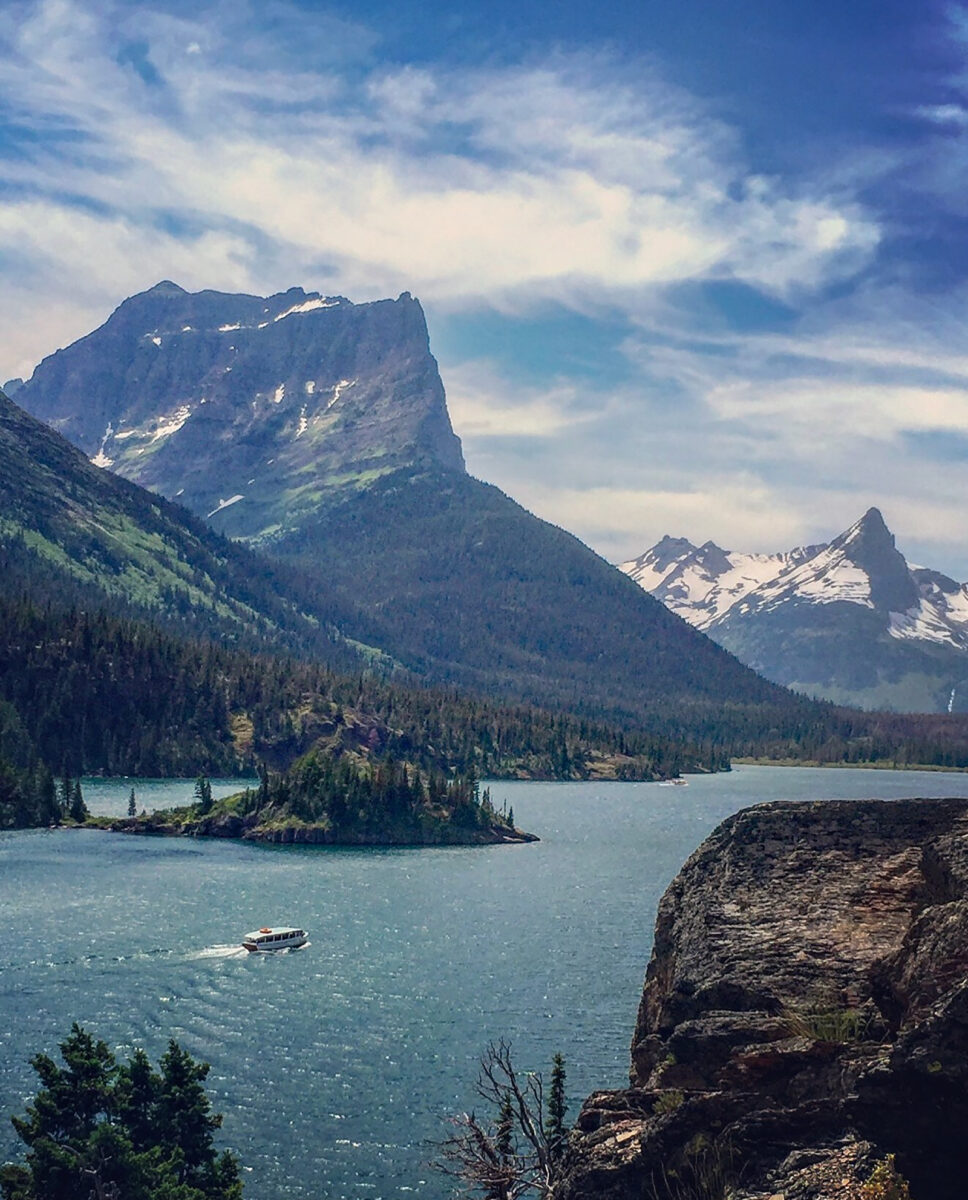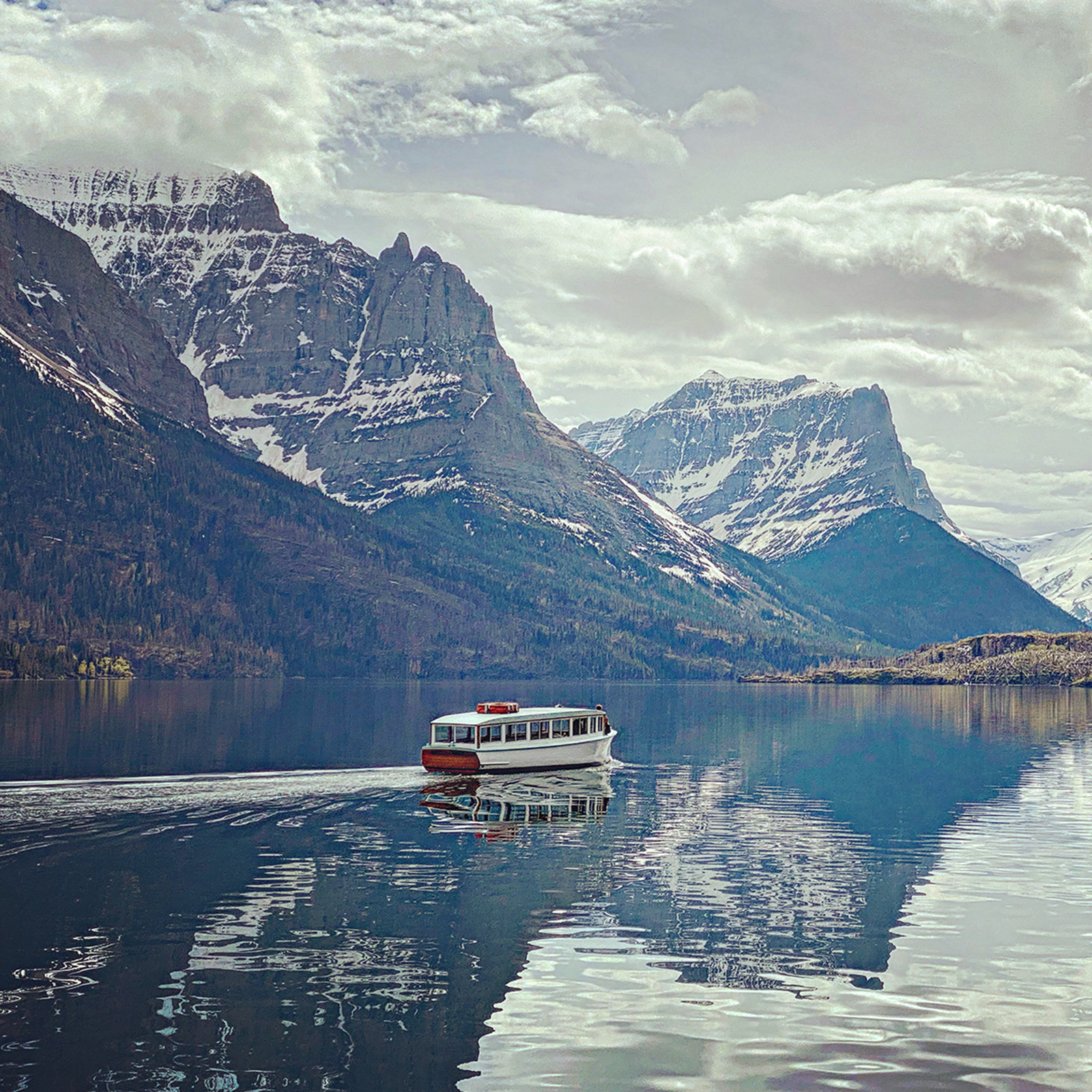
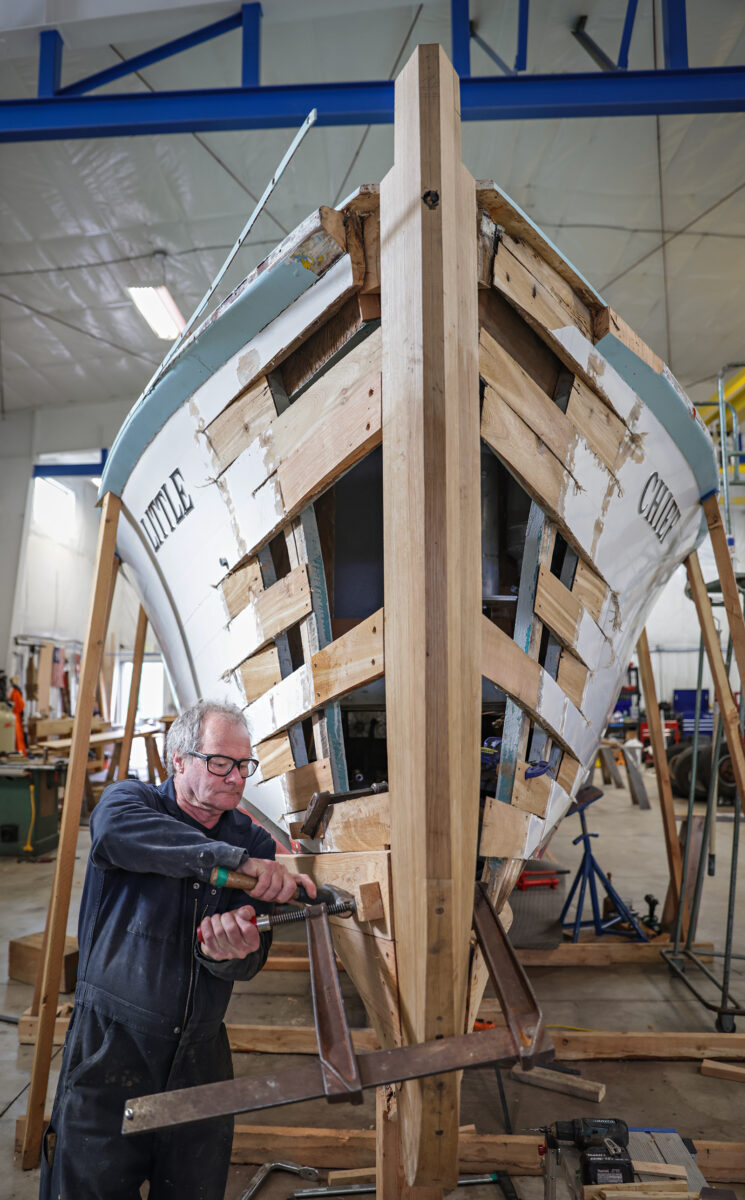
Rays of sunshine peaked through the clouds of a gloomy, brisk February day, illuminating the darkened outline of wood planks temporarily absent from the deconstructed bow of the Little Chief — one of the oldest wooden boats in the Glacier Park Boat Co.’s fleet.
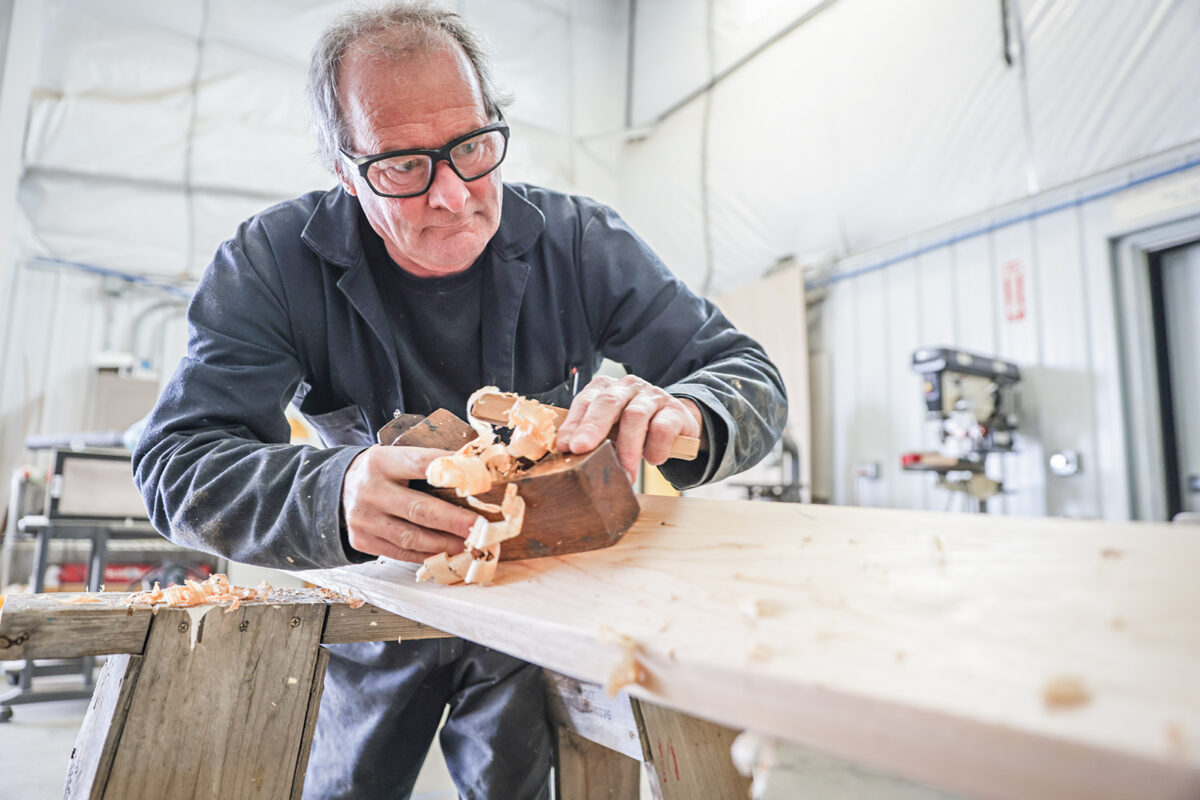
Nearly hidden by the 45-foot vessel was Andy Lyons, who meticulously carved the finishing touches into a wood plank with an unnatural, yet purposely crafted curve.
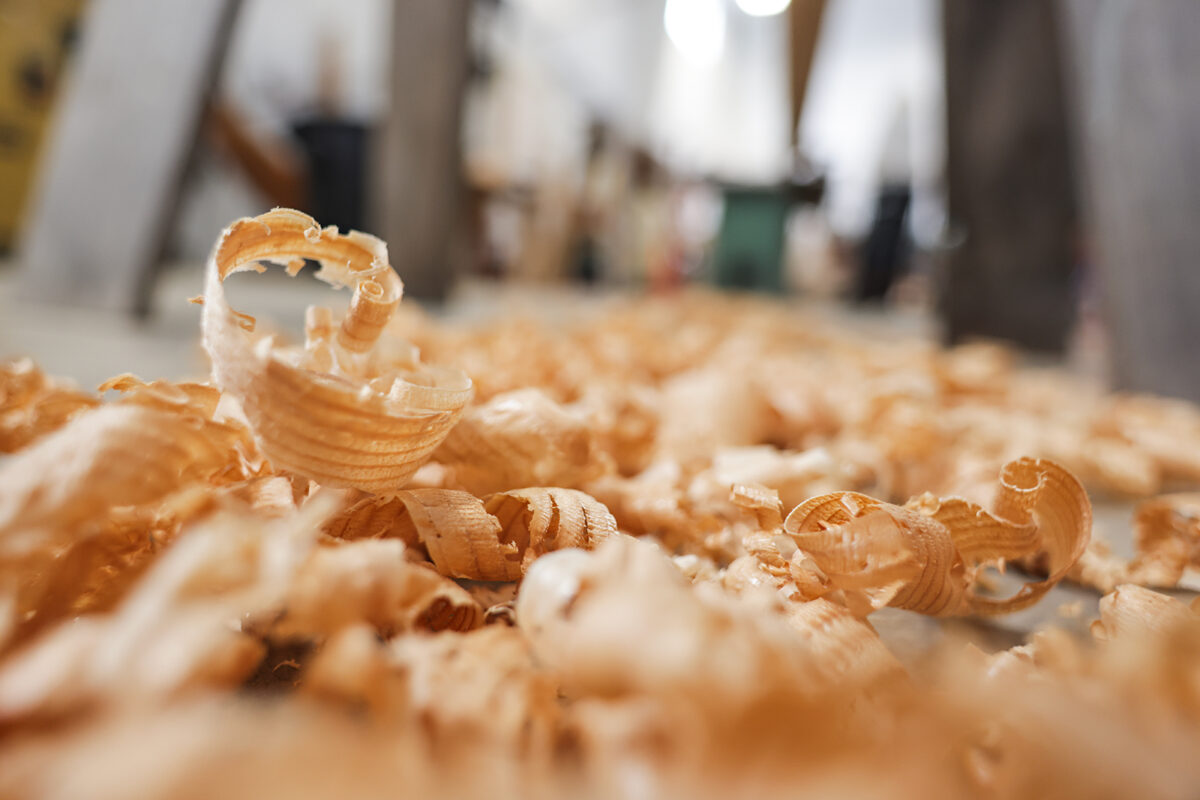
The sharp tool quickly scraped the plank’s surface — a cadence marked by staccato, measured strokes from the hand of a man more than 40 years into his craft. Thin wood shavings lazily drifted to the floor as the smell of cedar filled the otherwise quiet workshop in Columbia Falls.
“You just have to stick to it,” Lyons said about the process of restoring antique wooden boats. “You just have to motivate yourself to keep moving and picking away at it. There’s no real secret to it.”
Lyons was brought in from Martha’s Vineyard in Massachusetts by the Glacier Park Boat Co. to assist in Little Chief’s restoration ahead of its 100th year servicing Glacier National Park’s visitors.
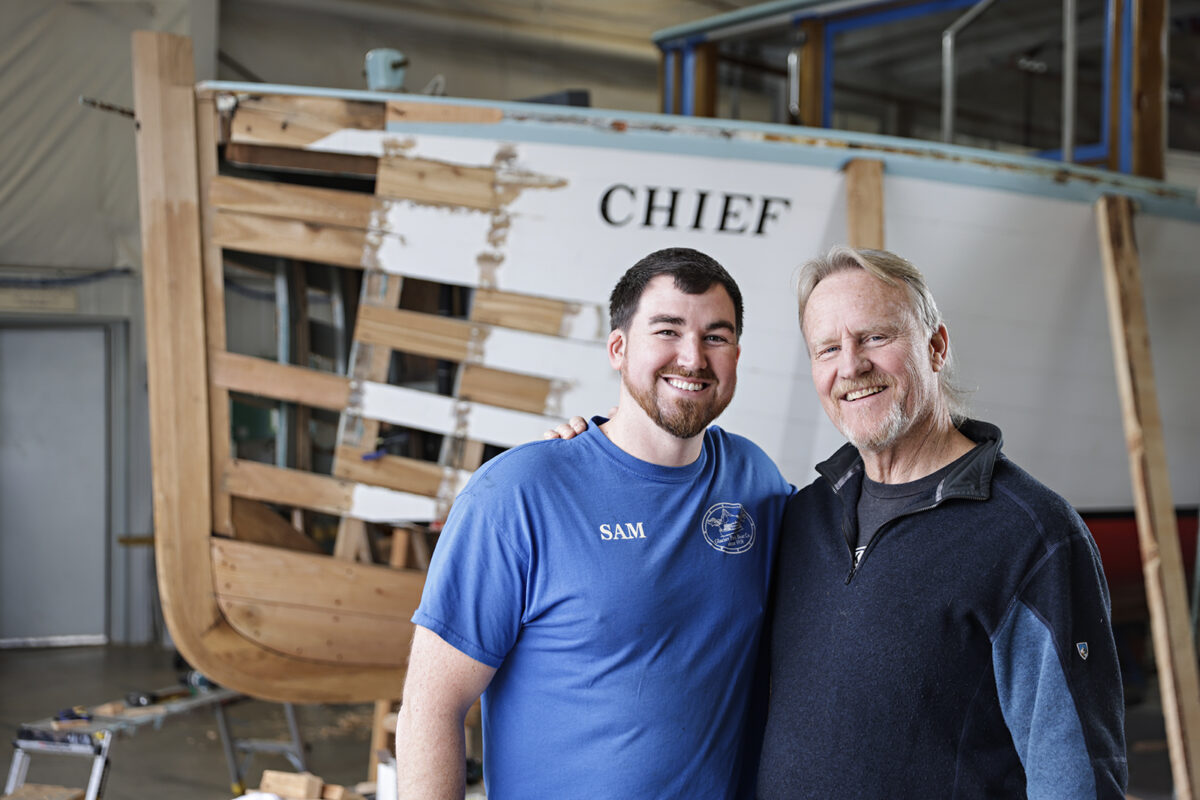
From December until Little Chief returns to its home on St. Mary Lake in May, Glacier Park Boat Co.’s eight-person in-house team, which includes Lyons and company shipwright Sam Wagner, will catalogue between 2,000 and 2,500 hours to restore the vessel’s bow.
“With this bow, we knew we had an issue developing with the keel and in the stem, and we were able to do kind of stopgap issues with it where it’s still safe to operate, but we knew we were coming up against this real major project,” said company owner Scott Burch, the son of its previous owner Arthur M. Burch and the grandson of its founder Arthur J. Burch. “So as it so happened, it was this year, when the boat’s 100 years old, that we’re doing this major overhaul to it.”
Over the course of the spring, Burch’s team will take sturdy wood planks and “make them a noodle” through high heat and steam, shaping the piece with clamps for an airtight fit into the Little Chief’s existing puzzle design. The crew will opt for the hand placement of screws, as opposed to the latest technology, in order to “have the ultimate feel” of the screw’s tension in the wood as it is placed alongside the other screws hand-crafted for the boat when it was first built.
The diligent, exhausting process of molding and arranging is nearly identical for those who crafted the vessel a century ago.
“We might spend a little more time doing it than they did because we don’t look at them as being so disposable, because the guys who built this boat, they didn’t expect it to go 100 years,” Lyons said. “If it went 20, they probably figured they did their job. I think the only difference is we’re trying to make them last even longer.”
Little Chief was built in 1926 by Captain J.W. Swanson of Kalispell — a prolific boat builder who constructed many of Glacier’s historic boats, including four of the current vessels — and has operated in the park ever since. Originally named Rising Wolf after the massive mountain that flanks the entire north shore of Two Medicine Lake where she operated, the boat was rechristened Little Chief in 1976 after moving to St. Mary Lake where the mountain Little Chief is a prominent feature of the view. In 2016, Little Chief became the first boat from the State of Montana to be added to the National Register of Historic Places.
Once built to be a main source of transportation throughout Glacier National Park, wooden boats like Little Chief evolved their purpose to endure and become a park staple, carrying more than just passengers, but instead a history and legacy maintained by the Burch family’s Glacier Park Boat Co.
“I just think it’s really cool that these boats are 100 years old and that we maintain them the way we have, that we’ve maintained the cultural significance to the boats in the park,” Burch said. “I think it’s very significant and people need to really know about these boats.”
The use of boats in Glacier National Park occurred before the actual establishment of Glacier National Park in May 1910 and was even more critical after the park’s opening.
“The boats were an integral part of the whole development of the park; the hotels, the chalets, the boats and the horses,” Burch said. “That was how you got around in Glacier.”
As the role of the Great Northern Railway within the park expanded to include serving as the primary concessionaire, opportunities arose for boat-related businesses to serve not only transport-related functions, but also recreation-related activities.
After three seasons working with the Glacier Park Hotel Company — the tourism subsidiary of Great Northern Railway — and its St. Mary Lake launches, Swanson started developing his own boat concession on the lakes on the east side of the park. A one-year contract was approved, with Swanson beginning operation of his own boat concession in the summer of 1920.
Swanson in 1926 constructed and launched two new 45-foot, 50-passenger vessels: the Rising Wolf on Two Medicine Lake — now known as Little Chief — and the Little Chief on St. Mary Lake — now named Sinopah.
By 1938, Swanson sold his National Parks Service contract so he could attend to his ailing wife, announcing the sale to the elder Burch and another Kalispell businessman named Carl Anderson. The newly renamed Glacier Park Boat Company has operated continually under the same family ever since as the Burch family has carefully managed what is now a fleet of seven wooden boats.
Throughout almost the entirety of the concession contract, the Little Chief has been of service to passengers all across the park, navigating the waters of every major lake besides Lake Josephine in its 100 years, Burch said.
Little Chief’s story is one of consistency — of always being there when needed.
In response to a tourist boom in the 1920s, Little Chief began its tenure in the park providing the primary service alongside another boat on the busy Two Medicine Lake.
“In 1975, we had an avalanche at Many Glacier which nearly destroyed Chief Two Guns and that boat, we did salvage it … but we had to move the Little Chief up to Many Glacier … so it operated there at Swiftcurrent,” Burch said. “Then it went back to service on St. Mary Lake and spent many, many years there. One late season, the drive shaft broke on the DeSmet and we still had three weeks or so of the season left, so we brought the Little Chief over, put it in Lake McDonald and ran it there at the end of the season.”
Today, Little Chief continues its service to park visitors at St. Mary Lake.
“It’s traveled a lot,” Burch said. “That’s a unique story to that boat. She’s traveled around a lot of miles and different waters of the park.”
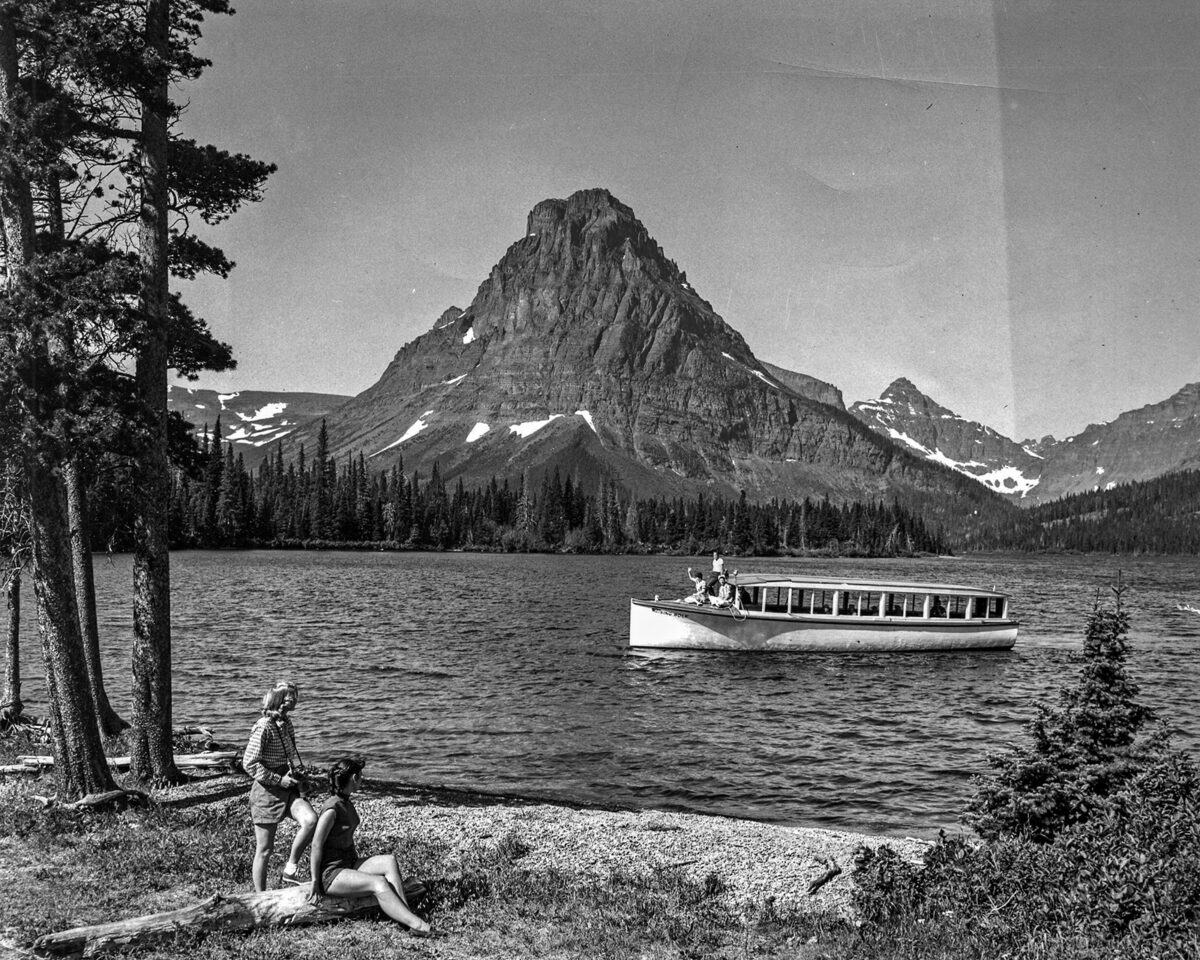
No matter what century it is or what lake the boat ripples through, the millions of passengers who have boarded the Little Chief are all provided the same experience, Burch said.
“I think it’s really, really amazing, actually,” Burch said. “The thing that I really like about the boats is that they’re doing exactly the same thing they were developed to do. So people have an experience in Glacier Park on this boat, just as they did 100 years ago. The experience is the same, and the smell and the feel and everything.”
While the experience has remained the same over the last 100 years, the Little Chief’s passengers certainly haven’t.
“One hundred years ago, the people that came to this park were the wealthiest people on the planet,” Burch said. “Wealthy Americans were going to Europe, to the Alps, and having these experiences, then the railroad developed the park, and their advertising slogan was, ‘See America First.’
“So instead of people getting on the ships that were owned by the railroad, taken to Europe, they got on the train; they came out from back east, and they traveled around the park on these boats and on horses and stayed in the back country tent camps and chalets that were scattered around the park.”
The advent and mass production of the car signaled a significant shift in who had access to the park and, in turn, the unique views and experience from Glacier Park Boat Co.’s fleet.
“The common man could buy a car and get here, and they could camp,” Burch said. “So now it was a different segment of the American public. It was really the common man, not the wealthy elite, and then that really changed the park significantly.”
Today, people from all over the world come in droves — to the tune of over 3 million visitors each of the last two years — to see the beauty of the park, now capturing it on their smartphones as opposed to their Kodak Brownie.
But even as the park’s visitors have changed, Burch and his staff still see the same excitement from passengers as they see sights only possible from the wooden boats — something he was reminded of recently while looking through historic photos of the fleet.
“There’s a lot of cool little pictures,” Burch said. “There was one that I saw just a little while ago, and I don’t know which boat it was, but it was pulled into the dock at Two Medicine, and these kids had gotten off with their moms. They were walking down the dock, and the kids were running down the dock.”
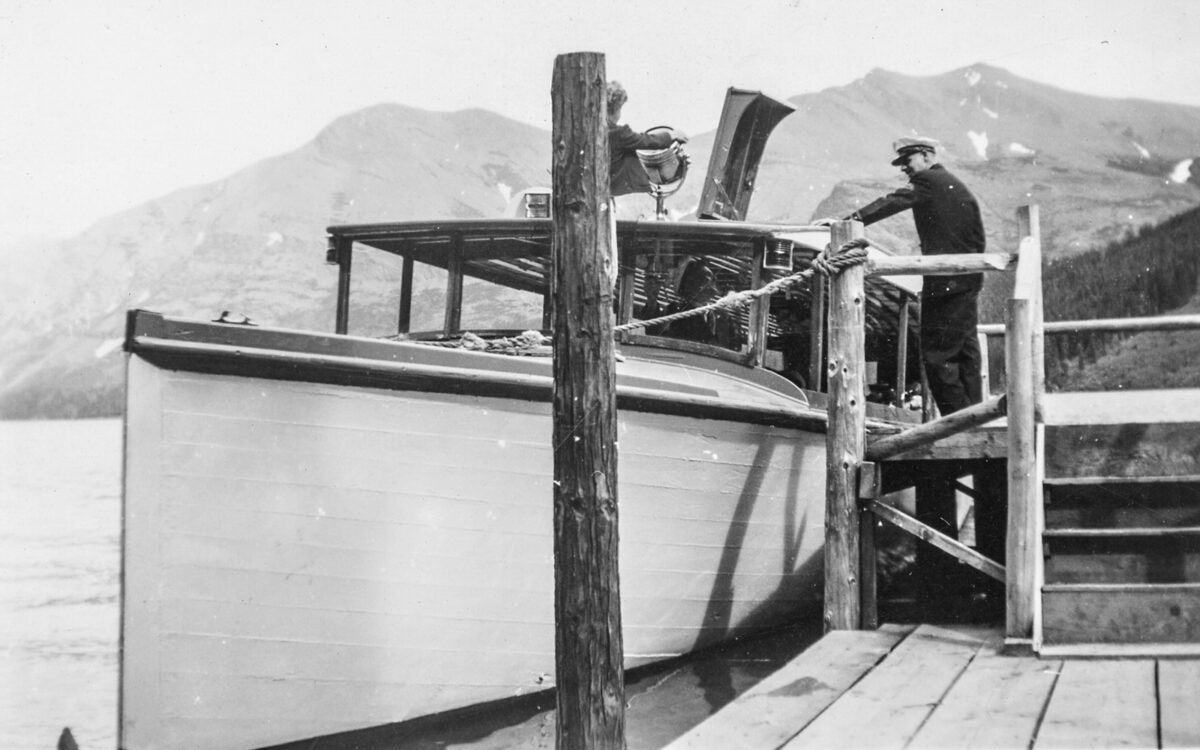
“It was just … it’s exactly the same today,” he paused, a moment of emotion brimming over. “It was a cool picture, because I’ve just seen it all my life.”
It’s been up to the management of Swanson and three generations of Burches to keep Little Chief and the other boats in the proper condition to continue this time-honored experience, with Burch noting he “runs a really tight ship” and has “a great deal of pride” in his boats.
“My take on vehicles and wooden boats and houses is they have no lifespan; people just don’t take care of stuff,” Burch said. “Because it is made of all these different pieces, when a piece goes bad, you just put a new piece in it, and you just keep up with it. If you let them go to the point where you know 60% of it is bad, then you know they’re beyond repair.
“We never let the boats get that way, and so we’ve been able to just maintain them. The main structure of the [Little Chief], which is what we’ve done now, basically lasted 100 years.”
This same disciplined upkeep of Little Chief and the rest of the Glacier Park Boat Co.’s fleet is a practice the Burch family hopes to continue for the next 100 years and beyond, he said.
“In our tenure, we’re just gonna keep fixing it up and just keep repairing,” Burch said.