Groups Say Flathead Logging Project Sidesteps Endangered Species Imperatives
A lawsuit challenging the West Reservoir Project accuses the federal agency of invoking emergency procedures instead of examining impacts of logging roads in grizzly bear and bull trout habitat
By Tristan Scott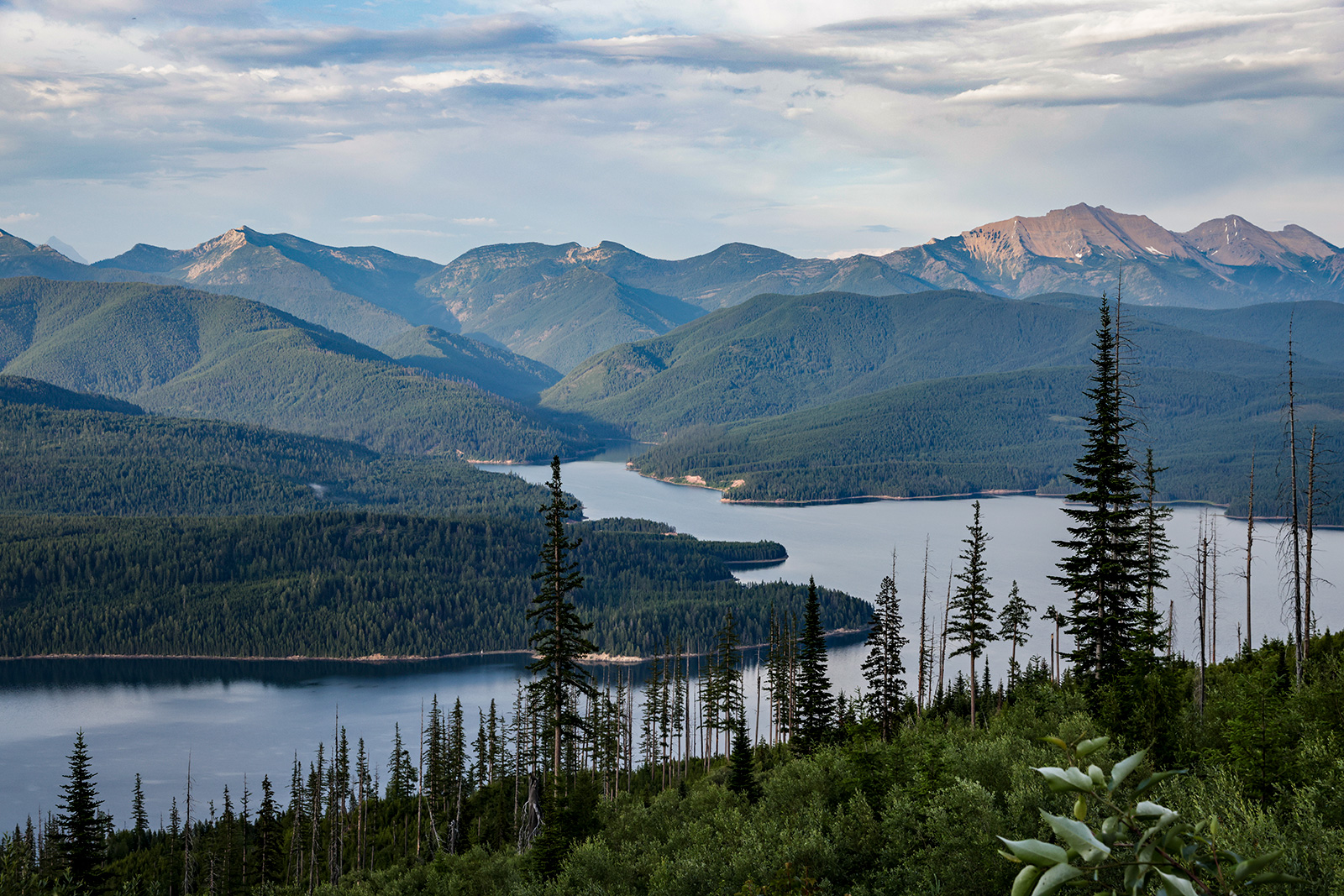
Local conservation groups on June 5 sued the Flathead National Forest for authorizing a timber sale in grizzly bear and bull trout habitat under an emergency exception to the Endangered Species Act (ESA).
Rather than examine the potential effects of logging road construction on federally protected species, plaintiffs in the lawsuit, the Swan View Coalition and Friends of the Wild Swan, said the federal agency illegally invoked an “emergency consultation procedure” to “sidestep” requirements “under the guise of an emergency.”
According to the lawsuit, the ESA emergency consultation regulation “applies to situations involving acts of God, disasters, casualties, national defense or security emergencies.”
“Here, the agency identified no emergency to which it was responding,” the lawsuit states. “Instead, the agency’s purported ’emergency’ appeared to consist of nothing more than well-known factors, such as generalized wildfire risk and the potential for insect or disease infestations, that have long been considered in Forest Service management decisions.”
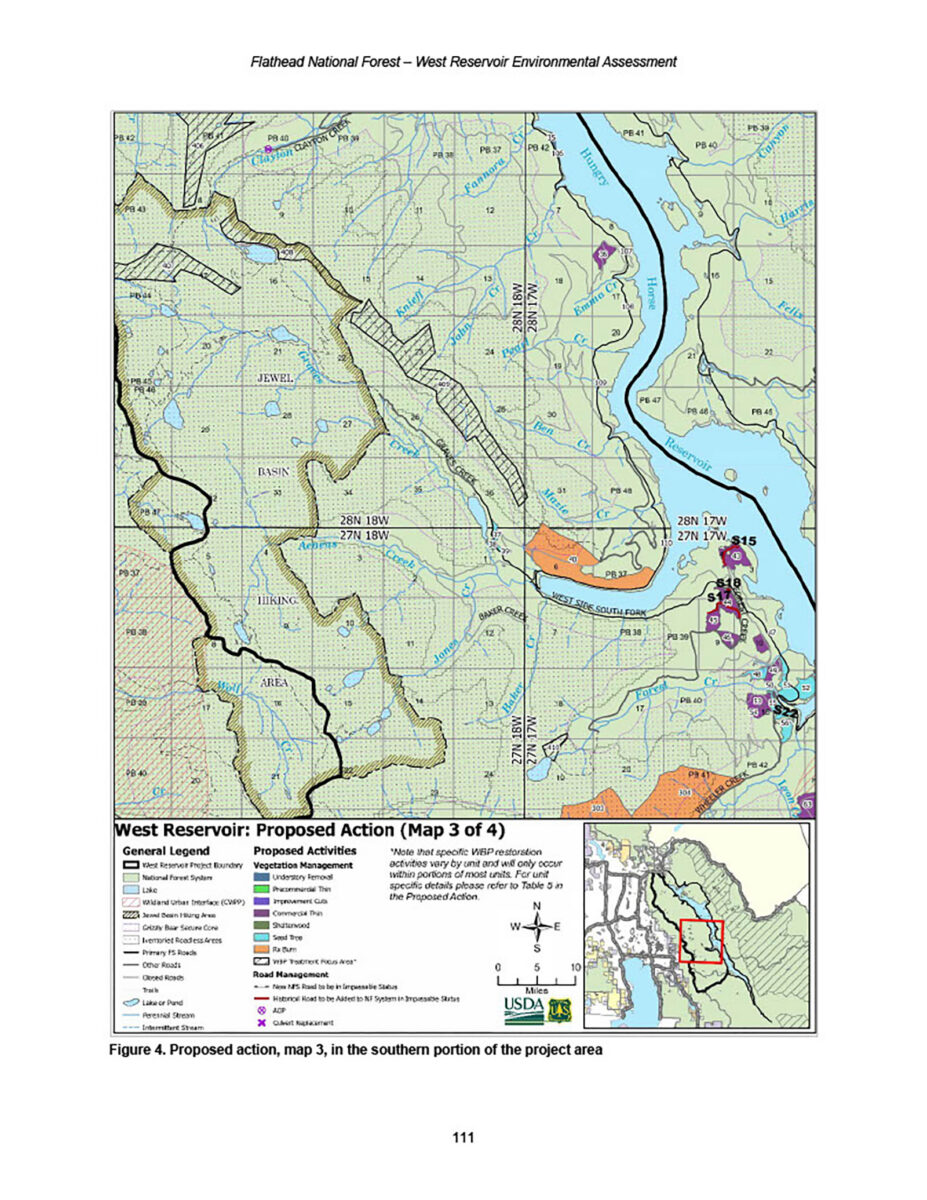
The case specifically challenges the West Reservoir Project, which would log portions of a nearly 130,000-acre expanse of federal land west of Hungry Horse Reservoir while adding 4.7 miles of road construction. Invoking the emergency exemption, the groups say the agency approved the project without adjusting its road density standards to comply with wildlife protection imperatives.
The plaintiffs in the lawsuit maintain the Flathead National Forest must formally consult with the U.S. Fish and Wildlife Service to update its biological opinion about how abandoned roads affect threatened and endangered species after logging activities have concluded. The groups said a project-specific biological opinion is required to ensure the Flathead National Forest’s 2018 Forest Plan complies with the Endangered Species Act.
But the West Reservoir Project bypassed the consultation requirement, the groups contend, when it was approved under a newly established Emergency Action Determination (EAD) with the stated purpose of reducing wildfire risk. In an April 2025 memo, the U.S. Secretary of Agriculture designated an “emergency situation” across 112,646,000 acres (59%) of National Forest System Lands determined to be at a high risk of wildfire.
In its March 2026 Decision Notice authorizing the West Reservoir Project, the Flathead National Forest applied the emergency consultation procedure under the Endangered Species Act, which states that “under emergency circumstances, consultation with the [U.S. Fish and Wildlife Service] can occur informally through alternative procedures …”
Conservation groups said the logging project appears to be the first instance in which the agency has invoked the ESA’s emergency procedures. However, they contend it is absent the exigent circumstances required to invoke emergency waivers.
“The Forest Service’s bogus emergency declaration thus threatens not only to subject grizzly bears and bull trout in the Flathead Forest to a series of unexamined harms, but also to establish a precedent for widespread Forest Service evasion of fundamental ESA … requirements across large portions of the National Forest System,” according to the lawsuit.

Keith Hammer, executive director of the Swan View Coalition, said emergency exemptions under the Endangered Species Act are “intended for things like hurricanes and floods and earthquakes — true emergencies where the agencies don’t have time for consultation because they have to take immediate action.”
The groups sent the Forest Service notice of their intent to sue in March. When the agency did not remedy the Endangered Species Act violations, they filed suit in U.S. District Court in Missoula. The environmental law firm Earthjustice is representing the groups in the federal case.
The U.S. Forest Service does not comment on pending litigation. However, in its environmental assessment of the West Reservoir Project, it said the project’s road management activities would be carried out to reduce the effects on threatened and endangered species, including by rendering new roads impassable to motorized vehicles and by removing and replacing four culverts. Culverts left in place on old logging roads can deteriorate during rain events or flooding, increasing turbidity in nearby streams and rivers and harming bull trout.
The Flathead National Forest’s policy for road building has been evolving for decades. In 1995, forest officials adopted a change to the policy called Amendment 19, which required forest managers to “reclaim” any road it wanted to delete from its total motorized road density (TMRD) calculations. A reclaimed road is a road that “has been treated in such a manner so as to no longer function as a road or trail and has a legal closure order until reclamation treatment is effective.”
In 2018, when it adopted its current revised forest plan, the Flathead National Forest replaced Amendment 19’s “reclaimed” road standard with an “impassable” road standard. Under the revised plan, impassable roads no longer count toward total road density if the road —generally the first 50 to 300 feet — has been treated to make it inaccessible to wheeled vehicles during the bear’s non-denning season.
In a June 2024 court order in a separate lawsuit, U.S. District Judge Dana Christensen acknowledged the ongoing chronic problem of ineffective road closures and unauthorized motorized access, even if forest managers have closed the roads to motorized use and deemed them “impassable.” But Christensen stopped short of prohibiting approval of any future timber projects under the Flathead’s revised forest plan as currently written.
Instead, Christensen remanded the provisions of the plan that violated the Endangered Species Act back to the agencies for further consideration.
The federal agencies initially filed a notice of their intent to appeal Christensen’s decision, as well as two subsequent motions for deadline extensions, but they ultimately decided not to move forward with the appeals process.
“The Forest Service admits the timber sale area already has too many roads for wildlife security,” Hammer said in a statement. “But rather than fix that, it is faking an emergency and bypassing Endangered Species Act requirements in order to build more roads.”