Whitefish City Council Discusses Future of Resort Tax Community Housing Funds
During a work session on Monday, city councilors discussed potential improvements to its grant process for housing initiatives using the levied dollars, while also floating around the idea of increasing the resort tax to bring in more funds to address the city's housing challenges.
By Lauren Frick
With more than $20 million in resort tax collections for community housing initiatives anticipated by 2045, Whitefish city councilors on Monday discussed the future of the city’s evolving grant program tied to its local-option sales tax levy.
City Manager Dana Meeker proposed utilizing the Community Housing Committee to develop a grant application process and criteria for the funds, in addition to the formation of a review panel once the grant application process is active.
City councilors, however, also began unspooling the thread of a remedy larger than annual grant contributions for housing initiatives, floating around the idea of going back to voters to bump the resort tax up by an additional 1% to dedicate to housing.
Following voter-approval in November 2023, the city’s resort tax was re-allocated for community housing initiatives, including the development of deed-restricted affordable housing units and community housing programs in an amount equal to 10% of the 3% resort tax revenues from the preceding fiscal year.
The city currently has a total of $5.2 million committed to funding various workforce housing projects, land purchases and rental assistance programs, with just over $1 million of this allocation coming from resort tax funds, Meeker said.
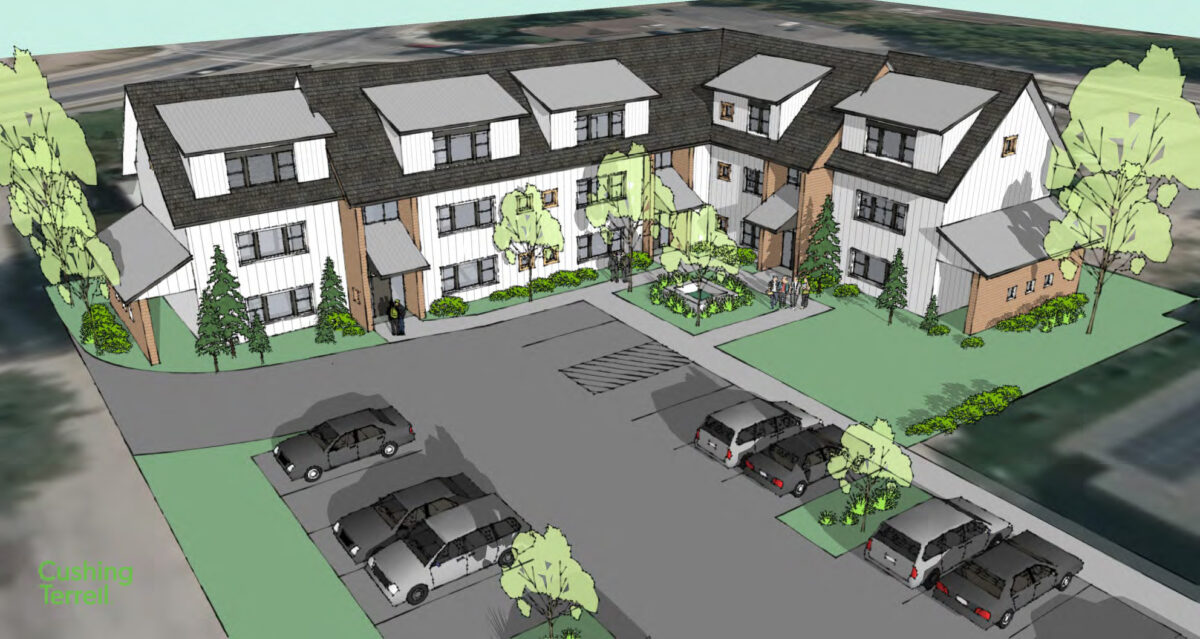
A bulk of the resort tax dollars used for housing so far — roughly $800,000 — has gone toward the Housing Whitefish-backed project for 18-additional units at Alpenglow Apartments on the 500 block of Edgewood Place. The remaining $250,000 of resort tax funds were distributed late last month when city councilors approved a one-time grant for Habitat for Humanity of Flathead Valley to purchase land for two Habitat homes.
Under the current grant process, interested housing partners work directly with the city manager to prepare the request for city council to determine if a resort tax grant is appropriate, Meeker said. Viable requests are then taken to the city council for final approval.
“Right now … somebody finds out we have resort tax dollars, they’ll come to me and say, ‘Hey, I’ve got this project, we’d like to see if the city would support it with resort tax dollars,’” Meeker said. “So I work with them to figure out what funding we have available in the budget.”
At city council’s Monday work session, Meeker suggested the process shift to include a more formal grant application process, as well as a multi-member review panel to comb through applications ahead of city council consideration.
Over the course of the discussion, city councilors floated the idea of having a three- or five-person panel, with staff suggesting panel members not be affiliated with organizations that intend to apply for resort tax grants.
“There’s specialized knowledge that would be really helpful here,” Councilor Ben Davis said. “Everybody in town has some sense of where the streets are at, but not everybody knows what our needs are for housing at the moment, and how to parse out some of these complicated trade-offs of where money is going for housing projects or programs. It feels to me like if the council wants to delegate some of this responsibility in this way that it would be a specialized group.”
Some councilors also expressed a distaste for making an application process or grant criteria too rigid, instead preferring a flexibility to address rental and ownership initiatives.
“I wish we could provide ownership opportunities for everyone that works and lives here, but at the same time I think we’ve, right or wrong, made some mistakes along the way with how we’re reading the crystal ball and how the market’s changing,” Mayor John Muhlfeld said. “So rather than set percentages, I would rather let the market tell us what’s going on and adapt, and use more of an adaptive funding policy.”
As the work session progressed, city councilors began to zoom out, instead talking about how more ambitious next steps may need to be taken to truly address the housing crisis in Whitefish.
Specifically, Councilor Andy Feury pointed to recent legislation that allows for additional resort tax to be levied for housing initiatives and projects.
Eligible communities in Montana are currently permitted to impose a resort tax — or a local-option sales tax on certain goods and services that is designed to direct tourism revenue towards community projects. Resort taxes can be set at up to 3% and are approved by voters. Up until the most recent legislative session, municipalities could ask voters to approve an additional 1% resort tax, but that could be used only for infrastructure, such as road and utility improvements.
Senate Bill 172, which was introduced by Sen. Dave Fern, D-Whitefish, now allows municipalities to spend that additional 1% resort tax, should it be approved by voters, on workforce housing.
“If we’re going to make any real dent in equity and home ownership, it’s going to be by going back to the voters and getting an additional percentage, getting that 100% housing, bonding that, and buying land and giving the land away. That’s how it works,” Feury said. “We’re not going to make a dent in home ownership with what we’re doing right now. We’re just not raising enough money.”
Feury referenced Big Sky as an example of thinking big with resort tax money in relation to housing, noting the Big Sky Community Housing Trust’s “Cold Smoke” neighborhood project. The project will bring 125 homes for ownership and 264 rental apartments for local workers and their families, with financing coming from nearly $55 million in resort tax bond funding for land and infrastructure, which was voter approved.
“I think if that’s going to be our goal, then we need to think beyond what we’re just talking about right here tonight,” he added. “Whether or not there’s an appetite to go back to the voters yet one more time and see if there’s an interest, but I mean it’s not going to kill us to do it.”
Meeker told councilors they would need to home in on a specific housing project or opportunity before going to voters, but it would be possible to map out a plan fitting for Whitefish.
“We would have to have land identified and really have more of a plan in place, but it’s definitely a project that could be worked on and become a council goal,” Meeker said.
Fern, who spoke during Monday’s public comment, urged councilors to explore financial logistics of taking the matter to voters, and encouraged the city to utilize Whitefish’s city-owned and public land potential when considering future housing projects.
“I think you should get some financial feedback on what would happen if you did bond what you have available right now,” Fern said. “How far could you stretch it? Is that something you want? Then look at some of the logistics of what might happen if you propose 1%, a half-percent, whatever it is beyond the 3% because we do allow you to do that for single purposes, and that might fit under housing. I would say just keep moving; it’s really important.”