Interior Department Delegates Greater Grizzly Bear Management Authority to States
Hailed by western governors, including Montana's, as the most significant "reform" to grizzly management in a half-century, wildlife advocates called the decision to relax federal protections "reckless"
By Tristan Scott
Interior Secretary Doug Burgum visited Montana on Tuesday to deliver a long-awaited announcement: The federal government is authorizing state agencies to assume day-to-day management authority of grizzly bears even as they remain federally protected under the Endangered Species Act (ESA).
At least, that is, for now.
After unveiling the U.S. Fish and Wildlife Service’s proposed rule change that gives western states greater management authority over grizzlies in the lower 48 states, which many view as a precursor to delisting the species altogether, Montana’s governor and its congressional delegation hailed the decision as the most consequential management reform since grizzly bears received federal protections more than 50 years ago.
“Thanks to the work of Montana Fish, Wildlife, and Parks, the U.S. Fish and Wildlife Service, and many Montanans over decades, the grizzly bear recovery story is one of America’s great conservation successes,” Montana Gov. Greg Gianforte said, speaking over crosswinds at the Gallatin Wildlife Management Area Tuesday evening.
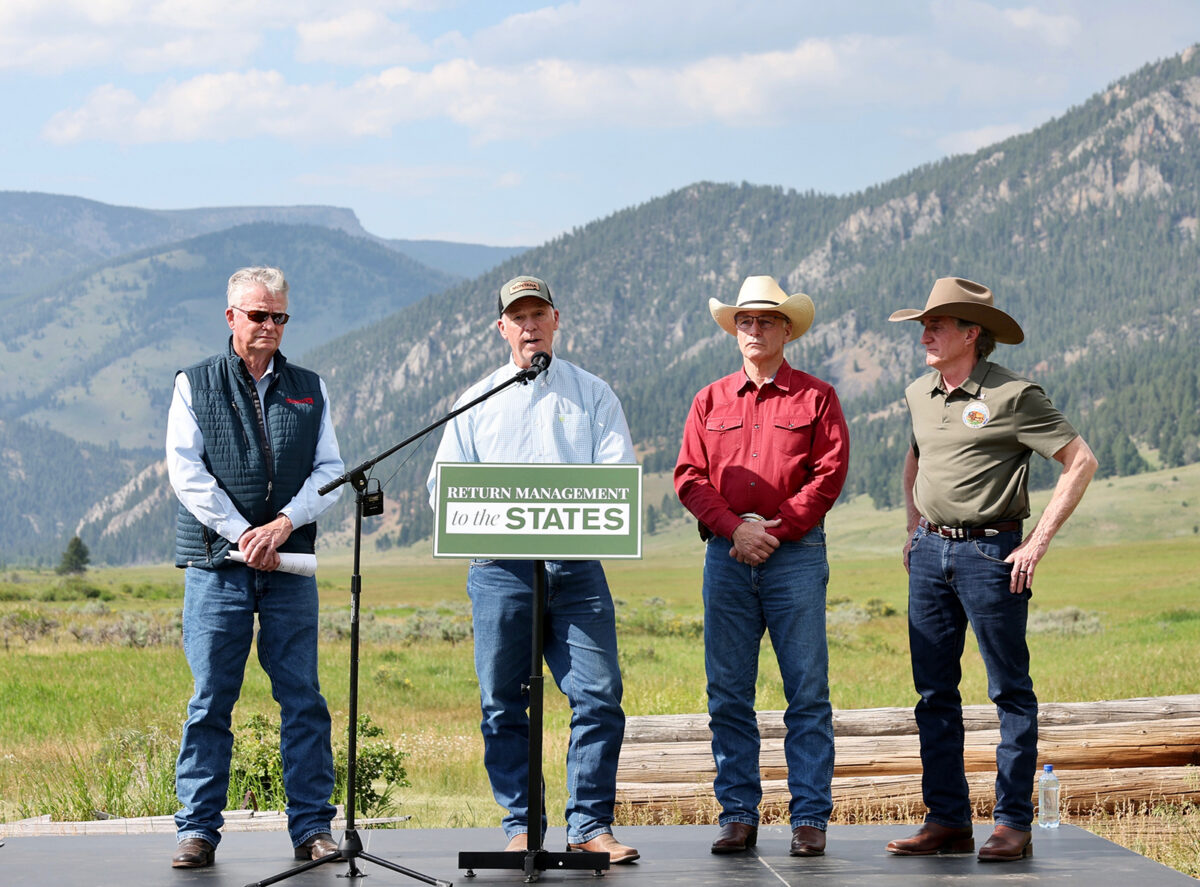
Standing behind a lectern sign that read, “Return Management to the States,” Gianforte delivered the announcement from atop an outdoor dais alongside Interior Secretary Doug Burgum, as well as Governors Mark Gordon and Brad Little, of Wyoming and Idaho, respectively. Having unsuccessfully petitioned the federal government in 2021 to delist the grizzly bear in the Northern Continental Divide Ecosystem, Gianforte on Tuesday described a new era of grizzly bear management in which populations have increased in step with conflicts involving farmers, ranchers, hikers, and hunters.
The logical next step, he said, is to shift management power to individual states.
“With this success has come a challenge — bears have expanded into new areas and conflicts have increased with farmers, ranchers, recreationists, and residents,” Gianforte said. “Returning management to the states is a welcome change and Montana is ready to lead to balance conservation and the safety of our communities.”
Grizzly bear advocates, meanwhile, called the move “reckless,” particularly as it unfolds against a backdrop of the Trump administration’s campaign to cleave back other bedrock protections for wildlife and their habitat while relaxing standards for the logging and mining projects on public land. And it comes on the heels of a decision by the federal government to weaken the ESA by rescinding its cornerstone “harm” clause, which restricts damage to threatened and endangered species’ habitat.
When viewed in isolation, wildlife advocates say, each policymaking decision represents another stumbling block for grizzly bears and other threatened and endangered species on their road to recovery; when taken together as a whole, however, critics say the new rules and rollbacks represent death by a thousand cuts by undermining the suite of conservation tools that have promoted the species’ comeback.
“This decision would remove a federal backstop that’s kept grizzly bear recovery on track for 50 years and it does so at exactly the moment that the species is facing escalating threats, including from rising incidents of human-bear conflicts, road building, climate stress, and fragmented populations,” Jenny Harbine, managing attorney for the environmental law nonprofit Earthjustice’s Northern Rockies office, told the Beacon. “Then there’s the ongoing threats from an administration that is fast-tracking logging and mining, weakening environmental review, and moving to rescind the Roadless Rule, which opens up some of the most critical habitat corridors to new threats. Any attempt to weaken grizzly bear protections in this context is reckless.”
If finalized, the revision would amend species-specific protective regulations for grizzly bears under section 4(d) of the ESA, providing a tiered framework allowing Montana Fish, Wildlife and Parks (FWP), as well as other state and tribal management agencies, to have more flexibility in managing the federally listed species in areas where local populations are thriving.
The U.S. Fish and Wildlife Service (FWS) will publish the revised proposed 4(d) protective regulations for grizzly bears in the lower 48 states on July 17, with public comments due by Aug. 17. A pre-publication draft of the rule is available here.
Although wildlife advocacy groups have been bracing for a proposal by the Trump administration to delist grizzly bears in the Northern Continental Divide and Greater Yellowstone ecosystems, as well as to relax protections for distinct population segments and authorize hunting, the proposed rule change announced Tuesday stops short of taking those steps. Instead, it establishes a two-tier management framework that allows exceptions for the “take,” or killing, of grizzly bears under certain conditions.
But the proposal also does not provide specific information as to how states would manage grizzly bears, deferring those finer-grained details to as-yet unpublished Memorandums of Understanding (MOUs).
“We don’t know exactly what the MOUs authorize. We do know that they give a lot of authority to states that have been quite hostile toward grizzly bears and have engaged in political shenanigans when it comes to promoting their recovery, and the recovery of endangered species more broadly,” Harbine said.
The proposed rule change does explicitly allow individuals to take a grizzly bear “in defense of their own life or the lives of others,” requiring the person to report the killing within 48 hours or “as soon as practical given remote conditions.” It also provides an exception for the incidental take of grizzly bears during regulated trapping of other species, such as wolves, which could touch off a cascade of legal repercussions.
In recent years, courts in Montana and Idaho have limited wolf trapping seasons to avoid the likelihood that grizzly bears and their cubs could be harmed by trapping during their non-denning period. If finalized, the new rule’s incidental take exception would reverse those trapping limits.
“In Montana and Idaho, courts have found that wolf trapping in particular creates a likelihood that grizzly bears will be trapped and harmed when trapping occurs in a non-denning period for bears,” Harbine said. “This rule says that take will be authorized by the Fish and Wildlife Service.”
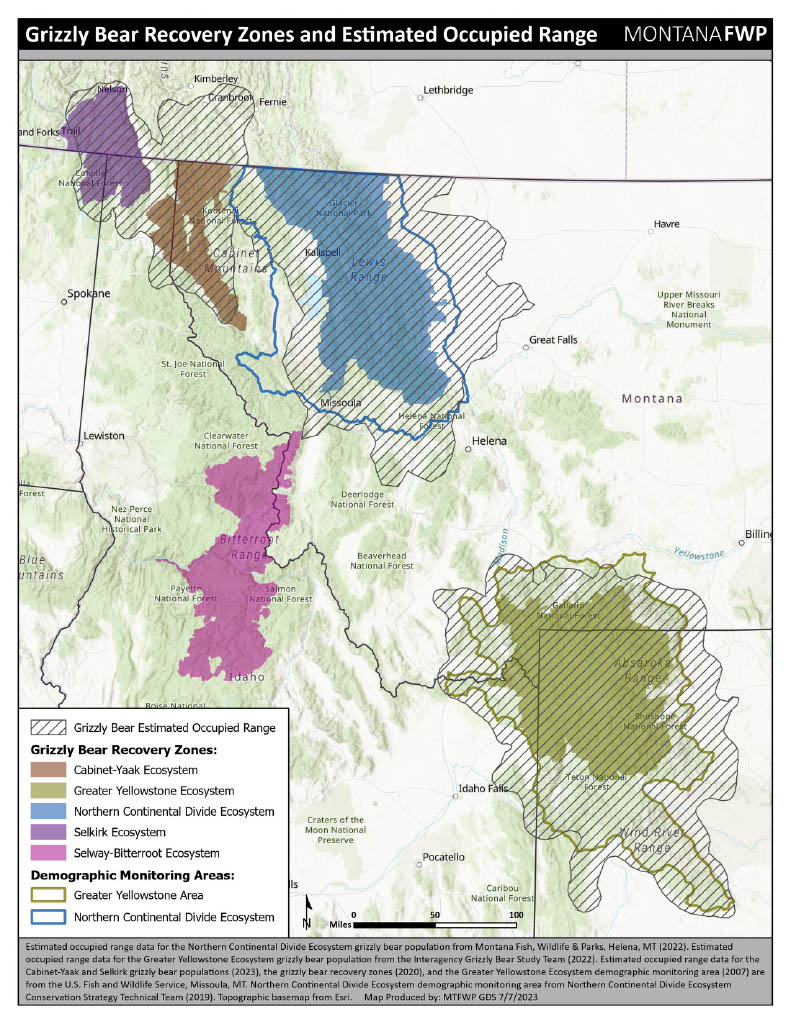
Still, Secretary Burgum, whose vast department oversees the FWS, said recovery goals for the species have been met in the Greater Yellowstone and Northern Continental Divide ecosystems, which harbor approximately 2,000 bears.
“The science is more than clear: grizzly bears have recovered and far exceeded every federal recovery benchmarks. Today, Interior is returning conservation leadership to the Western states instead of Washington bureaucrats,” Burgum said Tuesday. “Under the leadership of President Trump, we’re following the science, upholding the law and ending politics masquerading as conservation.”
In Montana, the rule change would explicitly codify a shift in management authority that has been underway for years.
Since grizzly bears are listed as threatened by the FWS, the federal agency has final authority to approve all relocations and lethal removals, as well as to conduct investigations. But in Montana, FWP is responsible for much of the day-to-day management, including responding to conflict calls from landowners and determining a bear’s eligibility for relocation. The state agency is beholden to rules adopted by the Montana Fish and Wildlife Commission, as well as laws enacted by the Montana Legislature.
FWP Director Christy Clark, who previously headed the Montana Department of Agriculture and brings a livestock-production perspective to the wildlife management agency she now oversees, said that in recent years multiple factors have prompted FWP to evolve its philosophy when it comes to grizzly bear management, including its policy of relocating or removing (killing) conflict bears.
“With a statewide management plan in place and our decades of on-the-ground experience, Montana is ready to take over management of grizzly bears,” Clark said Tuesday. “Our specialists follow the best available science and utilize existing relationships with ranchers, landowners, and recreationalists to maintain conservation efforts while supporting the communities that call grizzly bear country home.”
Grizzly bears in the lower 48 states were listed as threatened in 1975. Since that time, sustained conservation efforts by states, tribes, federal agencies, private landowners and local communities have contributed to significant recovery progress in several geographic areas.
WHAT DO THESE CHANGES MEAN FOR NORTHWEST MONTANA?
We’re committed to highlighting our great outdoors and the policies and conversations shaping it. And you can help! Become a member to support more reporting on public lands and keep you and your neighbors in the loop and on the trails.
But a host of major environmental wins have aided grizzly bear recovery, including habitat protection, strategic reintroduction plans, and collaborative coexistence programs, helping grow the populations from a floor of about 200 to around 2,000 today. With many of those safeguards facing elimination, Harbine said a critical safety net is being dismantled for grizzly bears.
“The proposal does not identify parameters for management in areas essential for habitat connectivity. And it appears to afford states significant discretion to relocate or kill bears,” Harbine continued. “All of these provisions worsen conditions for grizzly bears that need protections now, more than ever.”
The revised proposal aligns with the Trump administration’s goal of reducing regulatory burdens, but it does not change the grizzly bear’s listing status under the Endangered Species Act and does not affect existing experimental population designations, such as in the Bitterroot or Cascade ecosystems of Montana, Idaho and Washington.
The proposal also maintains federal consultation requirements for state and tribal agencies, but under Tier 2 of the two-tiered system could allow substantially more day-to-day management authority once demographic objectives, conservation strategies, management plans, and federal agreements are established.
Mike Mershon, president and board chair of the Montana Wildlife Federation, said the organization “supports a durable path toward responsible state management and, ultimately, delisting.”
“We support continued federal, state, and tribal collaboration, science-based management, rigorous monitoring, and effective conflict prevention,” Mershon continued in a prepared statement. “The proposed Tier 2 framework represents a significant shift in management authority, and we will be looking closely to ensure the final rule provides strong, durable safeguards — including science-based state regulations, transparent mortality monitoring, protection for habitat and connectivity, and meaningful federal oversight—to keep grizzlies recovered for generations.”
“The Service remains committed to a collaborative approach that supports conservation while ensuring communities have the tools they need to respond to expanding bear populations,” according to the FWS’ proposed rule change.
U.S. House Rep. Ryan Zinke, R-Mont., a former head of Interior under Trump who last year inserted language into an bill directing the delisting of grizzly populations in the Greater Yellowstone, Northern Continental Divide and Bitterroot ecosystems, said in a prepared statement that the rule change was overdue.
“This announcement is a long time coming and very good news for many communities and the wildlife within the Yellowstone ecosystem and across bear country,” Zinke said in a prepared statement. “Like the bald eagle before it, the recovery of the grizzly stands as one of America’s great conservation success stories — the culmination of decades of hard work and dedication on the part of the state, tribal, federal, and private partners. As a Montanan and former Secretary of the Interior who started this process, I’m proud of what we’ve achieved together. I trust our state wildlife professionals in managing the bear population according to the best science going forward, as they do all our wildlife.”
Likewise, Montana Republican U.S. Sens. Steve Daines and Tim Sheehy released statements supporting the decision, as did eastern congressional Rep. Troy Downing.
Keith Hammer, head of the Swan View Coalition, one of nine conservation groups who on Tuesday filed a lawsuit challenging the Interior Department’s decision to rescind the ESA’s longstanding regulatory definition of “harm,” which protects the feeding, breeding and sheltering habits of an endangered species, said the public ought to be concerned by the rapid succession of proposed changes.
According to Hammer, the best available science reveals that more needs to be done to secure the recovery of grizzly bears, including restoring connectivity between distinct populations and augmenting recovery zones.
“We don’t put it past this administration to in the morning say we can destroy wildlife habitat and it doesn’t violate the Endangered Species Act and in the afternoon turn around and say, ‘you know what, let’s just kill grizzly bears outright, too,'” Hammer said, adding that the cumulative effect of the Trump administration’s rule changes would “destroy more grizzly bear habitat and more grizzly bears.”
When taken in concert with the administration’s other efforts to rescind Roadless Rule protections and streamline logging projects under emergency authorization determinations to mitigate wildland fire risk, Hammer said the pattern is even more concerning.
“Roads built for logging and other human access destroy grizzly bear habitat and the bear’s ability to safely use its habitat,” Hammer said. “Repealing the harm rule allows industry to devastate the habitat grizzly bears and many other wildlife species depend on for their survival.”
The U.S. Fish and Wildlife Service is reopening a 30-day public comment period on the revised proposed 4(d) rule. The revision updates a January 2025 proposal and focuses solely on the 4(d) provisions. The proposed rule, supporting documents, and instructions on how to participate in the public comment process can be found here.
This article has been updated to include comment from the Montana Wildlife Federation.