Glacier National Park to Host First Logan Pass Star Party of the Summer
The late night celestial celebration offers an uninterrupted view of the Milky Way, Ursa Major, and more
By Jules Lingenfelter
This Friday night, hundreds of Glacier National Park visitors are sure to see why Montana earned its reputation as the “Big Sky” state at its first star party of the summer. The moon will be only a small silver in the sky, allowing the night to be nearly uninterrupted by any light — the perfect time to observe what Montana has to offer right above our heads.
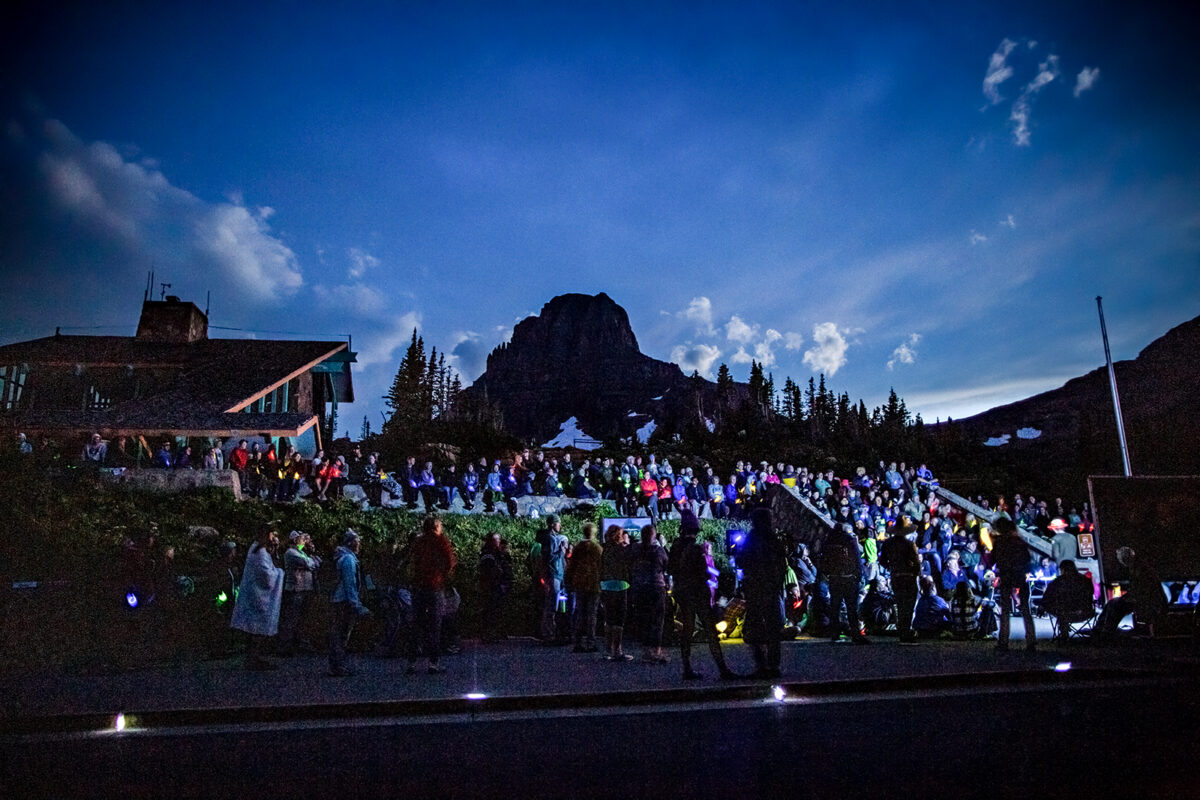
The Logan Pass Star Party on July 17, hosted in collaboration with the Big Sky Astronomy Club and The Glacier Conservancy, is the first of three this year — the latter two coming Aug. 14 and Sept. 4. The night promises both educational and stargazing opportunities. The program begins with a presentation about the unique aspects of Montana’s night sky as well as stories from Blackfeet Nation tribal members. Party-goers will then be led through constellation tours and have the chance to look through telescopes pointed at different objects including galaxies, star clusters, nebulas, and more.
“The Logan Star Parties are fantastic,” said Jim Rittenburg, president of the Big Sky Astronomy Club. Members of the club volunteer their personal equipment to be used at the parties. Including the park’s own astronomy program, Rittenburg said there are nearly a dozen telescopes, if not more, for participants to look through.
Since 2000, the Big Sky Astronomy Club has sought to bring the stars a little closer to the Flathead Valley community. Rittenburg joined the club after it increased activity post-pandemic and he is currently serving his third year as president. But he cites his interest in astronomy occurring much earlier — way back in 1985, he built a telescope to observe Halley’s Comet passing by the following year.
“It’s just a fascinating topic. It’s one that you can continue to learn your entire life,” Rittenburg said. “I think it’s really good to help educate people and make them aware of the dark sky and appreciate what we have here in Montana.”
He highlighted Glacier National Park’s title as a Dark Sky Park certified by the International Dark Sky Association (IDA). Due to the park’s remoteness and size, it is largely protected from light pollution — a growing issue in the United States disrupting wildlife patterns and our ability to observe the night sky.
“One of the unique things is that about 80% of the country can’t see the Milky Way,” Rittenburg explained, “but not only can we see the Milky Way really well here, lit up in the sky, it’s one of the few places you can actually see another galaxy.” If there’s no moon, and you know where to look, one can see the Andromeda Galaxy with their naked eye.
The Logan Pass Star Party also offers views of Ursa Major, and the Summer Triangle which is composed of three bright stars from the constellations Aquila, Lyra, and Cygnus. Rittenburg pointed out that Cygnus is particularly great to observe. Unlike other constellations, he believes it really does look like the object it’s meant to represent: a swan swooping through the night sky.
Tickets are only available the day before, and go on sale at 8 a.m. for $5 per vehicle at both the Apgar and St. Mary Visitor Center. Typically drawing crowds in the hundreds, and with limited parking at the pass, tickets tend to sell out quickly and can only be purchased in person.
Party-goers are required to arrive at the Logan Pass Visitor Center by 9:30 p.m. with the program beginning at 10 p.m. and continuing until midnight. Rittenburg emphasized the park’s rule that attendees must stay until the end; even the headlights of a car exiting early are enough to disrupt the view.
For those unable to attend one of the star parties, Glacier National Park also offers a nightly ranger-led astronomy program at Apgar and St. Mary called “Half the Park Happens After Dark!” Viewers can also take advantage of the Dusty Star Observatory, located at St. Mary, through its online sky cam.