2025-2026 Winter Marks Fifth Consecutive Season Without Avalanche Fatalities
Last season’s unstable snowpack led to the highest volume of near-misses and accidents involving avalanches in eight years while Flathead Avalanche Center forecasters rated elevated danger for more than half of its daily advisories
By Maggie Dresser
Despite experiencing the highest volume of near-misses and accidents in the past eight winters, the 2025-2026 winter marks the fifth consecutive year with no avalanche fatalities in the Flathead Avalanche Center’s (FAC) forecast region and represents the longest continuous streak since 1992, according to the annual report.
Established during the 2014-2015 winter, the FAC and its nonprofit partner, Friends of the Flathead of the Flathead Avalanche Center (FOFAC), fall under the umbrella brand of Flathead Avalanche. The two-pronged organization has recorded a dramatic drop in avalanche fatalities since its launch.
Between 2016 and 2021, there have been four avalanche deaths in the 1.2 million-acre forecast area covering the Whitefish, Flathead and Swan ranges and parts of Glacier National Park while the lion’s share of fatalities occurred prior to the organization’s formation.
In 1994, five people were killed in an avalanche in the Swan Range while three individuals were killed in 2012. A dozen other recreationists died in avalanches between 1995 and 2011.
While there were no avalanche fatalities this winter, there were 10 accidents involving individuals who were caught and carried and there were eight near-misses, more than half of which occurred in the sidecountry adjacent to Whitefish Mountain Resort.
The 2025-2026 winter started in December with an atmospheric river that brought a record-breaking volume of rain to valley floors in the Northern Rockies, causing destructive flooding and boosting snowpack levels at high elevations.
High winds caused downed trees and widespread damage while rain decimated the low-elevation snowpack and resulted in limited recreation access, especially in the Flathead Range.
Following the atmospheric river, a two-week long dry spell weakened the snowpack as prolonged inversions left the snowpack exposed and prone to the development of surface hoar, a snow-science term for frost. The conditions resulted in a widespread weak layer combined with a separate faceted layer of fragile snow that’s caused by cold temperatures.
Later dubbed the January Drought Layer, the first major reported avalanche occurred on Feb. 12 in the Flathead Range and set the stage for prolonged period of elevated avalanche danger, a slew of human-triggered avalanches, near-misses and accidents.
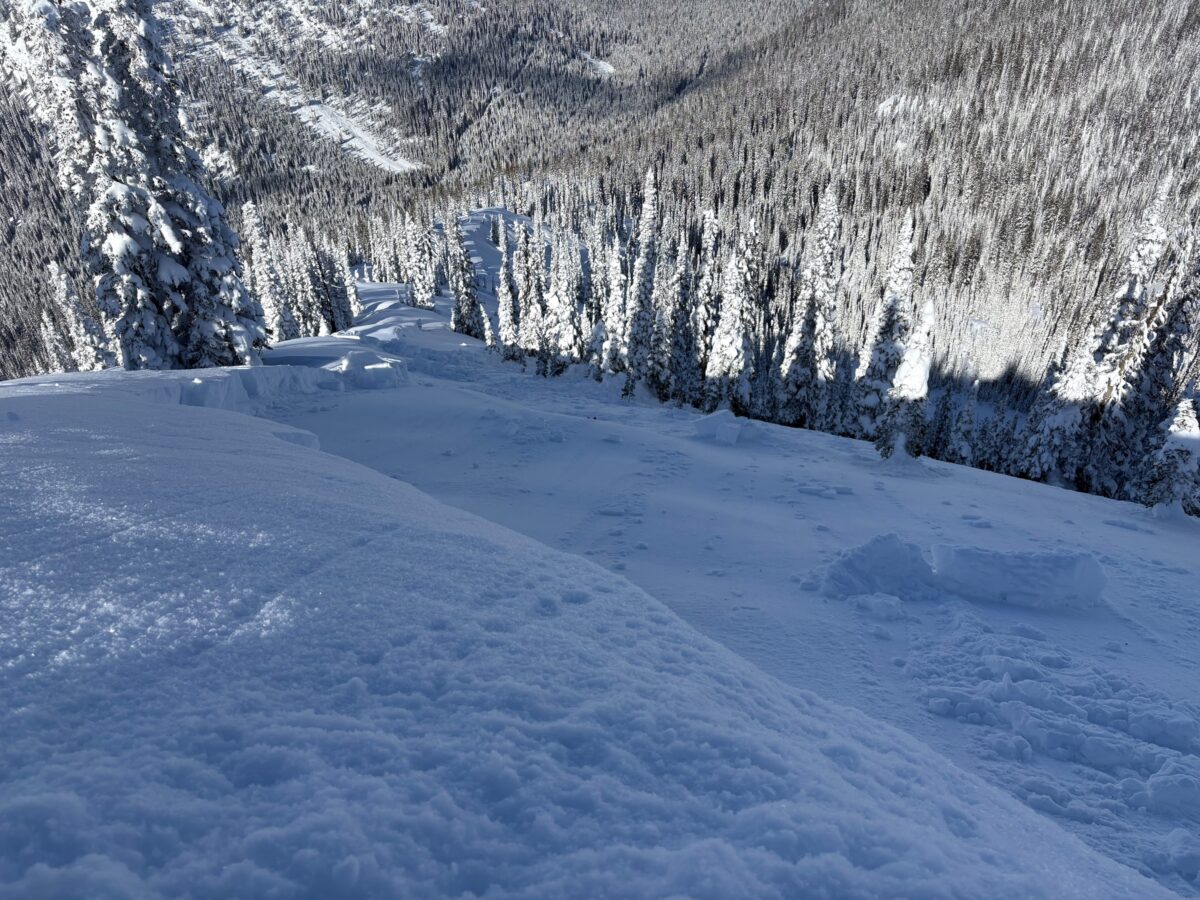
During this time frame, FAC received 19 reports of human-triggered hard slabs, many of which released remotely with some avalanche crowns extending up to 2,000 feet. Seven riders were reported caught and carried with four confirmed partial burials and one confirmed full burial.
From Feb. 15 to Feb. 24, 67% of the 55 observations submitted were of reported avalanches.
March brought another few storms, dumping several feet of snow and blowing extreme winds followed by a warming event that brought rain to upper elevations. This prompted a prolonged period of elevated avalanche danger rated at “considerable” or “high” for 34 consecutive days.
Storms continued on and off through the spring and May 10 saw a very large wet slab avalanched rated D3 on the Destructive Force Scale, which is large enough to bury a car or house, and marked the 109th avalanche size D1.5 or larger that failed on the January Drought Layer.
The unstable snowpack that began in January led to more than half of avalanche forecasts to be rated at “considerable” or “high” compared to a mean of 31% for the previous five winters while FAC issued 10 days of avalanche warnings.
Forecasters described a “challenging” season that “ended with a collective ‘Whew!,’” according to the report.