Montana’s New Wolf Estimation Tool Indicates Population Decline
To account for a reporting discrepancy that pegs the statewide population at 725 wolves instead of 1,094, FWP is recommending a reduced harvest quota in its hunting regulations
By Tristan Scott
A new report indicates there are fewer wolves on Montana’s landscape than previously estimated, prompting state wildlife managers to recommend a lower harvest quota in their upcoming wolf hunting regulation.
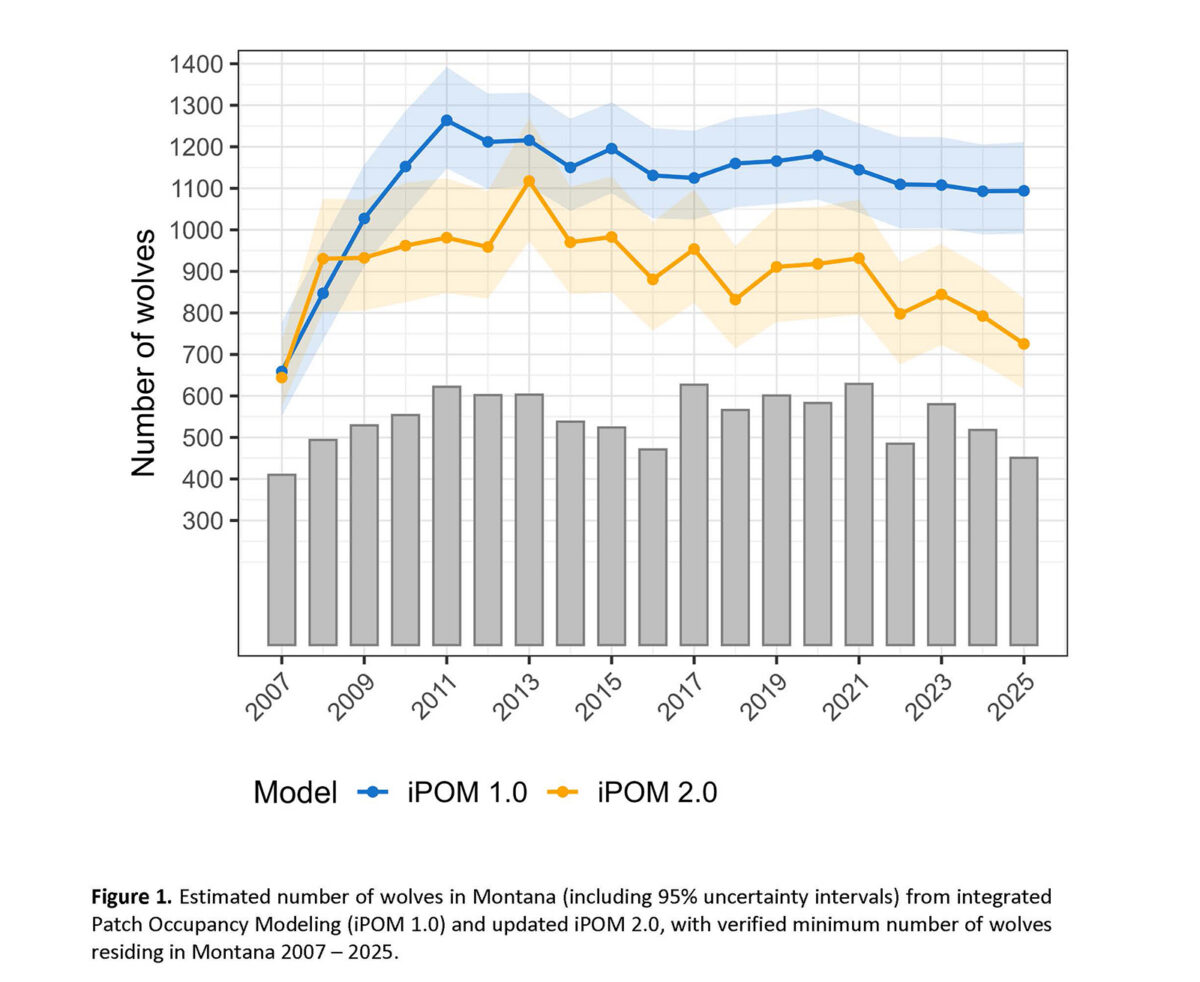
Evidence of the population discrepancy comes amid Montana Fish, Wildlife and Parks’ (FWP) adoption of a new wolf-estimation tool. Using the new approach to estimating wolves, which does not yet meet peer-reviewed research standards — even as the state’s top wildlife official described it as “an advancement in science and modeling” — FWP pegged the population at 725. Under the old criteria, “the wolf population is estimated to be relatively stable at 1,094 wolves,” agency officials announced July 17.
Although both figures are above the minimum 450 wolves that the Montana Wolf Management Plan sets as the bottom limit to ensure a stable population and at least 15 breeding pairs, the agency explained that “these are minimum numbers and not a management objective for FWP.”
“As a result, FWP is recommending a reduction to the … wolf harvest quota to 250. This is down from a quota of 450 last year,” according to an agency press release.
Last year 247 wolves were harvested in Montana.
The annual wolf report for 2025 renewed concerns over FWP’s integrated patch occupancy model (iPOM) and its accuracy at estimating the state’s wolf population, which wildlife advocates have long said overestimates the abundance of wolves.
This year’s wolf report appears to support those concerns as it contains two population estimates — the old version, iPOM, and an updated version, dubbed iPOM 2.0.
FWP published its annual Wolf Report, along with proposed changes to its hunting and trapping regulations, as part of a package released for public comment on July 17. The proposed regulations will head to the Fish and Wildlife Commission on Aug. 19 for consideration at its regular meeting.
In developing iPOM 2.0, Montana researchers were able to incorporate much of the wolf data and research they have collected over the past several years, FWP said. This Montana-specific data, particularly on pack sizes and distribution, provides a more accurate estimate, said Quentin Kujala, FWP’s Chief of Conservation Policy.
“We’re confident in iPOM 2.0 and see it as an advancement in science and modeling,” Kujala said in a press release. “However, it hasn’t been through the same peer-review process as the original iPOM. Until that happens, we want the Commission and the public to see estimates from both models.”
By using iPOM 2.0 to analyze wolf population estimates from past years, it shows a steady decline in wolf numbers from 2021. As a result, FWP is recommending a reduction to the 2026-2027 wolf harvest quota to 250. This is down from a quota of 450 last year.
Wildlife advocates said the marked-down quota did not diminish their concerns about Montana’s wolf management policies aimed at driving down populations.
In 2021, state lawmakers delivered a mandate to FWP to reduce the wolf population. Since then, FWP has blended that directive with its own recommendations, which are based on population estimates and projections that meet the minimum recovery criteria determined by the U.S. Fish and Wildlife Service.
With a sizable gulf between wolf population estimates coming to light, wildlife advocates said the agency had built its management policies on a false premise.
“FWP finally admitted what we’ve been saying for years: the state’s wolf counts were wrong and they’ve been misleading the public,” Lizzy Pennock, an attorney at WildEarth Guardians, said in a prepared statement following the report’s publication. “Yet FWP is still proposing to kill a third of Montana’s wolves in one season. The agency remains more interested in managing wolves for the bare minimum instead of treating this beloved species with respect.”
Gray wolves are still listed under the Endangered Species Act as endangered in 44 states, and are considered threatened in Minnesota; however, in Montana, Idaho, Wyoming, and portions of eastern Oregon and Washington, the wolves are managed under state jurisdiction, with their respective legislatures passing laws allowing wolf harvests, while setting quotas and regulations to manage the populations.
Still, despite Montana’s more aggressive wolf-hunting regimen, the 2025-2026 season harvest was the lowest observed in a decade.
At the close of the 2025-2026 wolf season on March 15, the harvest totaled 247 wolves, including 145 taken by hunters (59%) and 102 taken by trappers (41%). The total calendar-year 2025 wolf harvest in Montana was 264, including 165 wolves harvested during spring of the 2024-2025 season and 99 wolves harvested during fall of the 2025-2026 season.
As the accuracy of Montana’s population estimates comes under greater scrutiny, however, so too should its management policies and hunting regulations, Pennock said.
WHAT DO THESE CHANGES MEAN FOR NORTHWEST MONTANA?
We’re committed to highlighting our great outdoors and the policies and conversations shaping it. And you can help! Become a member to support more reporting on public lands and keep you and your neighbors in the loop and on the trails.
According to FWP, a manuscript detailing all iPOM 2.0 model updates is in progress and will be submitted for peer review and publication.
The agency said a series of updates to iPOM have been in progress for several years and “reflect the iterative nature of the scientific process and model development.” IPOM 1.0’s occupancy model had remained largely unchanged since its original development more than a decade ago. Advances in available data and analytical methods provided an opportunity to revisit the occupancy framework and evaluate additional model formulations.
While estimates for Montana’s wolf population vary between iPOM 1.0 and iPOM 2.0, both models show a declining trend in the population from 2013 through 2025. From 2021 through 2025, the population consisted of a five-year average of 185 packs and 1,110 wolves per year under iPOM 1.0 and 162 packs and 818 wolves under iPOM 2.0.
While iPOM 1.0 and 2.0 both use the same underlying territory model, FWP said the framework for the new version is more advanced.
The Fish and Wildlife Commission will consider the wolf and furbearer trapping regulation proposal from FWP at its Aug. 19 meeting. Included in that proposal is the annual wolf harvest quota. The public can comment on the proposal through Aug. 12.
Commissioners can propose amendments to FWP’s proposals and those amendments will be available for public comment if possible. Commissioners can also propose amendments or other proposals at the commission meeting.
The public can comment on commission items in advance, as well as during the meeting by attending in person or virtual via Zoom. The public can attend in person at the Montana Heritage Center or at one of FWP regional offices. The meeting will start 8 a.m. Aug. 19. Anyone who wants to attend virtually must register online between Aug. 4 and noon on Aug. 18.