Transition of Power
As Flathead Electric Co-op braces for a tighter, pricier energy future, its newly retired General Manager, Mark Johnson, and his successor, veteran COO Jason Williams, remain bullish about the region's energy outlook — in part due to a costly new bet on natural gas.
By Tristan Scott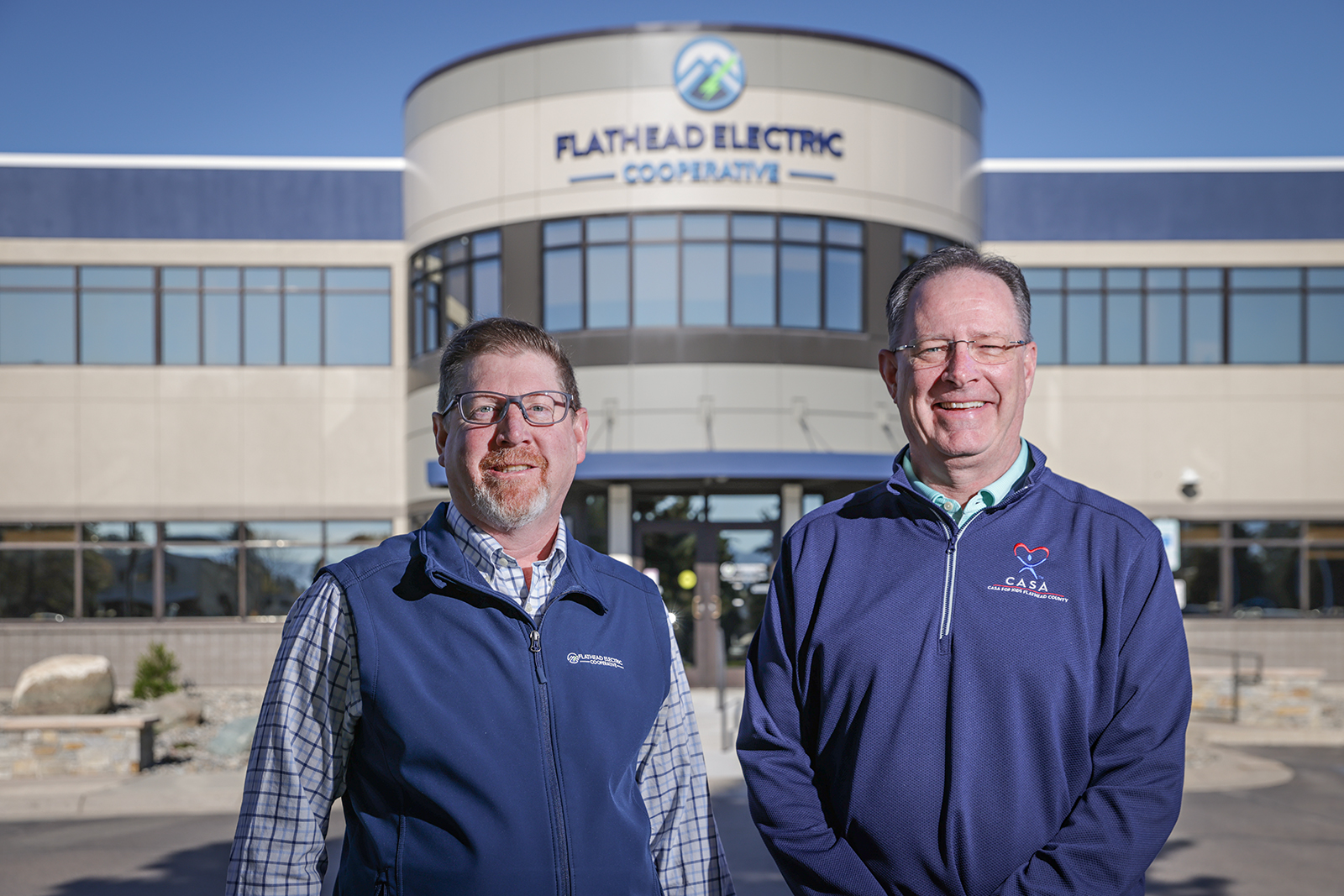
Given the gamut of challenges energy utilities face as they navigate the complexities of the modern power grid — surging load growth, aging infrastructure, extreme weather events, the shift to renewable energy — it may not seem like an optimal moment for the longtime chief executive of the largest electric cooperative in Montana to pass the baton. But earlier this month, Mark Johnson did just that, ushering in Flathead Electric Cooperative’s first leadership transition in 13 years.
The transfer of power comes as Flathead Electric Cooperative (FEC) confronts an energy landscape defined by skyrocketing demand, a maxed-out federal hydropower allocation, rising equipment costs, and mounting expectations from an increasingly grid-reliant membership base. But even as FEC braces for a tighter, pricier energy future, its newly retired general manager and CEO, Johnson, and his successor, veteran COO Jason Williams, are bullish about the region’s energy outlook, in large part due to what Williams described as a “proactive, forward-looking power strategy to address those challenges before they come.”
For both Johnson and Williams, that strategy has been evolving for decades. So, too, have the challenges.
Johnson spent 27 years at the co-op and more than 13 as its chief executive before retiring on July 1, handing the reins to Williams, who’s been with the co-op for two decades. Johnson’s background in accounting and Williams’ engineering chops are distinct, they say, but complementary, and the Flathead Valley’s steep growth trajectory has been a prominent contour line in both their careers.
“I can’t recall a time when we weren’t facing significant challenges and significant growth in our industry,” Williams said.
In an interview with the Beacon shortly after announcing the leadership transition, Johnson and Williams detailed a “resource agnostic” strategy that FEC is deploying to narrow the gap between electricity supply and demand, balance its resource portfolio to accommodate the region’s growth and protect its members from “going on a rollercoaster ride for the next 30 years.” The blueprint includes hedging against future shortfalls — specifically, FEC’s reliance on a fully leveraged hydro-power system — with investments in community solar, landfill gas-to-energy, a biomass plant, wind and, crucially, a natural gas-fired generation facility in northern Idaho.
For the past 20 years, Johnson said his work has focused on advocating to protect the co-op’s statutory rights to hydro output under the Northwest Power Act (formally the Pacific Northwest Electric Power Planning and Conservation Act of 1980) as competing environmental and legal pressures, including recent federal court rulings on fish protections, have restricted that output. The advocacy has been central to FEC’s reliability and affordability, Johnson said.
“Protecting our members’ statutory rights to the federal hydropower system is a big part of what we do,” Johnson said of FEC’s stake in the 31-dam federal Columbia River Basin Power System, which stores energy while also generating power. “I have spent a lot of my career, especially in the last 20 years, advocating for those rights. We are obviously huge supporters of the federal hydro system. It’s why our region has some of the lowest electricity rates in the country. Not only is it clean, it’s the best battery in the world. And our members have grown accustomed to its reliability. But that doesn’t mean that there aren’t things that have to be improved.”
Access to cheap and plentiful hydroelectric power has shielded FEC from the forces driving up electricity prices in other U.S. markets, but its low rates have long depended on preference access to the Bonneville Power Administration’s (BPA) federal hydro system for affordable and reliable power, which is maxed out — not only is the federal allocation capped, it’s already insufficient for current demand, let alone future growth.
“It’s important to note … our slice of the federal hydro system pie, at least the preference power that we receive, is already not enough to serve our load,” Johnson said. “We’re pushing our limits and that pie’s not getting any larger.”
With load forecasts projecting a 30% increase in demand over the next decade due to population growth and “the electrification of everything,” Johnson said FEC has been puzzling out an energy portfolio that’s more diverse and is designed to give its members more control.
“We can’t rely on the hydro system to serve our load growth. We know that,” Johnson said. “So we have to look to other resources.”
One of those resources is natural gas-fired power generation, which continues to be the region’s second-largest source of electricity after hydropower and, according to Johnson and Williams, plays an important balancing role in meeting peak demand while managing variability.
In April, FEC announced plans to participate in a new advanced natural gas generation facility being developed in northern Idaho by PNGC and Kindle Energy. FEC became an official member of PNGC Power, an Idaho-based generation-and-transmission cooperative, in October 2022, after a nearly two-year internal review of its options.
Unlike its relationship with BPA, PNGC membership gives FEC direct governance influence and access to shared economies of scale. The centerpiece of the partnership with PNGC is a combined-cycle facility expected to come online in 2032 and projected to serve FEC’s needs through roughly 2040. The project is designed to be among the most efficient and lowest-emitting gas-fired generation resources in the U.S. By using advanced generation technology, the plant would produce more electricity with less fuel and water than older thermal resources, Williams said, lowering emissions while providing the dependable power needed to support a modern grid.
“We could not build a plant large enough to gain the scale that PNGC can build,” Williams said. “The larger you can build, the cheaper it is. This partnership with PNGC gives us the opportunity to build more, lower costs, and have more control.”
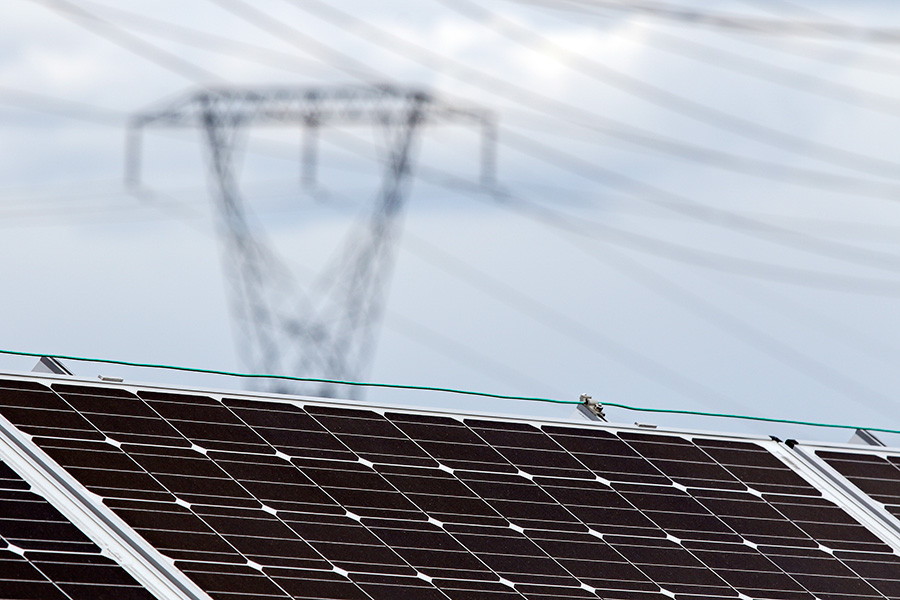
Both Williams and Johnson are sensitive to the perception that an investment in natural gas is at odds with a green power transition, but they framed the project as one piece of a broader “all-of-the-above” strategy that also includes wind and solar power purchases. But those renewables amount to a small fraction of the 200 average megawatts of availability FEC needs, with demand peaking to 440 megawatts during recent extreme weather events.
“We’re resource agnostic,” Johnson said. “We don’t discriminate against resources. What we do care about is that it needs to be reliable, and it needs to be as affordable as possible.”
Members will realize the benefits of the partnership in a decade, Williams said, “when demand skyrockets and all of the utilities that don’t have the agreement that we just signed are going to have to buy energy on the open market.”
“By locking in this power agreement we are ensuring we won’t go on rollercoaster ride for next 30 years,” Williams said.
FEC’s plans to preserve its share of the pie while ensuring reliability and affordability into the future also rely on investments in major system upgrades across its territory, including substation upgrades, new transformers, underground line work, and power line reconductoring in Whitefish, Bigfork, Lakeside, Hungry Horse, Kalispell, and the Swan.
“These projects take a tremendous amount of planning, coordination and skilled field work,” Williams said. “They may not always be visible to members, but they are essential to keeping the system safe, reliable and ready to meet the needs of our growing communities.”
In an era in which extreme weather events are causing major disruptions to grid function, FEC’s strategy involves investing heavily in infrastructure to “build redundancy,” which allows FEC to reroute electricity between adjacent distribution substations during an outage, temporarily transferring the electrical load until permanent repairs are completed.
The co-op’s exposure came into sharp focus in January 2024 when a regional cold snap delivered a week of severe subzero temperatures, pushing FEC “dangerously close” to regional outages, or “rolling blackouts” as system demand peaked at a staggering 442 megawatts. During prolonged cold weather events like that, solar and wind energy is limited while battery storage technology cannot compensate for the demand, both Williams and Johnson said.
“We’ve been on the precipice of [blackouts], I think, three or four times since then,” Williams said, adding that some eastern Montana co-ops connected to the BPA system did experience rolling blackouts during separate events.
Johnson called the January 2024 event “probably the closest” the region has come to a blackout, noting BPA’s own after-action review concluded that the Lower Snake River dams “saved western Montana.”
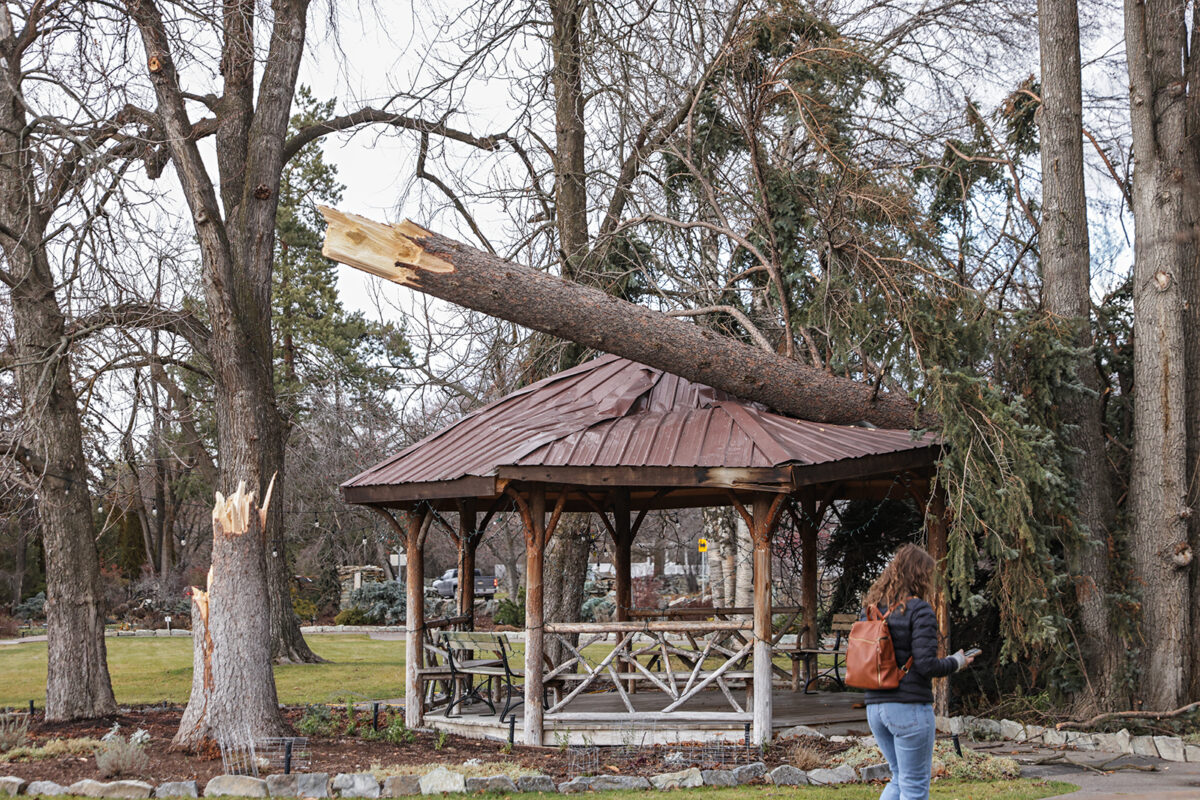
The co-op’s redundancy strategy was again put to the test when a windstorm ripped through northwest Montana last December, buffeting communities from Flathead County to Lincoln County and causing the largest power outage for the longest duration in FEC’s history.
“It was the worst I’ve seen in my career,” Williams said. “As I talked to our line crews out responding, they confirmed it was some of the worst devastation that they have seen in their careers. This was the first storm that really tested our resolve. And it wasn’t just the resolve of our crews, but also the resolve of our members.”
To ensure that availability over the coming decades, FEC is betting big on its investment in natural gas while taking precautions to guard against the potential consequences of high-density load users, such as data centers, which both leaders said stands out as the “top concern for our members.”
FEC’s limited transmission capacity and constrained regional power supply make hosting a major data center currently impractical, they said, and co-op policy — modeled on rules adopted by the Chelan County Public Utility District (PUD) in Washington — requires “high density load” customers to cover the full cost of any infrastructure their presence would require.
“We’re doing this to protect our existing members from any large-scale growth that may occur, separately from our organic growth,” Williams said.
Federal preference-power rules reinforce that protection, barring large single-load users from accessing BPA hydropower directly.
“Our board made the decision 12 or 15 years ago that growth was going to pay for growth,” Johnson said. “So if you’re an entity that comes in to take power from the Flathead, you’re going to pay for your own line extension cost. Growth is going to pay for growth. So instead of all of the members paying for it, now it’s paid for by the entity making the request, whether it’s a grocery store or a tavern or a data center.”
Even as Johnson and Williams emphasize that FEC has “an obligation to serve” large and small consumers of electricity equally, the region’s limited transmission capacity and regional constraints on the availability of power has been a deal breaker for developers kicking the tires on new data center locations.
“Without more capacity in our transmission system, we’re not going to have a large data center that can come in here and start actually consuming electricity,” Johnson said. “That’s one limitation. The other limitation is just the availability of power. In the northwest, we’re way short on energy right now. Even our portion of the [natural gas] plant in Idaho isn’t going to allow a large data center to come in here.”
As a not-for-profit public utility owned by the members it serves, FEC provides electricity to residential, commercial and industrial customers in northwest Montana. Formed in 1937, it was established by a group of neighbors to provide electric service to 117 farm homes. As the area grew, so did FEC. But in 1998, FEC purchased the facilities of the investor-owned utility PacifiCorps, effectively doubling its size overnight. Today, FEC provides electric service to more than 77,000 meters and is the second largest electric utility in Montana, serving a high-density hub with large load users including hospitals, airports and timber mills.
But the core of FEC’s mission remains serving its members, which is why FEC has kept its rate increases at a minimum even as overhead costs have increased at almost every level of operations, Johnson said.
A significant factor driving those expenses is the cost of purchasing power, which represents 60% of FEC’s expenses. With BPA announcing a 20% average increase for transmission service rates and a 9% increase for power rates through September 2028, FEC announced a 5.5% rate increase for its members, which, Johnson emphasized, “we did not take lightly.”
“I was raised on the accounting side of things, so I know what a challenge this creates,” Johnson said. “We went four years without a rate increase, and that’s in large part because of good management and good board direction. But I don’t know anything in our business that hasn’t increased in costs, whether that’s labor, materials, transmission. It’s all more expensive.”
“We’re a co-op, we like local control,” Johnson added. “So we want to maintain that local control relative to our costs and our cost increases, but a lot of it’s out of our hands. And with our growth, we have to build to serve. And it gets expensive, but I think we’ve done a really good job managing it. We’ve been very cognizant of our members.”
Looking further ahead, both leaders point to fundamental shifts in large-scale generation options for the region. With geographic limitations on the region’s transmission and generative potential, and with the reliability risk of intermittent resources like wind and solar, Williams described FEC’s “all-of-the-above” strategy, including its PNGC deal, not as an endpoint, but as a bridge.
“It’s a challenge when the sun’s not shining and the solar’s not generating, or the wind’s not blowing and the wind’s not generating,” he said. “You have to have those baseload generations to fill in the gaps.”
The PNGC partnership, he said, will fill in some big gaps and ensure dispatchable power, but it’s not a permanent guarantee.
“The gas plant is not going to serve the load for rest of FEC’s life. It will serve our needs until about 2040,” Williams said. “This isn’t the end game, this is just part of the game.”