Forest Service Approves Scaled-back Wastewater Facility at Historic Holland Lake Lodge
In response to 155 public comments, Flathead National Forest Supervisor Anthony Botello said he modified the project to overhaul the wastewater treatment system. Work will begin in 2027.
By Tristan Scott
After months of public debate over a proposal to modernize the aging wastewater treatment system serving Holland Lake Campground and the historic Holland Lake Lodge, the U.S. Forest Service has signed off on a final reconstruction plan, scaling back a design the agency proposed in March in response to community pushback.
Flathead National Forest Supervisor Anthony Botello signed the final decision on Aug. 4, authorizing crews to rebuild the lagoon-based treatment facility that has served the popular recreation area roughly 11 miles south of Condon since the 1970s. The system, which handles wastewater from the campground, its RV dump station, and the privately operated lodge, has been offline since 2023 when a tear was discovered in one of its lagoon liners.
To rectify that, the Flathead National Forest has been laying plans to demolish the existing system and build a new public wastewater system that serves both the lodge facility and the adjacent campground and RV dump station.
Given the historic lodge’s location in a popular recreation corridor near the Bob Marshall Wilderness area, as well as the Swan Valley’s pristine ecological character, public interest in its ownership and infrastructure upgrades has run high in recent years. In 2022, an expansion proposal by a Utah-based resort company generated a firestorm of controversy that, coupled with discrepancies in the prospective buyer’s permit application and shortcomings in its review, ultimately led the Flathead National Forest to reject the plan.
But in October 2023, longtime owner Christian Wohlfeil accepted a different offer from investors Eric Jacobsen and Thomas Knowles. Doing business as Holland Peak, LLC, Jacobsen and Knowles secured a new 20-year special-use permit through the Flathead National Forest authorizing them to operate the lodge in its existing footprint on national forest land.
The more modest magnitude of the new owners’ plans tempered public concerns, but the lack of a functioning wastewater facility has remained a formidable obstacle.
With ongoing deficiencies in the wastewater treatment plant, the new owners did not open Holland Lake Lodge during its centennial anniversary in 2024 or in 2025. The Flathead National Forest served the 44-site campground on a temporary basis with portable toilets, a stopgap measure that remains in place this summer.
On March 2, 2026, the Flathead National Forest released its proposal to replace the outmoded infrastructure with “state-of-the-art equipment” and “improved design features” that Botello said aims to modernize the system and “protect the water of Holland Lake for many years to come.”
But that proposal drew a wave of public concern — ultimately about 155 comment letters, plus turnout at an in-person and virtual information session and a local community council meeting. Much of the criticism centered on the size of the proposed system, which some residents worried was too big relative to historical use and primarily benefited the privately run lodge.
In response, officials went back to the drawing board. The final approved design has a treatment capacity nearly half that of the existing system, largely due to a reduced treatment capacity in winter — 4,066 gallons per day in summer and 1,600 gallons per day in winter, down from the March proposal’s 4,330 and 3,030 gallons per day, respectively. The current system has an annual treatment capacity of 1.69 million gallons, while the March 2026 proposed action had a capacity of 1.24 million gallons per year. The agency’s Aug. 4 decision authorizes a treatment capacity of 961,298 gallons per year.
“The project decision authorizes reconstruction of a smaller system than what we proposed in March,” Botello said in a prepared statement Tuesday announcing the decision. “In response to what we heard from the public, we looked more closely at the actual treatment needs from the Holland Lake campground, RV dump station and lodge and were able to adjust the winter capacity to more accurately reflect anticipated winter use of the treatment system. Reducing the size of the aeration and storage lagoons will reduce the cost of the project as well as the footprint, ground disturbance and minimize impacts compared to a larger system.”
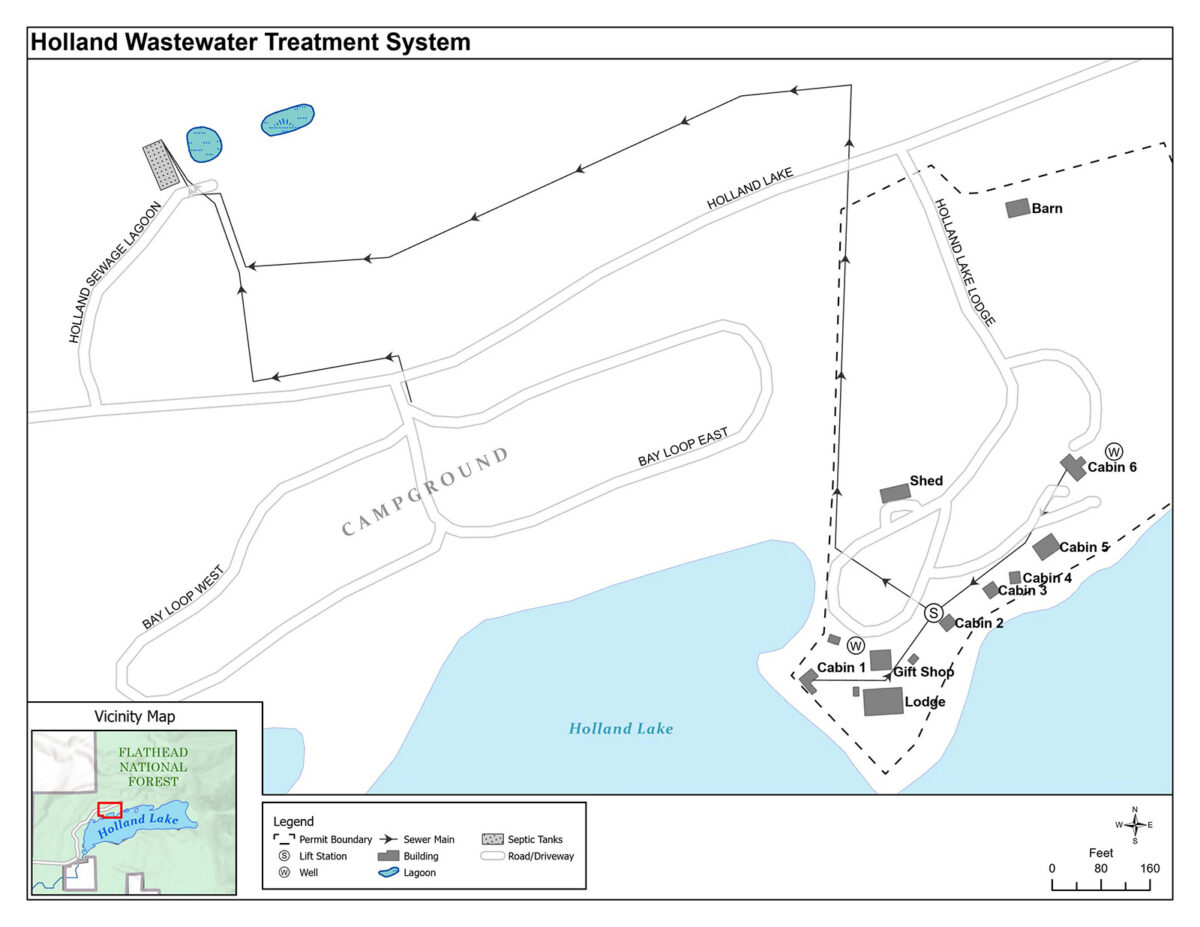
Forest officials say the new lagoons will still have a larger surface footprint than the current ones, but a smaller one than what was proposed in March — a change Botello attributed to updated state design standards for groundwater separation and retention time, not to any planned expansion of lodge or campground operations.
“The forest has not proposed expansion of the lodge, the campground or other special recreational uses at Holland Lake,” officials wrote in their formal response to comments, characterizing the project instead as an infrastructure modernization effort.
Stewards of the Swan Valley, a nonprofit based in Condon, released a statement Wednesday saying it was reviewing the Flathead National Forest’s final decision “to build a new wastewater treatment system that is larger than what is there now.”
“We’re aware of concerns that the proposed wastewater treatment system is larger and the Forest Service will use millions of dollars in taxpayer money to build a system that primarily benefits the private lodge on public land,” Grace Siloti, president of Stewards of the Swan Valley, said in a statement. “We’ll determine next steps based on a close analysis of the proposal and public comments.”
According to Botello, the final action was reduced and refined from the March 2026 proposed action based on public comment, interdisciplinary review and updated design parameters. He said calling the system “larger” is a mischaracterization.
“The final design has changed from the current footprint for several reasons, but to characterize the change as an increase depends on which measurement is being used,” according to the decision. “The updated wastewater facility will be larger in surface area than the existing lagoons even though the daily flow rates are being reduced.”
A handful of commenters went further in their opposition, urging the Forest Service to terminate Holland Lake Lodge’s special-use permit altogether and convert the site to public recreation use. Officials declined to consider that option, noting the lodge is one of four such resort permits authorized on the Flathead National Forest and has long served forest visitors under the agency’s land management plan.
Because the project qualifies for a categorical exclusion under federal environmental analysis rules — meaning it doesn’t require a full environmental assessment or impact statement — the decision is not subject to administrative review.
Implementation of the project, including demolition of components of the current system and installation of the new system, is anticipated to begin in 2027. Reconstruction of the system is expected to be complete in 2028. Project documents are available for public review on the project webpage.
The original treatment facility was built in the early 1970s and overhauled in 2000, when the lagoons were reshaped, lined and reconfigured so treated effluent could be sprayed onto a nearby forested area rather than discharged directly into the ground. But engineers say the facility has reached the end of its useful life, and the recent liner failure — while not found to have contaminated groundwater or Holland Lake — underscored the need for a full rebuild.
Under the approved plan, crews will remove sludge from the existing lagoons, demolish the old infrastructure and construct two new lagoons in the same location: one for aerated treatment and one for storing treated effluent during winter months when spray irrigation isn’t possible. Both will be lined with thicker, more durable synthetic liners than those currently in use, and the primary lagoon will get a floating cover designed to control odor, maintain treatment temperatures and block algae growth.
Public comments also raised concern about grizzly bears being drawn to open sewage lagoons, potential water quality impacts to Holland Lake, seismic risk, and construction traffic on the road serving the campground, lodge, and a popular trailhead.
The Forest Service said it consulted with Montana Fish, Wildlife and Parks’ bear specialists in designing the project and will install electrified, chain-link fencing around the facility consistent with state guidelines, along with warning signage. Contractors will also be briefed on procedures for working safely in grizzly country. Officials said water samples collected near the site in 2023 showed nutrient levels well within normal ranges, and a required consultation with the U.S. Fish and Wildlife Service concluded the project is “not likely to adversely affect” threatened bull trout or their critical habitat. The agency also noted the lagoons are far too small to be regulated as dams under federal or state seismic standards.
To ease construction impacts, the Forest Service added several conditions to the final decision, including a ban on hauling activities during summer weekends, dust abatement along Holland Lake Road, and construction warning signage for the public.