Whitefish City Council to Consider Picking Up Carryover Mills in Final FY27 Budget
With roughly 27 carryover mills and a threat for them to be stripped in the upcoming legislative session, city councilors are weighing the risk of leaving them on the table
By Lauren Frick
Whitefish city councilors must decide whether to capture additional “carryover” mills in the city’s Fiscal Year 2027 budget ahead of their Aug. 17 meeting, with city staff expressing serious concern over the city’s roughly 27 carryover mills potentially being stripped in the upcoming legislative session.
After two budget work sessions this week, councilors on Thursday night gave a split recommendation to City Manager Dana Meeker to capture five additional mills in the budget she originally proposed earlier this summer. Based on the city’s 2026 certified taxable value released Monday night, one mill equates to $121,346.206.
While Councilors Ben Davis, Giuseppe Caltabiano and Steve Qunell supported the five additional mills, Councilors Rebecca Norton and Andy Feury voted against the direction, instead advocating for capturing 10 additional mills in the FY27 budget. Councilor Frank Sweeney was absent.
Although direction was given to Meeker to continue with a budget that includes five additional mills, all options will remain on the table until the city council’s first public hearing on the final budget on Aug. 17.
Carryover, or “carry-forward,” mills refer to unused mill levy capacity. Under Montana Code Annotated 15-10-420, if a local government or taxing jurisdiction doesn’t levy the absolute maximum number of mills allowed in a given year, it can “carry forward” that unused taxing authority and impose it in a later year.
Reading the tea leaves for the 2027 legislative session, Meeker told councilors there’s legitimate reason to believe that the city’s ability to carry forward mills will be taken away next year.
“If they actually get rid of the ability to carry forward mills completely, that’s where we’re really going to get hurt,” Meeker said at the Aug. 3 work session. “I don’t want to be a doomsdayer and try to say like yes, we should raise property taxes because of that, but I think we have to think really carefully about what the future holds and what the demand is for this community.”
“We have $165,000 going to nonprofits,” she added. “If in a year from now we can’t afford the wages of our firemen or policemen, we cut positions, or you find other revenue. Other revenue might be telling nonprofits we can’t support you anymore, or we cut our police force down. I mean, there are times where it can get that bad, and we just haven’t been in this place in a very long time. We still aren’t technically in it, but that is my fear.”
Feury at Monday’s work session adamantly supported capturing as many additional mills as possible, saying he would be “remiss” in his duty if he didn’t advocate for picking up all 27 carryover mills currently on the table.
“If we don’t pick up extra mills this year … we’re going to kick that can down the road, which means we’re going to make future councils have a very difficult time, and we’re also going to be taking away some of the financial tools that they would have to deal with those problems,” Feury said. “I think the only valid argument I can make for not doing it right now is that we’ll feel good about ourselves and we can go out to the Bulldog or wherever and go, hey, we didn’t raise taxes this year. That’s the only benefit this community would get out of that today.”
After receiving the city’s certified taxable value late Monday night, Meeker presented multiple options to the council that would allow them to capture zero, five or 10 additional carryover mills.
If the council later this month were to adopt Meeker’s budget proposal that includes five additional mills, the total property tax revenue collected by the city increases by 31.39%, and primary residence/long-term rental properties with a median home value of $1 million will see around a 1% increase, according to city documents. The budget would require no elimination of proposed projects or positions in FY27 preliminary budget and would close the gap of reserve spend-down for operations. There would be roughly 16.59 carry-forward mills remaining.
If the council adopts the preliminary budget plus 10 additional mills, the total property tax revenue collected by the city increases by 42.32% and primary residence/long-term rental properties with a median home value of $1 million will see around a 6.6% increase, according to city documents. This budget also would require no elimination of proposed projects or positions in FY27 preliminary budget and would close the gap of reserve spend-down for operations. There would be roughly 11.59 carry-forward mills remaining.
No matter which alternative the council selects for its final FY27 budget, many second-home owners and short-term rental properties will see the biggest increases due to the state’s decision to redistribute the burden of property taxes, Meeker said.
Under the city’s preliminary budget proposal plus five additional mills, a primary resident with property that has a 2026 market value of $862,700 will see a total annual increase of $0.51 for their city taxes, or a total 0.07% increase from last tax year.
That same property under the same budget proposal would see a total annual increase of $448.14 — a roughly 61% increase from last tax year — if it was designated as a non-primary resident or non-long-term rental property, according to city documents.
Under the city’s preliminary budget proposal plus 10 additional mills, a primary resident’s $862,700-valued home would see a total annual increase of $37.76, representing a 5.17% increase in their city taxes from last year.
That same property under the same budget proposal would see a total annual increase of $620.10 — a roughly 85% increase from last tax year — if it was designated as a non-primary resident or non- long-term rental property, according to city documents.
Meeker also presented to the council an analysis of the total property tax bill change for the city, county and state/education over the last eight fiscal years based on an example property with the FY26 market value of $1 million. The analysis found the city’s tax bill had an average growth of 2.5% since FY19, compared to 6% for the county and 6.7% for the state/education.
“Every year we’re a smaller and smaller portion of a tax bill,” Meeker said. “If we’re trying to level out other people’s property tax bills, there’s no way that we’ll ever be able to do that when you have these other jurisdictions increasing it. I think that the important part is that you know we’ve been very fiscally sound in our decisions.”
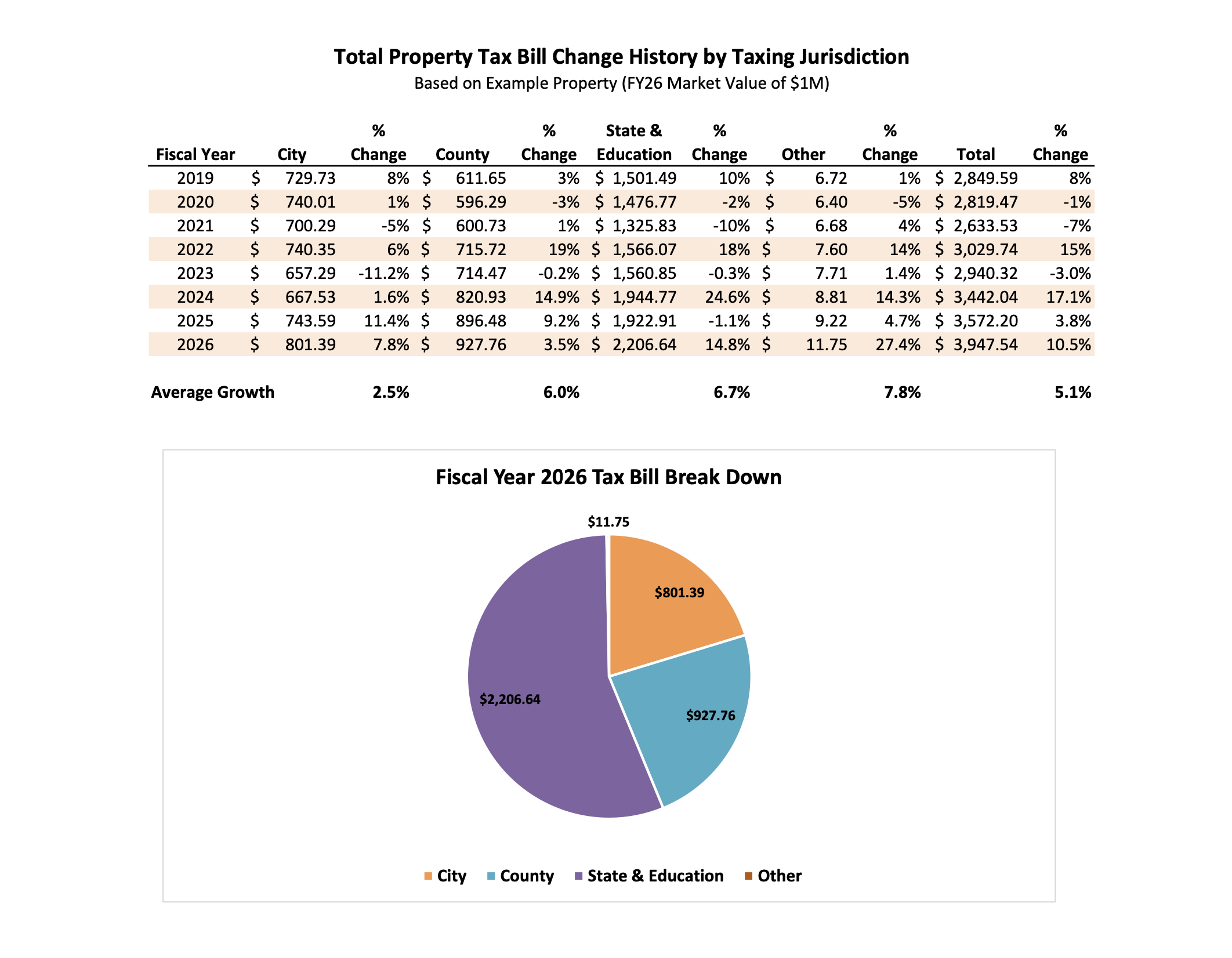
The city’s modest average tax bill increase over the years, paired with what some councilors saw as a marginal increase in taxes for primary residents despite capturing more mills, led to some city councilors strongly advocating for the budget proposal with 10 additional mills at Thursday night’s work session.
“I think this turned out a lot better than we thought it was going to be,” Norton said. “I don’t think it’s a hardship. I’d really like the staff to be fully supported, and I think there are risks of losing our mills, legitimate risks. So, I just would feel better about our future if we actually collected them in a good year when it’s not going to be too much of a hardship.”
Feury and Mayor John Muhlfeld also voiced support for the additional 10 mills, with Feury saying not picking up as many additional mills as possible “would probably be the most irresponsible thing that we have ever done with the budget” in his 26 years on council.
“If we look at the $1 million home … we’ve raised people’s taxes, the city portion of their taxes, over that six-year period of time $1.58 per month,” Feury said. “That’s it, and that’s picking up the 10 mills. I think that’s quite frankly, I think that’s very fiscally responsible for us. I would feel terrible going forward … to hamstring further councils with not having enough mills to deal with what we know we’re going to have to deal with in the future.”
Davis, who initially asked for cuts in expenditures in the preliminary budget, said he was now comfortable with the budget as it is following the official calculations from the certified tax roll, but was frustrated with the idea of being forced to pick up any extra mills because the legislature might take them away.
“I’m not very excited about picking up extra mills just because of what the legislature might do,” Davis said. “I would rather act it when it comes personally.”
Qunell described capturing 10 additional mills as “shooting for the moon,” adding that while the tax increase may seem marginal, it will still add up for residents.
“People that didn’t ever expect to live in a million-dollar home live in million-dollar homes right now, and $2 a month here; $2 a month for trash; $2 a month for water; $2 a month for electricity; it adds up,” Qunell said. “And when you’re in a situation where your income doesn’t grow by that much, it’s a burden.”
“I would rather tell the story, look at this, we picked up five mills, and we pretty much kept taxes flat,” he added. “I think we can pick up five mills, and taxes are not going to increase, and we can tell that story because we’ve done such a good job that our taxes, our average growth is not going to increase.”
By the end of Thursday’s work session, the budget proposal with five additional mills gained the majority support from the council, garnering the recommendation back to staff. No final decisions on the budget will be made until the public hearing on Aug. 17.