Montana Fish and Wildlife Commission Adopts Reduced Wolf Harvest Quota Amid Population Estimation Error
Faced with revised counting methodology that dramatically reduces the state’s estimated wolf population, commissioners approved a scaled-down quota of 300 wolves in Montana
By Jules Lingenfelter
As the Montana Fish and Wildlife Commission sat down Wednesday for its August meeting, Region 1 Commissioner Ian Wargo repeated a comment he had heard earlier — “It’s really difficult to manage what you can’t measure.” With that observation, a nearly 10-hour meeting unfolded to determine how best to manage, and measure, Montana’s wolf population.
In the end, commissioners approved a set of regulations reducing the number of wolves hunters and trappers can harvest this season.
Even as the last item on the agenda, the proposed wolf and furbearer hunting and trapping regulations commanded much of the room’s time and attention, consuming nearly half of the proceedings and generating intense debate.
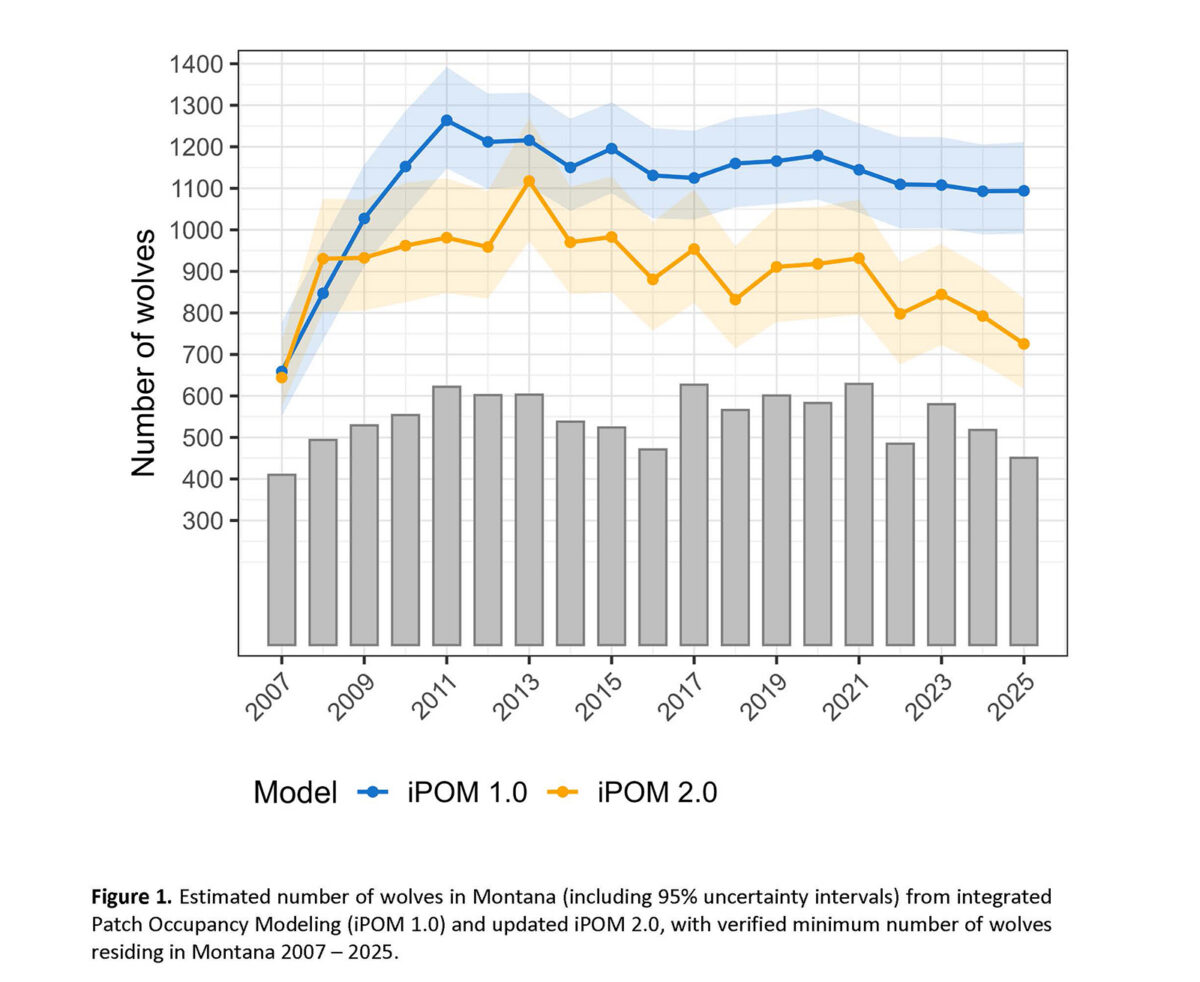
The lengthy deliberations represented a culmination of several weeks of rising tensions around wolf management. In July, FWP acknowledged that it had overestimated the wolf population — after instituting the updated estimation model iPOM 2.0, the wolf population stood at 725, compared to the previous estimation of 1,094. Due to the counting disparity, the agency recommended cutting the statewide harvest quota in half, bringing it down to 250 wolves to reflect the new numbers.
After five hours of discussion and public input, the commission voted to adopt a statewide quota totaling 300 wolves, broken up into region-specific subquotas. The sudden shift from statewide to regional numbers, and an increase of 50 wolves compared to Montana Fish, Wildlife and Parks’ (FWP) recommended harvest quota for the entire state, was introduced through a last-minute push by Wargo, the commissioner representing northwest Montana, a region that is home to one of the state’s highest concentration of wolves. As such, it now has the highest regional subquota in the state at 131 wolves. That compares to 92 wolves in Region 2; 33 wolves in Region 3; and 28 wolves in Region 4.
Critics from both sides of the aisle were quick to point out that iPOM 2.0 has yet to be peer-reviewed, and questioned how heavily that estimate could be relied on, especially when arriving at a finer-grained regional approach.
During the Aug. 19 meeting, the commission members, too, expressed differing opinions on how the new estimate should influence wolf hunting regulations. To mitigate some of the confusion, FWP Carnivore Coordination Molly Parks opened the discussion with a presentation on the difference between iPOM and iPOM 2.0, which stand for integrated patch occupancy model. Still, the rushed timeline of the new model’s release and the lack of clarity around the estimates colored much of the discussion.
“This same group coming to us last year with a 500 statewide quota is now to 250,” Wargo said at the meeting. “I feel like, it’s a little bit of a tap the breaks, have a little more discussion.”
Wargo, who voiced the belief that the new estimate was “overly conservative,” spearheaded the charge for more liberal hunting regulations. Five days before the meeting, he introduced three new amendments, two of which addressed wolves. The first amendment he introduced, which passed, increased the Region 1 bobcat quota to 200 from 175.
Wargo’s second amendment proposed specific quotas for each of Montana’s seven regions and two Wolf Management Units which totaled 317 wolves, rather than a blanket, statewide number of 250. “I think there’s gonna be a lot of folks that don’t like the numbers I threw out but do like the structure,” Wargo said.
A two-pronged back-and-forth ensued as commissioners battled over the amendment, as well as how much faith they should place in iPOM 2.0 and whether wolf management should return to a more localized method.
A regional approach to wolf management, FWP’s Game Management Bureau Chief Brian Wakeling said, is a double-edged sword. The approach allowed for more targeted harvest goals, but wolves aren’t bound to human-drawn boundaries and frequently roam between regions.
Region 2 Commissioner Jeff Burrows, who seconded the amendment, agreed with Commissioner Wargo. “I really like the regional approach,” he said. “I think it makes sense to go to a regional approach and manage like we do pretty much any other species.” Both Commissioners argued that northwest Montana faced issues that set it apart from the rest of the state. The two regions oversee the highest number of wolves, and Burrows and Wargo cited specific concerns over depressed ungulate populations in the areas. The amendment proposed the highest quotas for Region 1 and 2 at 135 and 95, respectively.
“There’s a need for a little more localized, granular approach,” said Region 3 Commissioner Susan Kirby Brooke. “With iPOM 2.0 coming out with such short notice, I didn’t have the chance to have that conversation with a lot of people.”
Brooke expressed further concern over the increased overall quota. “It warrants being cautious,” she said. “The department came with 250. And we’re gonna go 50 over.”
Burrows pushed back on Brooke’s critique of the amendment, arguing that they either needed to base their decisions fully on iPOM 2.0 or disregard the estimate entirely. Earlier in the meeting, the commission passed an amendment proposed by Brooke to reduce bag limits in Region 3 and Wolf Management Units (WMU) 313 and 316. If the commission was willing to approve Brooke’s amendment that went against the opinion of FWP’s biologists and was last minute, Burrows said, they couldn’t hold Wargo to a higher standard.
Other commissioners were less enamored with the proposed shift. “I feel like you’re kind of shooting from the right now, as far as the numbers go,” said Region 7 Commissioner Bill Lane. Lane voiced the strongest opposition to the amendment. A regional approach, he said, would offer far less flexibility and it was too soon to make a decision without the input of the regional offices.
After an extended back-and-forth, Burrows suggested the commission return to an idea offered up by Region 5 Commissioner Vern Gagnon earlier in the session. Gagnon proposed a slight tweak to each of the region’s quotas that would bring the total harvest down to 300.
“We’re bound by the law on one side, bound by relisting on the other,” Wargo said, as the commission moved to a vote. “I don’t know why we’re not trying to thread that needle a little bit more.”
The amendment passed with a vote of 5-2 with Lane and Region 4 Commissioner K.C. Walsh dissenting.
In his third and final amendment, Wargo reemphasized his concern over depressed ungulate populations in the Northwest. He proposed to establish another WMU with a hunting season extended between September and June. A new WMU, Burrows said, would be worth a shot to see if it recovers elk populations. The amendment failed with a vote of 3-4.
The meeting opened up to a session of public comment — much of which echoed concerns voiced both by commissioners and the earlier written public comment period. iPOM 2.0 and uncertainty around the new estimate remained a particular sore spot for all parties involved.
The commission voted unanimously to adopt the Fall 2026-Winter 2027 hunting and trapping regulations, marking a shift to a more-localized approach to wolf management and an overall harvest quota of 300.