Stimson Timberland Easement Gains Final Commission Approval
The 20,629-acre conservation easement would protect timberland in Lincoln, Mineral and Sanders counties as part of a broader effort to conserve Stimson's entire inland timber base
By Tristan Scott
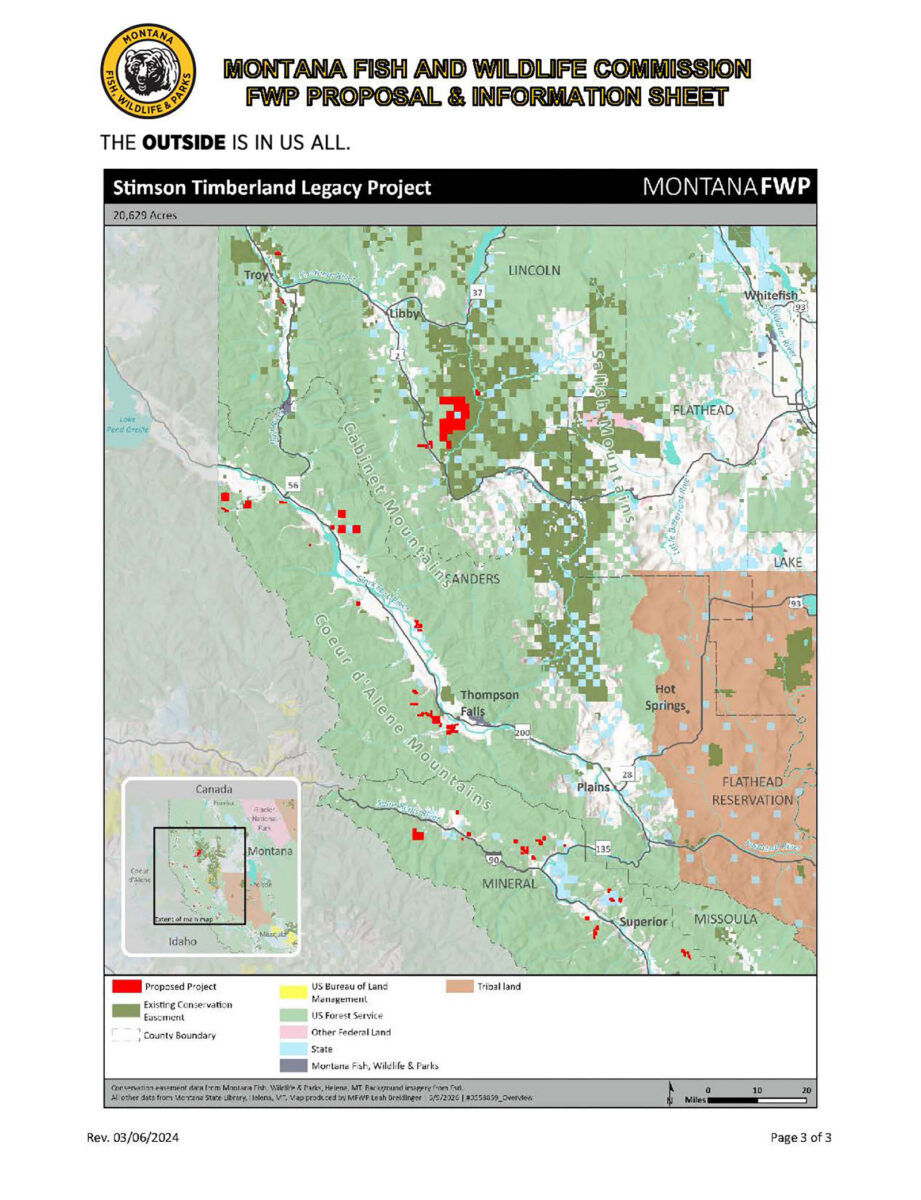
A multi-generational, family-owned timber company is set to place the last of its entire 130,000-acre Montana timber base under working conservation easements after the state’s Fish and Wildlife Commission approved the purchase of 20,629 acres in northwest Montana.
The Stimson Timberland Legacy Conservation Easement, which last year was awarded a $10.2 million grant through the U.S. Forest Service’s Forest Legacy Program, is part of an even broader effort to conserve Stimson’s timber inventory spanning Washington, Idaho and Montana. The easement would prevent development, protect important wildlife habitat, maintain key landscape connectivity, and provide permanent free public recreation access.
Barry Dexter, Stimson’s resource advisor, told commissioners on Aug. 19 that the latest easement marks the final piece of the puzzle in Stimson’s long-term vision to conserve its working timberland in Montana.
“For more than 15 years, Stimson has worked to place its Montana timberlands under working conservation easements. This easement is the final step, the final building block in that process. When we complete this, the company’s nearly 130,000 acres will be under working conservation easements in this state.”
With an appraised value of $29,293,900, the easement proposed by Montana Fish, Wildlife and Parks (FWP) would be paid for in federal grant money and through donations. As such, it does not require approval by the state’s land board, meaning the commission’s approval on Wednesday is the final word.
Bill Schenk, FWP’s land and water program manager, told commissioners that secured funding for the project includes: $10,200,000 from the U.S. Forest Service (USFS) Forest Legacy Program, $250,000 from Avista Utilities, $150,000 from NorthWestern Energy, and $1,015,000 from private fundraising coordinated by the Trust for Public Lands. Stimson has committed to donate approximately 60% of the easement’s value, or $17,678,900.
“As with others you have seen come before you, this easement is geared toward the protection of habitat in the sense that it prohibits subdivision, ensures the public access that has taken place on these lands for many, many years remains and, importantly, perpetuates the production of timber, the intent of which is to preserve productive timberlands,” Schenk said.
The project would conserve year-round wildlife habitat and protect a migration corridor for elk, mule deer, white-tailed deer, and moose. It would also preserve critical habitat for bull trout, grizzly bear and Canada lynx — all species listed as threatened under the Endangered Species Act.
The property, which is broken up into checker-boarded parcels ranging from Libby to Superior, has long been a haven for hunters and anglers, providing approximately 6,000 days per year of public hunting and angling use, Schenk said. The project shares 115 miles of border with U.S. Forest Service and state lands, as well as 15 miles of border with other privately conserved lands.
Along with Stimson’s contribution to the cost of the conservation easement, Dexter said FWP and the Trust for Public Lands have “been right by our side with a shared vision and support to make this a reality.”
“Stimson is an active manager of our timberlands; we are not an absentee landowner,” Dexter said. “We work to keep our timberlands healthy and vibrant, planting trees, reducing hazardous fuels buildups, improving fish and wildlife habitat, and removing noxious weeds. Why does it matter? Why it matters is that many of the private industrial timberlands of western Montana have been sold and converted to other uses, including development, over the last 10 years. A big chunk of it. So, what remains of this traditional timberland is really important to preserve these lands, produce timber, provide jobs, maintain open space, provide key fish and wildlife habitat, and also provide the public with free and permanent access.”
In both written and in-person comments submitted to the commission, the conservation easement received broad support from sportsman groups, outdoor recreation stakeholders and conservation organizations, including the Montana Outfitters and Guides Association, the Anaconda Sportsman’s Club, and the Montana Wildlife Federation.