Columbia Falls School District Asks Voters to Approve $75.9 Million Bond for High School Improvements
This year’s bond efforts come on the heels of a steeper-priced ask shot down by voters last November, but those advocating for it hope this year’s bond can garner support as they describe safety and infrastructure needs in the aging building.
By Mariah Thomas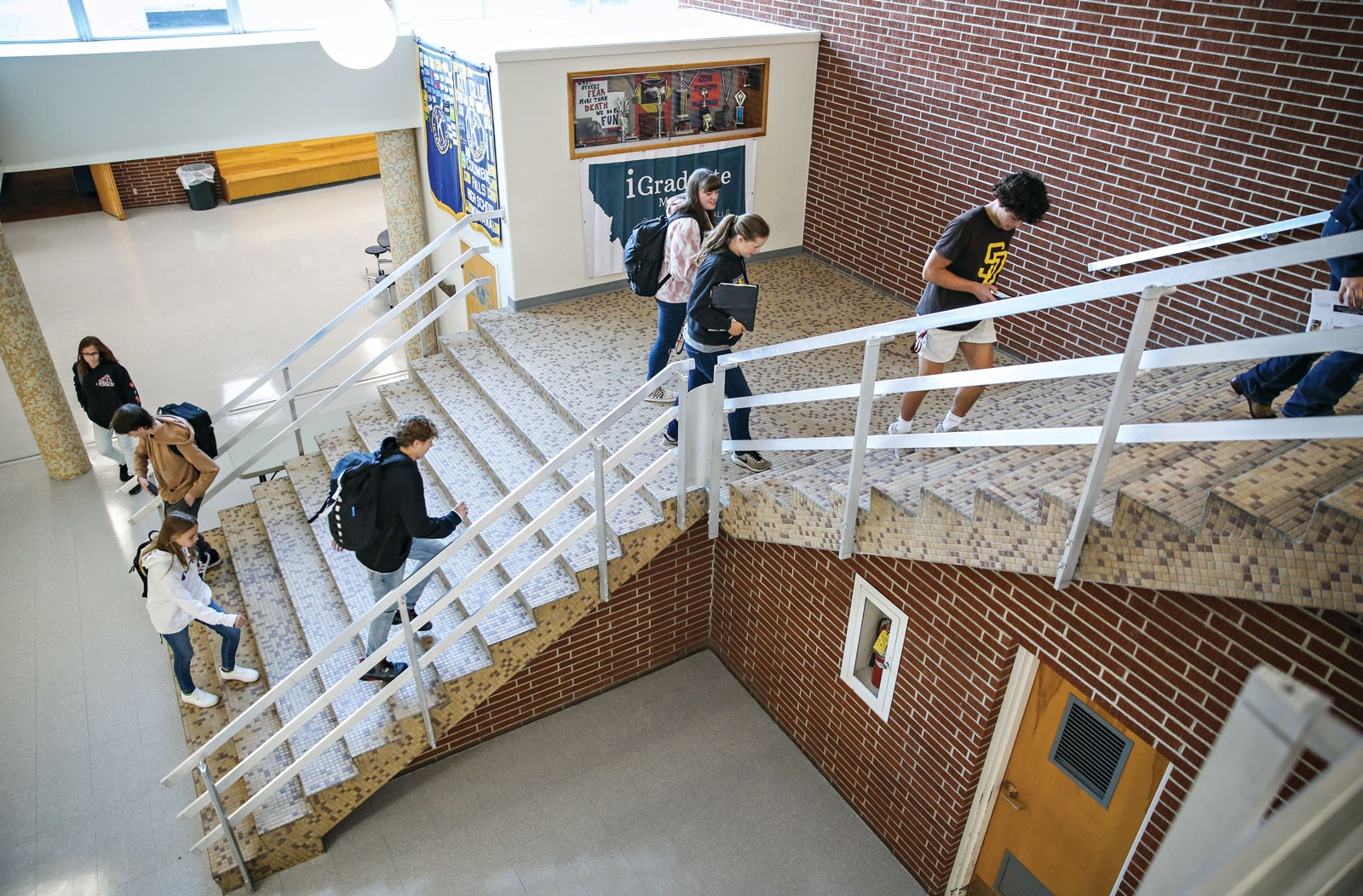
Since AuBonny Nagel graduated from Columbia Falls High School in 2003, she said not much has changed in the building, first constructed in 1958. Fast forward 23 years and Nagel, who now works at First Interstate Bank, has joined forces with a tight-knit group of five volunteers forming the backbone of the Wild Political Action Committee, formed in the spring to advocate for a high school bond that will hit voters’ mailboxes this September.
The bond, with a price tag of $75.9 million to be spread over 25 years, is the school district’s second attempt to garner community support to make improvements to the Columbia Falls High School campus.
The district has proposed a phased approach for collecting the funds, said district clerk Dustin Zuffelato. That phased approach, Zuffelato explained, comes because the district anticipates the project taking several years to complete. When a district sells bonds, though, it has only three years to spend that money; and the Columbia Falls School District anticipates a longer timeline than that for the high school improvement project.
In total, the bond is estimated to cost $321.15 annually for taxpayers whose homes are valued at $600,000. With the phased approach, Zuffelato said that cost won’t hit all at once. The district plans to collect $50 million through fiscal year 2028, so the bond will increase taxes by around $211.64 at first. Then, the district plans to collect the rest, which will cause the spike up to the $321.15 figure.
This year’s bond efforts come on the heels of a steeper-priced ask shot down by voters last November. But things are different this year, according to superintendent Cory Dziowgo.
The district slashed $9 million from last year’s price tag by reducing the proposed square footage, moving the library to the school’s first floor and redesigning its “Little Theatre,” among other cost-saving measures. A two-year building reserve levy has come off taxpayer rolls, along with a new property tax code taking effect, which Dziowgo said has brought down property tax bills for many in the district.
And with the PAC’s involvement, more full-throated advocacy for the bond effort can take place as Nagel and other volunteers drum up support for the measure.
“Historically, bonds do not pass without a PAC’s support, because the PAC can be front and center and give that information to the public without having kind of a quiet stance on it,” Nagel said. “The school has to be very careful not to sway votes or put a yes or a no in either direction. We don’t want to sway; we want to be able to encourage people to pay attention to the facts and ask the questions and become informed and really invest in the future of this community — not to just pass judgment because they see a number, but to really invest in what they’re getting for the pass of this bond, which is a building to sustain for the future.”
Nagel and Sarah Day, a paraprofessional in the district who has two children attending the junior high, described efforts to put together video content to share on social media in support of the bond. They’ve attended several community functions, like the Columbia Falls Heritage Days parade, to spread the word. And as ballots go out Sept. 9, Nagel, Day and a slew of other volunteers will also start to “hit the pavement,” knocking on neighbors’ doors to talk to them about the bond.
They described their personal support for the bond as a matter of concern about the school’s challenges with safety and infrastructure, pointing to a slew of examples.
First built in 1958, the high school hasn’t received significant changes since the 1980s. It has more than 30 entrances to secure, a challenging task in a modern schooling environment where security risks have caused most schools to consolidate to only a few entrance points. The building also has no fire sprinkler suppression system. Its wiring and boilers are out-of-date, which makes it difficult to keep the school’s temperature regulated.
Beyond the building itself, the district has also said it hopes the renovations will provide updated spaces for career and technical education options it has championed in recent years. Additions like a mechanics bay and machining options were part of the bond package last November. The chance to offer state-of-the-art spaces in those areas — alongside an improved theatre, moving the arts program closer to the school and increasing seating in the gymnasium — remain part of the argument Nagel and Day presented for the bond’s passage this fall.
Still, the bond issue likely faces an uphill battle as school districts across Montana have struggled to pass funding asks in recent years. That struggle is particularly pronounced for general fund levy requests, which help bolster school districts’ bottom lines by providing funding to pay for operations and staff. Data is more inconclusive for bond issues, which are used to pay for schools’ physical structures. While it’s a less-clear trend, generally, voters still appear to have decreased enthusiasm for bond measures. In 2016, for instance, voters approved 11 out of 12 bond asks across the state; in 2025, they approved only 9 of 16 bond proposals.
Nonetheless, Nagel and Day remain hopeful about the Columbia Falls High School bond’s prospects for passage this fall. They said much of the feedback they’ve heard has been positive and hope their efforts talking to voters helps dispel questions and uncertainty.
The bottom line for the pair: it feels to them like it’s high time to pass the bond and give students something new and improved.
“Once you bleed blue, I feel like there’s always some passion and some heart in there that will carry on when you’re in the sports, and you’re part of theatre and choir and band,” Nagel said. “You take a piece with you forever when you’re in high school, and I think it’s important to give as much as you can in that space. But this isn’t just about for the now for this bond. It’s for the future of our community … We want [the kids] to remember the opportunities that they were given and the dreams that we knew that they could do and pursue, and that the community believed in them.”
This fall’s school election will be conducted entirely by mail. Ballots will be sent out Sept. 9 and are due back by 8 p.m. on Sept. 29. Voters can either mail their ballots back or drop them off at ballot drop box locations in the county.
Those drop boxes are located at the Flathead County Election Office between 9 a.m. to 5 p.m. Monday through Friday; or at the Columbia Falls School District administration office between 9 a.m. to 4 p.m. Monday through Friday. Both drop box locations will remain open until 8 p.m. on Election Day.