Flathead National Forest Approves Logging Project Along Hungry Horse Reservoir
The Dry Riverside Project authorizes timber harvest on nearly 7,400 acres to reduce wildfire risk
By Jules Lingenfelter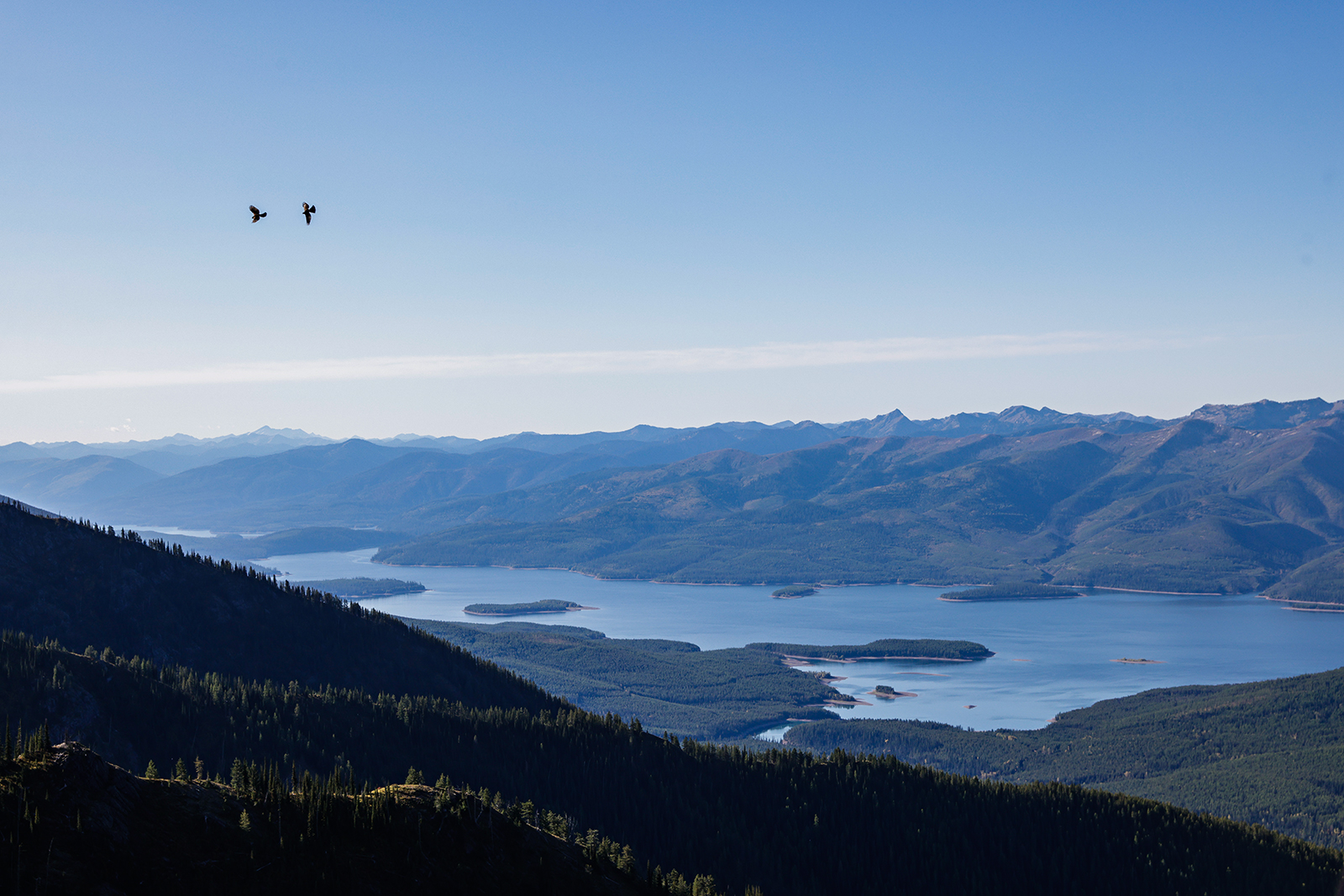
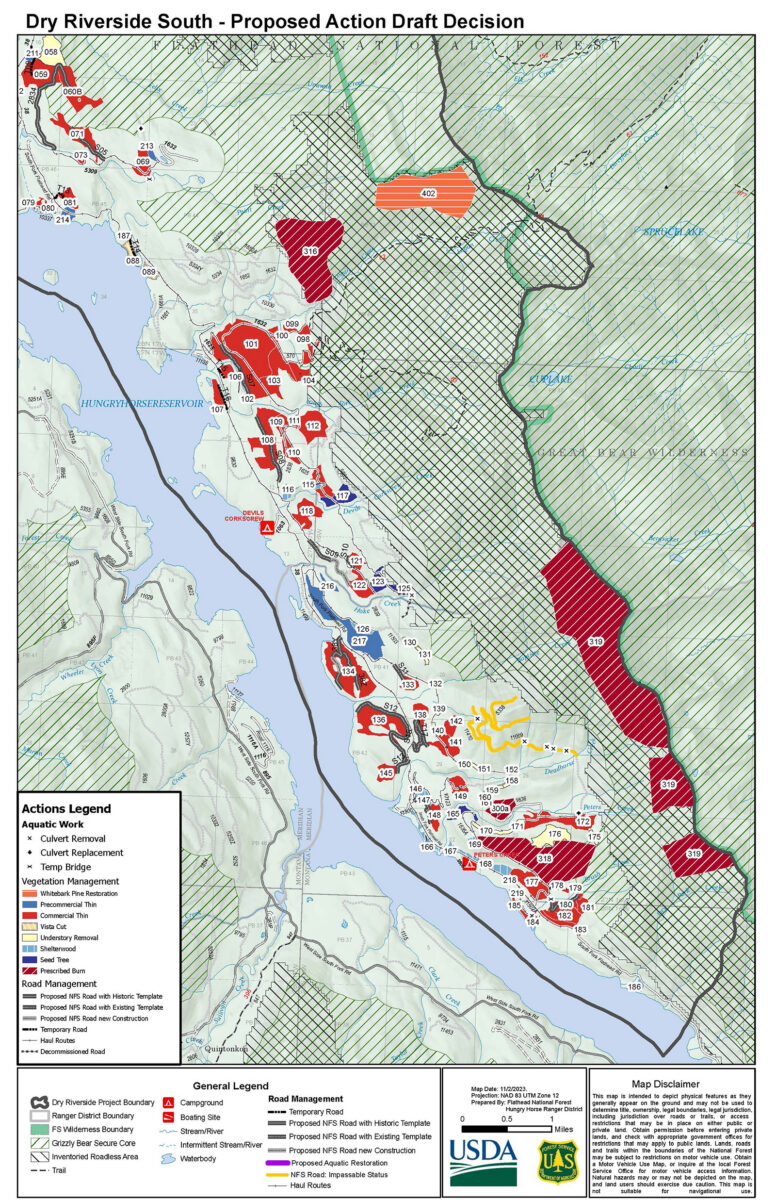
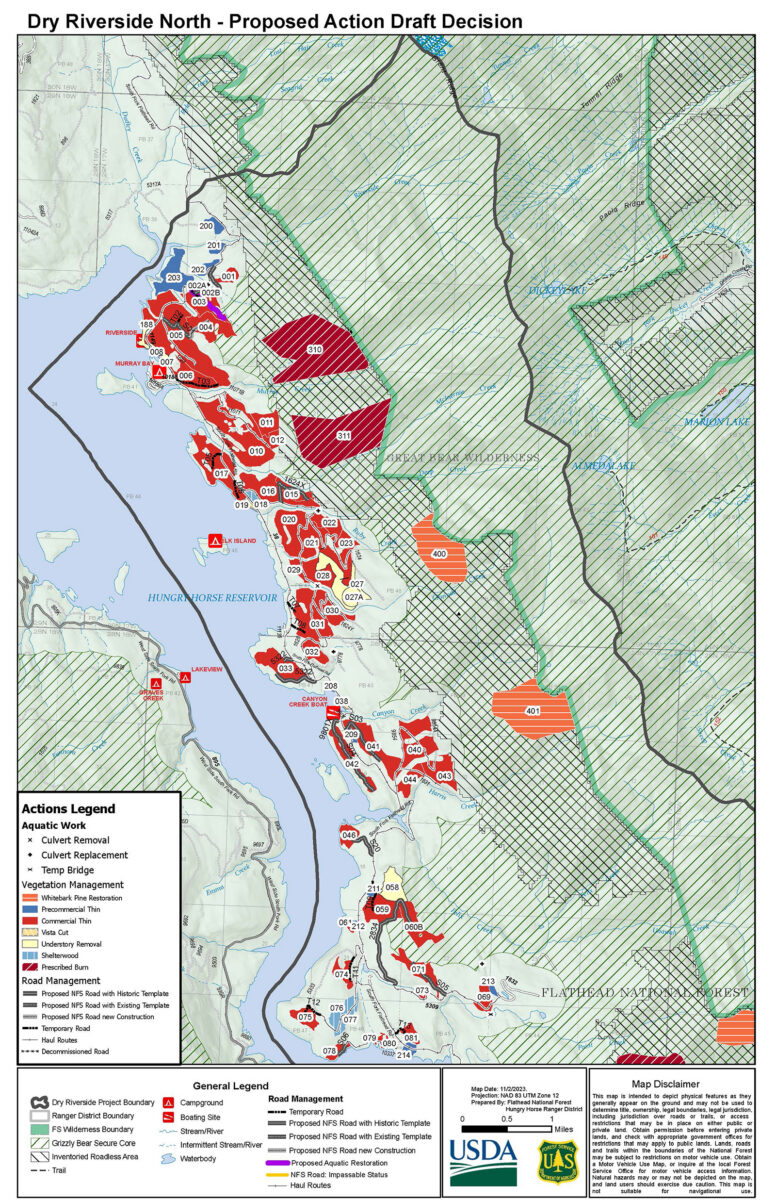
The Flathead National Forest has approved a forest logging and whitebark pine restoration project east of the Hungry Horse Reservoir. Forest officials released the final decision notice and environmental assessment on Sept. 8, capping a nearly three year process.
First scoped in Nov. 2022, the Dry Riverside Project spans nearly 55,000 acres, of which roughly 7,400 acres will see active treatment. The goal of the project is to address areas that pose wildfire risk, as outlined in the 2018 Flathead National Forest Plan, through fuel removal and by diversifying tree species and ages, agency officials said.
“The Dry Riverside Project was developed to manage forest conditions along Hungry Horse Reservoir with a high density of species that are less resilient to wildfire and drought compared to other species,” Rob Davies, the Hungry Horse-Glacier View district ranger, said in a press release. “This project will help transition the area to more open Western larch and Western white pine forests—two tree species that are more adapted to wildfire.”
“In addition to vegetation management work, this project will restore over 700 acres of whitebark pine through increasing genetic diversity and resistance to blister rust. We are excited to see this project moving forward,” Davies added.
The decision notice, signed by Flathead National Forest Supervisor Anthony Botello, outlined the approval of an alternative action that reduced the proposed area of treatment by 482 acres. The alternative action also reduced required road activity to avoid the implementation of a complicated subunit road system that would have been necessary to comply with grizzly bear conservation.
“I have selected this alternative because it increases contractor flexibility,” Botello wrote in the decision notice, “and as such, increases the feasibility of implementing the Dry Riverside Project.”
The approval authorizes commercial timber harvest on 3,727 acres and an additional 3,683 acres of non-commercial treatment including prescribed burning on 2,370 acres and planting whitebark pine seedlings on 718 acres. To complete vegetation treatment, the project plans to construct 4.3 miles of temporary roads and reconstruct approximately 16 miles of historical and existing roads in the Flathead National Forest.
During the initial scoping phase, several public comments expressed concern that the proposed fuel reduction actions would increase wildfire risk rather than prevent, according to the final decision notice. “The comments were considered, and the literature was reviewed for relevance,” Botello wrote, “Additional references were added to the project file to further document that fuel treatments in general do reduce the negative outcomes of wildfire, which included work by the Rocky Mountain Research Station.”
The Dry Riverside Project proceeded through another round of public comment in September 2023 after the first environmental assessment. In November 2023, a draft decision and revised environmental assessment were made available to the public for a 45-day period of objection — forest officials received five letters of disapproval and two in support. A public meeting scheduled in January 2024 to address the dissenters’ concerns was cancelled due to lack of confirmed attendance.
Over two years later, the project has officially been approved with the release of the finalized environmental assessment. In the decision notice, Botello stated that he found the proposed actions to have no significant impact on wildlife, carbon emissions, and public health and safety.
“Increasing forest resistance and resilience to fire, drought, insects, and disease slows the release of carbon and retains larger portions in forest carbon pools. By actively promoting a more resilient forest, the Dry Riverside Project is helping this ecosystem adapt to intensifying disturbances and extreme events,” Botello wrote. “I considered all these short and long term as well as beneficial and adverse effects. Based on the detailed resource reports contained in the project record and summarized in the Final EA I have determined that none of these effects or any other effects evaluated in the EA will have significant impacts.”
The Dry Riverside Project comes on the heels of several other logging projects in the Flathead National Forest; the Rumbling Owl Fuels Reduction project and Rad Reid Blowdown Salvage project were both approved in August and the Granite-Moccasin and 2026 Blowdown Emergency project are currently in the decision stage.
Work on the Dry Riverside project is expected to begin in 2027 and projected to take five to ten years for completion. Project documents, including the final decision notice and environmental assessment, can be found on the United States Forest Service website.