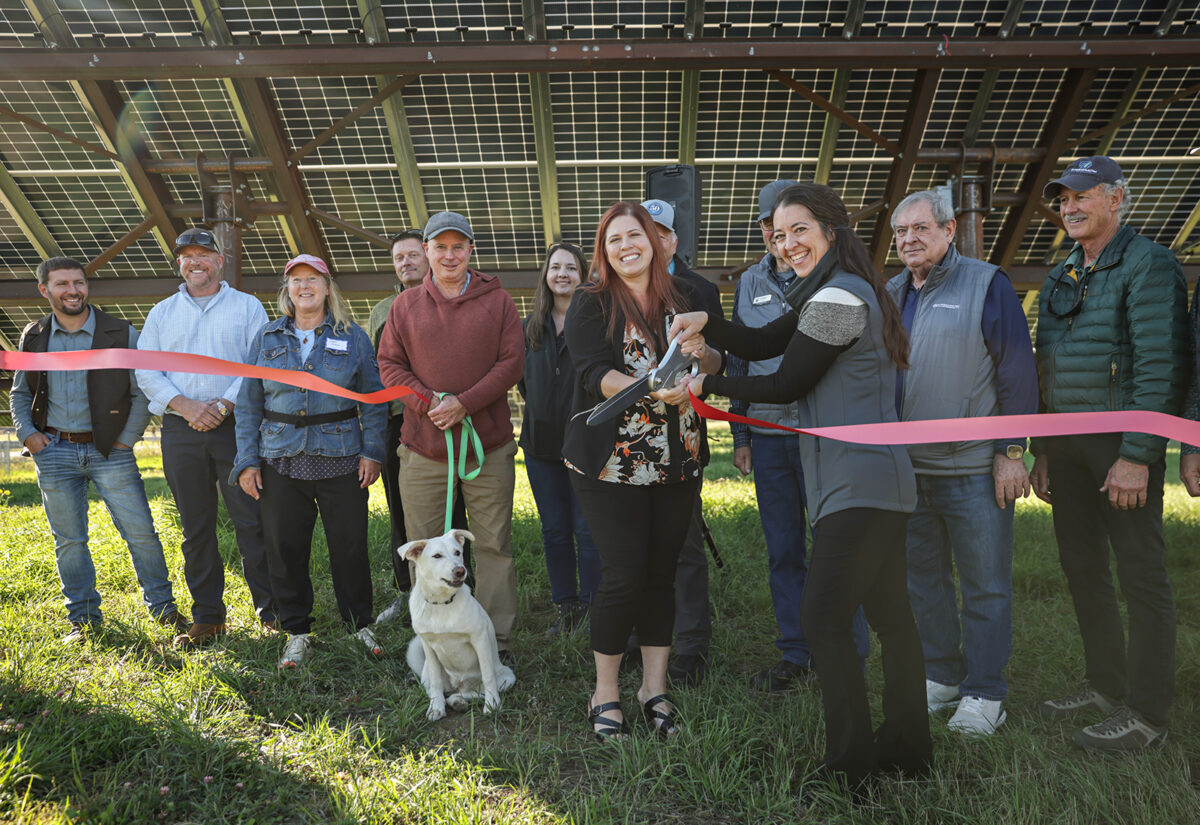
Flathead Electric Cuts Ribbon on Newest Community Solar Array, First Paired With Battery Storage
Co-op's third community solar project, built on city land in Whitefish, includes 448 panels and a utility-scale battery
By Tristan ScottFlathead Electric Cooperative (FEC) marked the completion of its third community solar project on Wednesday with a ribbon-cutting and open house at the 448-panel array on Monegan Road in Whitefish, near the city’s wastewater treatment plant. The project is notable not just for its size, co-op trustees said, but for the utility-scale battery bolted on alongside it.
“This is our first community solar project that is paired with a utility-scale battery,” FEC Board President Stacey Schnebel told the crowd gathered at the site on a bluebird September morning. “The battery allows us to store electricity and release it when it can provide better value to our electrical system, including during those periods of higher demand.”
Participating members purchase the generation associated with individual panels and receive bill credits based on their share of the output. It’s the same model the co-op employed at its first two community solar projects, Schnebel said, giving members who can’t install solar at their own home or business another way to buy in.
Of the 448 panels, roughly 80 are set aside to benefit low-income households across FEC’s service territory, funded through a $50,000 grant from the Bonneville Environmental Foundation and a donation from YETI Photovoltaic, a Whitefish-based nonprofit. Schnebel also credited the U.S. Department of Agriculture’s Rural Energy for America Program, or REAP, with a $463,307 grant that covered a large share of the project’s cost.
So far, the array’s output is tracking with projections, said Doug Gilmore, FEC’s power resources manager. The system has hit its 200-kilowatt nameplate capacity, which is capped by inverters, on multiple days for hours at a stretch. The paired lithium ion battery has been discharged during summer evening peak-demand periods, which Gilmore said has already shaved several peaks off FEC’s system-wide load, translating into a savings of a few thousand dollars per month for the broader membership, not just the project’s participants. One evening’s peak-shaving alone reportedly saved on the order of $5,000.
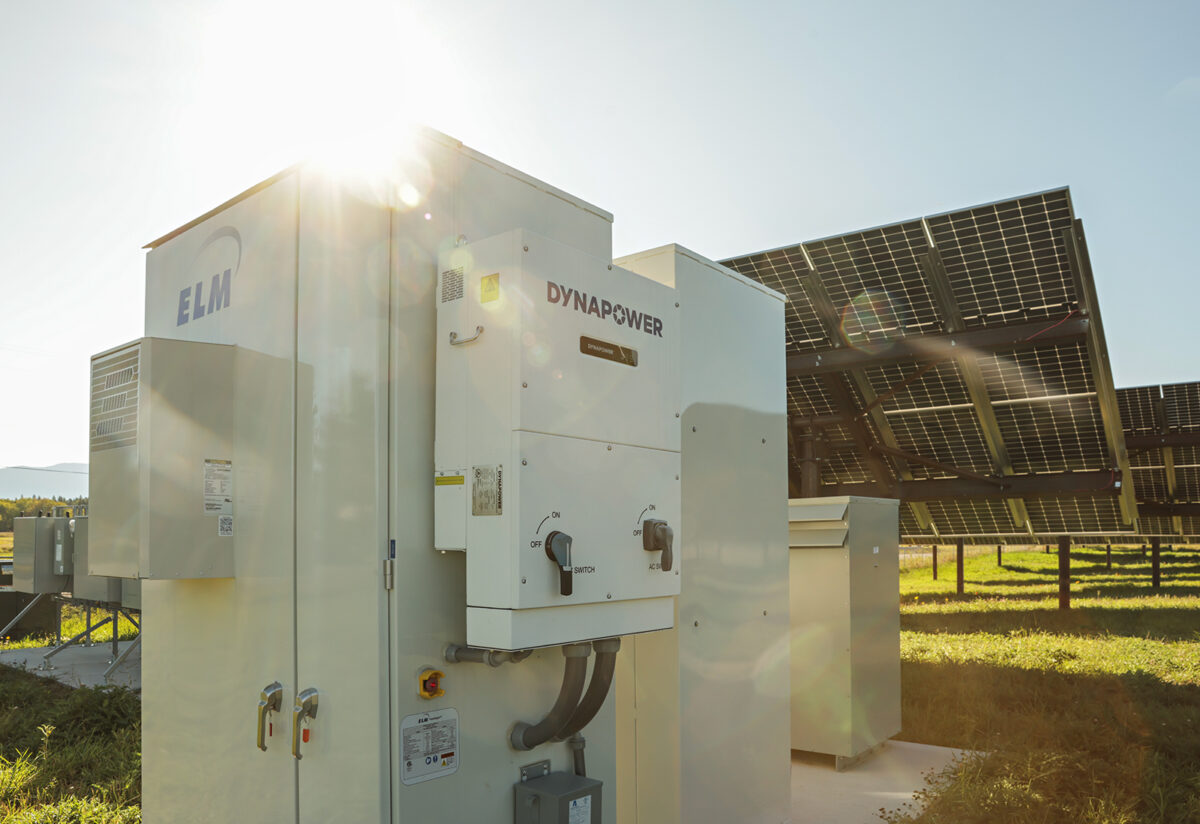
All 368 member-purchased panels are spoken for, Gilmore said, with roughly a dozen of the income-qualified allocation still being assigned. FEC is not currently planning a fourth phase but keeps an interest list for future projects. Qualification for the income-based panels runs through the state’s Low Income Home Energy Assistance Program (LIHEAP).
At $700 per panel, Gilmore said the 368 participant-purchased panels account for roughly $257,600 of the project cost, with the remaining 80 panels split between the BEF grant (72 panels), a YETI Photovoltaic donation (seven panels), and the City of Whitefish, which received a single panel in exchange for the leased land. Unlike the first two phases of FEC’s community solar project, where participants owned their panels outright, FEC retains ownership of all panels in the third phase and structures member participation as a power-purchase arrangement — a condition of the REAP grant, which requires the utility to hold ownership.
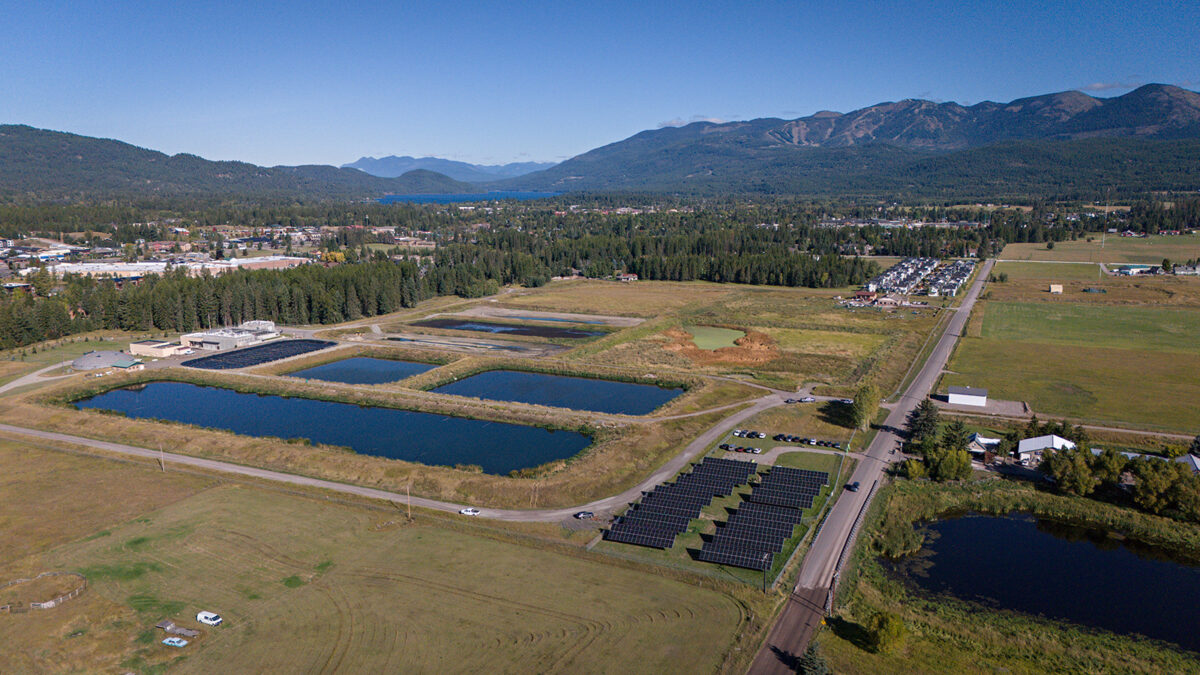
Craig Workman, Whitefish’s public works director, said the idea for the community solar array traces back to the city’s 2018 Climate Action Plan, developed with the Whitefish School District and the nonprofit Climate Smart Glacier Country. The city’s wastewater treatment plant was slated for a mechanical upgrade that would use significantly more power than the old lagoon-based system, and city staff pitched FEC’s board on running a community solar program at the plant.
The city set aside 8 acres for solar within a 30-acre master plan for the treatment plant property; the current array occupies just over an acre, leaving room for a possible future phase, though co-op officials said none is currently in the queue.
SUPPORT THE WHOLE FUTURE OF THE FLATHEAD VALLEY
Bolster your Flathead Beacon newsroom as we follow stories past the headlines and into the impacts on our communities by making a donation of any amount. With you, we can stay resilient, focused on solutions and committed to the future of the Valley.
A broader city-wide energy audit is now underway, signaling Whitefish’s first comprehensive analysis since the original climate plan. It will show how the city’s overall energy use has shifted, officials said, and whether the new panels and other efficiency work have offset other energy-intensive growth; for example, the newer, larger wastewater plant, a bigger city hall, and a larger staff have all pushed total usage up.
Karin Hilding, a retired project engineer with the city of Whitefish and one of the early architects of the community solar project, said her tie to the array isn’t merely professional. She bought into FEC’s initial community solar project as well as this newest phase; having lived in the valley for decades with no plans to leave, she’s now far enough into her Phase I plans to soon begin seeing real savings on her bill.
A representative from USDA’s Rural Development office did not attend but sent remarks, calling the project “a working example of public-private collaboration” that would “generate power” as well as “goodwill and interest in additional partnership opportunities.”
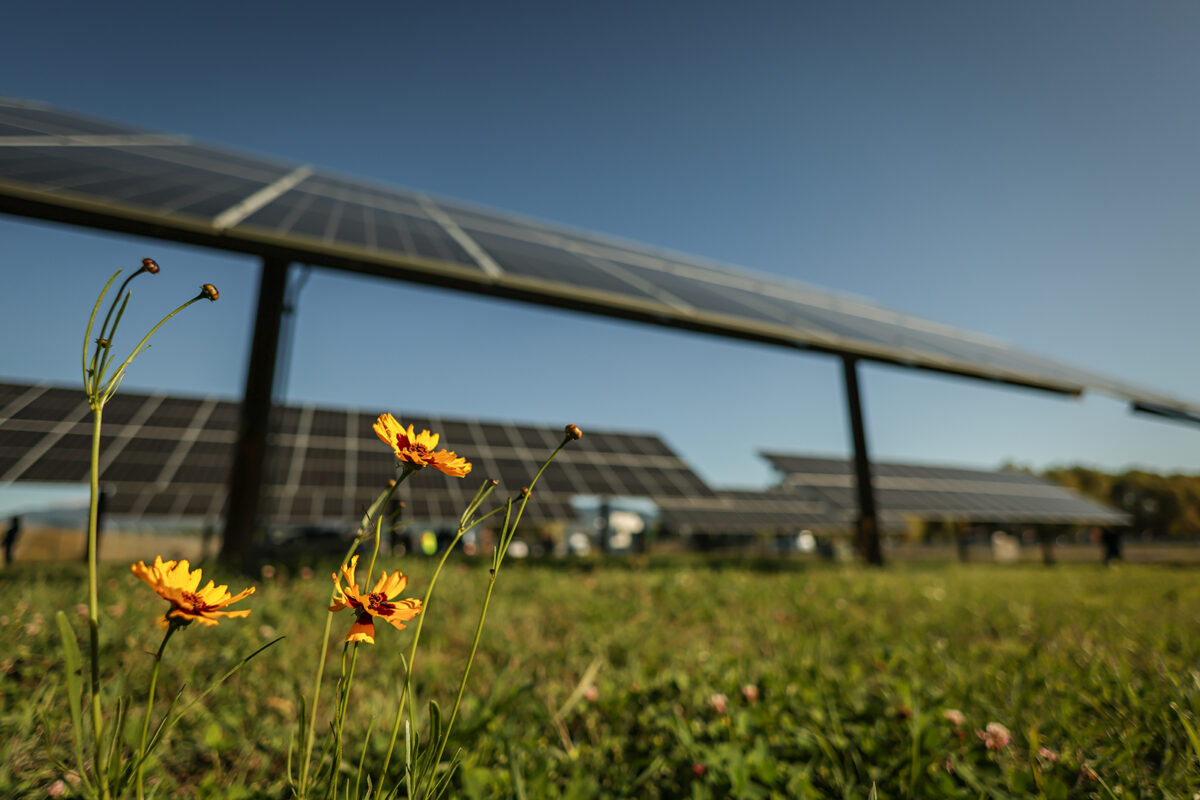
Travis Jordan, of Jordan Solar, the firm that built the array, said the site posed an engineering wrinkle. With more than 3 feet of elevation change across the property, plus city stormwater and sewer manholes that couldn’t be graded around, standard solar panel racking systems weren’t practical. Instead, Jordan’s crew used driven steel piles to level the array across the undulating ground, holding to roughly the same overall cost while improving aesthetics. “It’s a lot more visually pleasing for the people walking up and down Monegan,” Jordan said of the result.
Steve Thompson, founder of the nonprofit Climate Smart Glacier Country, which helped shape the city’s original climate action plan, said the value of projects like this one shows up cumulatively rather than all at once. Pointing to FEC’s other local renewable efforts — investments in landfill gas-to-energy, a biomass facility at F.H. Stoltze Land and Lumber Co. and FEC’s supporting role in the city’s Haskill Creek micro-hydroelectric plant — he said none of them individually amounts to “a big bang,” but together they add up to meaningful, locally generated power. He called FEC “a real leader in finding local renewable solutions.”