Flathead Judges Amy Eddy and Dan Wilson Face Off in Montana Supreme Court Race
The Flathead County District Court judges in northwest Montana have outlined contrasting judicial philosophies over the court’s role in the nonpartisan race
By Maggie Dresser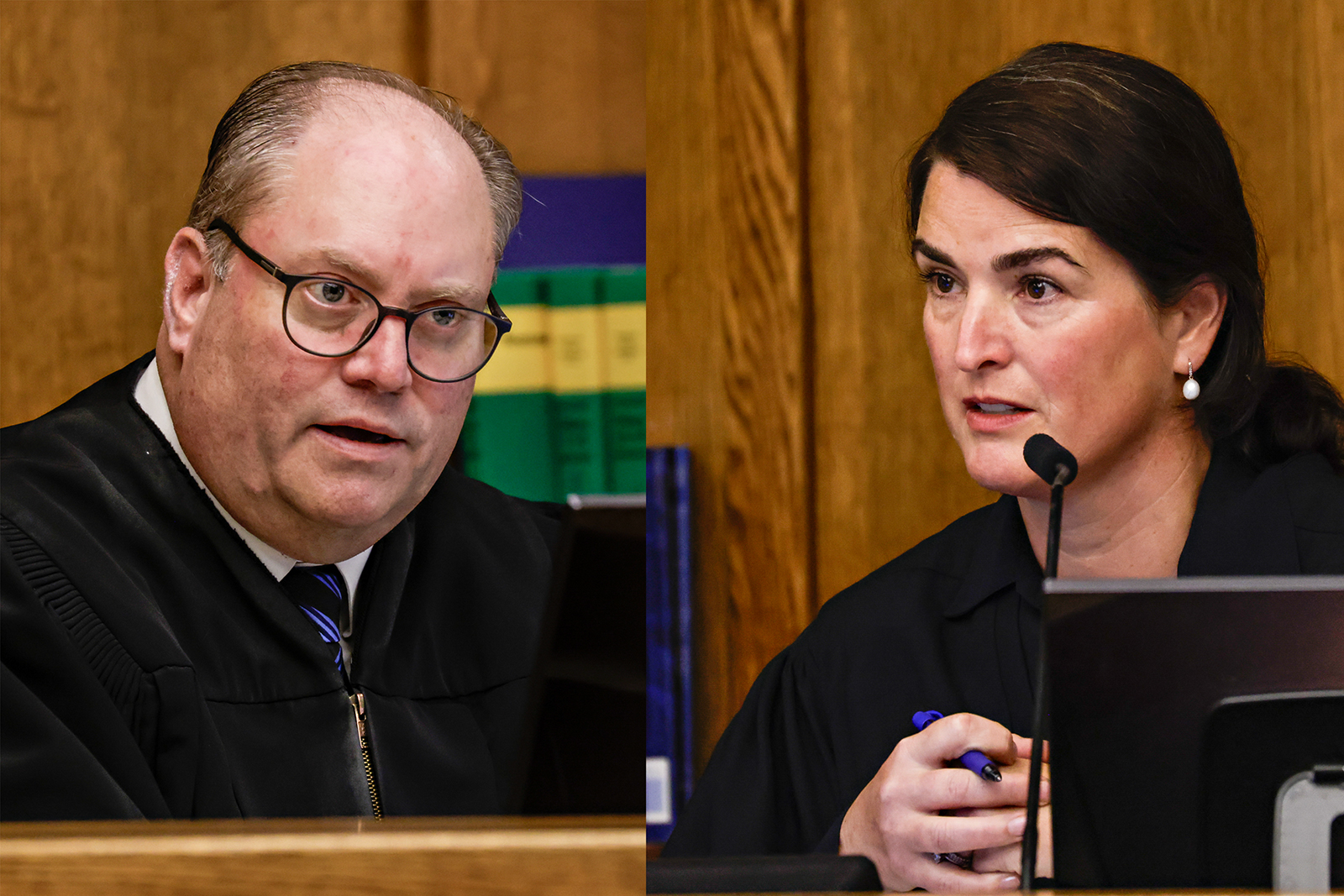
Flathead County District Court Judges Amy Eddy and Dan Wilson are facing off this November for an open seat on the Montana Supreme Court in a nonpartisan race set against a broader statewide fight over judicial partisanship.
Clashing over different judicial philosophies and campaign financing, the two colleagues are seeking to replace Justice Beth Baker, who is retiring after three terms on the bench.
Also on the ballot, Constitutional Initiative 132 (CI-132) will ask voters whether they want to amend the Montana Constitution to require that judicial elections remain nonpartisan. The initiative follows a failed effort by lawmakers to alter the judiciary during the 2023 Legislature.
Eddy vows to bring a “fair and impartial” approach to the Supreme Court. Wilson, who lost a 2024 bid for the high court to Justice Katherine Bidegaray by more than eight points, promises not to legislate from the bench and to “obey the will of the people.”
As a self-described originalist and constitutional conservative, Wilson centers his judicial philosophy around the Montana Constitution’s language as it was drafted in 1972. That language, he said, grants Montanans ownership of the constitution.
“I don’t view the Montana Constitution as a living document,” Wilson said. “It’s written in black and white and the meaning is clear either from the language itself or from the record of the debates, arguments and votes from the constitutional convention.”
Born and raised in eastern Montana, Wilson, 62, comes from an agriculture background. He earned his undergraduate degree at Penn State University and attended law school at the University of Minnesota. After working as a prosecutor in Great Falls, he moved to Kalispell to work for the Flathead County Attorney’s Office, then was elected to Flathead County Justice Court in 2010. After two terms, he was elected to Flathead County District Court, where he has served since 2017.
Wilson drew attention in 2020 when he denied the state’s attempt to force businesses to comply with a COVID-19 mask directive issued by the administration of then-Gov. Steve Bullock, a Democrat.
“It was a very sobering lesson for me to realize just how important it is that when someone claims their due process rights are being ignored or trampled, that we provide a forum and a hearing for them to present the evidence on it and decide,” Wilson said.
Eddy, 50, has served as a Flathead County District Court judge since 2015, when Bullock appointed her. She grew up in Stanley, Idaho, earned her law degree at the University of Montana and spent 15 years in private practice after moving to Kalispell.
Eddy pointed to her 2017 appointment to the Montana Asbestos Claims Court, which resolved thousands of cases tied to toxic asbestos exposure from vermiculite mining in Libby that had languished in the court system after W.R. Grace filed for bankruptcy.
Around that time, Eddy also did appellate work for the Montana Supreme Court, including a case the U.S. Supreme Court overturned as inconsistent with Citizens United v. Federal Election Commission. The ruling recognized free-speech rights for corporate spending in elections.
“Montana tried to carve out an exception for itself in Citizens United based on our history,” Eddy said, referring to the corruption of the Copper Kings era at the turn of the 20th century.
Eddy’s work on that case underscored her view that Montana’s judicial elections should be nonpartisan, that candidates should not align themselves with political parties and that the public “has the right to a fair and impartial judiciary.” Any judge affiliated with a political party, Eddy said, is in violation of the Montana Code of Judicial Conduct.
“The policy from the legislature in Montana has traditionally been, that we don’t want our judges associated or held captive by political parties,” Eddy said. “We don’t want them swearing loyalty oaths to political party platforms. We don’t want them making rulings while they’re considering endorsements or ongoing political contributions.”
For this reason, Eddy has accepted endorsements only from judges and organizations unaffiliated with a political party. Her endorsers include dozens of judges, among them sitting Montana Supreme Court Justices Ingrid Gustafson and Katherine Bidegaray, and groups such as Montana National Organization for Women and Big Sky 55+.
In contrast, Wilson said the First Amendment allows his supporters, who include the Montana Chamber of Commerce, the Montana Stockgrowers Association and the Montana Mining Association, to back whichever candidate they choose.
“The truth and the very simple truth comes down to this: when you’re running for judge, you don’t pick your supporters,” Wilson said. “Your supporter selects you and it’s not my job to go out there and criticize someone who decides that they want to support me because they like my message or that they look at my record as a judge and think they can trust me on the Supreme Court. That’s their business.”
Wilson defended his keynote appearance at the Montana GOP Winter Kickoff earlier this year as a “great opportunity.”
“I didn’t have to swear allegiance to them or any other party and all I had to do was show up and talk,” Wilson said. “I’ve been to events for both parties and after a while, the invitations stopped coming from one party and kept coming from another.”
Despite the nonpartisan label, Wilson said judicial races have historically been influenced by politics. He pointed to past open Montana Supreme Court seats that were filled by justices who were elected after serving in partisan positions such as the state Legislature.
“To say that there’s never been any partisan influence in judicial elections or appointment is just to ignore the plan facts and simple truth that’s been out there all along, but no one’s mentioned it,” Wilson said. “It’s been the elephant in the room all this time — I think it’d be more accurate to say at times it’s been the donkey in the room.”