Evergreen Special Education Teacher Kenny Ross Named Montana’s 2027 Teacher of the Year
Ross, who teaches at Evergreen Junior High, says “every student deserves to be seen.” He’ll represent Montana in the 2027 national program.
By Mariah Thomas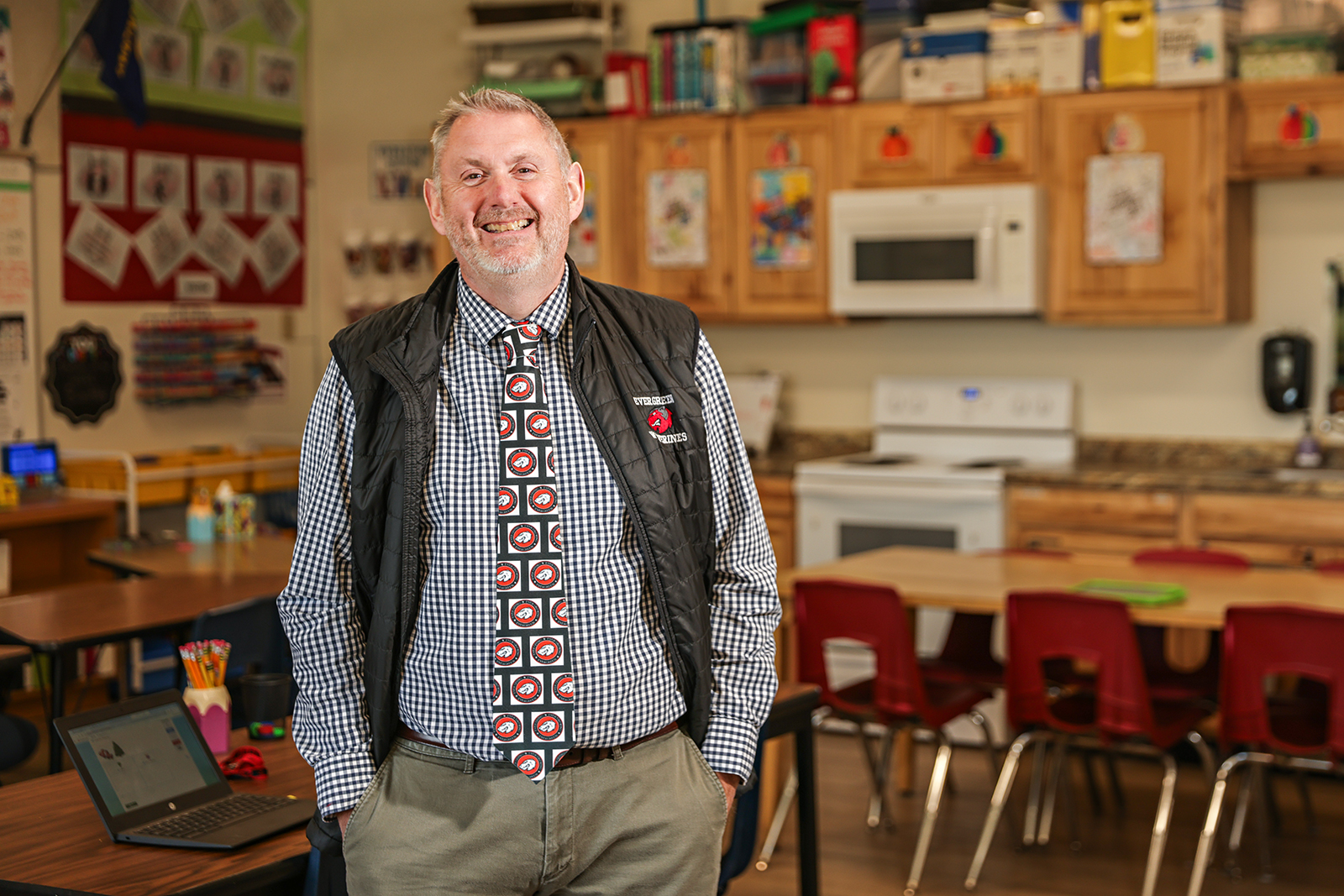
When Kenny Ross’s students return from their lunch period, they take their seats at desks arranged in a half-circle.
The special education teacher at Evergreen Junior High keeps a regimented schedule in his classroom, something he said helps his students, some of whom have autism and can struggle with changes to their typical day. While the classroom subject matter may change after lunch, the activity remains the same: Ross pulls out colored bins labeled with each of his nine students’ names, and they get to work on their lessons. As part of his students’ individualized education programs — more colloquially known in special education as IEPs — each one has specific educational goals, and Ross selects individual activities for them that help them achieve those benchmarks.
On Tuesday afternoon, they worked on writing. Ross, sitting in a rolling chair in the middle of the half-circle with an image of Snoopy warming his hands by a fireplace behind him, moved between desks while interacting with his students. He teased one about boys; talked to another about their next class period; and kept another on task as he completed his writing assignment quickly.
Now in his third year at Evergreen Junior High, Ross advocates for his students to be treated the same as everyone else. Rather than referring to his class as a special education one, he calls it “Foundations.” Ross explained his goal is to help his students, whose disabilities range from autism to cerebral palsy, develop exactly that: a foundation, both for learning and for life. The educator has also been clear about creating a team environment in his classroom, including trusting paraprofessional educators to help students navigate decisions about their education.
The culture Ross has built in his classroom and among his peers led to his selection last year as Evergreen Junior High’s teacher of the year. That designation meant the school nominated Ross for Montana’s 2027 Teacher of the Year. Ross won. Representatives from the state’s Office of Public Instruction (OPI) came to his classroom to present the award to him earlier this month.
The award, according to OPI, “recognizes excellence in teaching and celebrates educators who make a meaningful difference in the lives of students and their communities.”
For Ross, teaching was always the path. He grew up in Scotland and said he graduated from teacher training college there in 1996. He spent the bulk of his career in the United Kingdom — 24 years — teaching several subjects and learning from his peers’ approaches along the way.
It was also in the U.K. where Ross’s passion for special education came to the forefront. He ran a behavioral unit at a school he taught at in England, and approached it with a goal of reducing recidivism. He found that each student required an individual approach as he delved into their needs and family dynamics and tried to help them improve their behavior.
He found his way to Montana by way of his wife, who had lived in the state before and wanted to move there. But his own route to the Treasure State became complicated as his move collided with the COVID pandemic.
“It’s so serendipitous, because it could have just fallen apart real easy if one thread, one strand, hadn’t been in place,” Ross said.
He and his wife spent 18 months apart. His visa lapsed while he waited for travel restrictions to end, and he had to get a new one before coming to the Flathead Valley in 2021. The Scotland native has since worked toward U.S. citizenship.
Once in Montana, Ross quickly found his way back to the classroom, volunteering at the Whitefish School District and then working as a behavior specialist once he received his green card. He met Melissa Hardman, the special services director at Evergreen School District, at a conference. Hardman recognized him from his side gig of soccer refereeing (Ross, a Scotland fan, has also written several books about soccer). The two talked about how Ross could pursue teaching special education, and he applied to a master’s program at the University of Montana that he could complete while teaching.
“He just, he jumped on it. He got in,” Hardman said. “I mean, he is just very driven, and then applied for our position, and we hired him. He comes with a lot of different, diverse backgrounds. He brings a lot to the table.”
Ross got the job at Evergreen Junior High in 2024 and has taught there since. As he has progressed through the UM program, he has also been tapped for accolades, including a teaching award from the university this year. He called the recognition from his school, the university and the state OPI his own “triple crown.”
“I’m really excited about it,” Ross said of being named the Teacher of the Year. “You know, it’s a huge honor. I’m trying to be humble about it, but it’s hard. You know, my family in the UK are so proud of me, and it kind of justified my move here in many ways, because my family was like, ‘it’s gonna be 5,000 miles away from us.’ This is hard, but career-wise, it’s been phenomenal.”
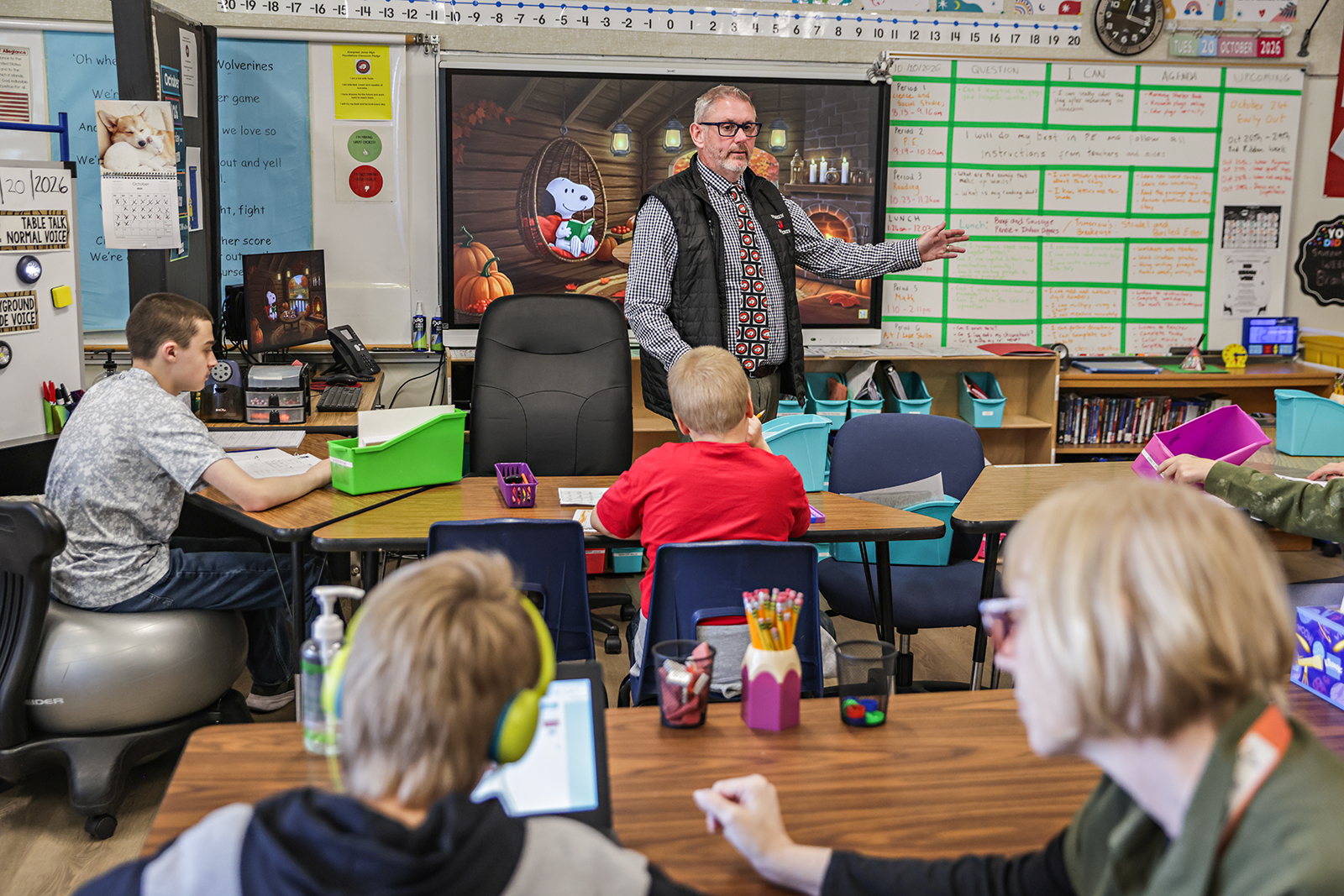
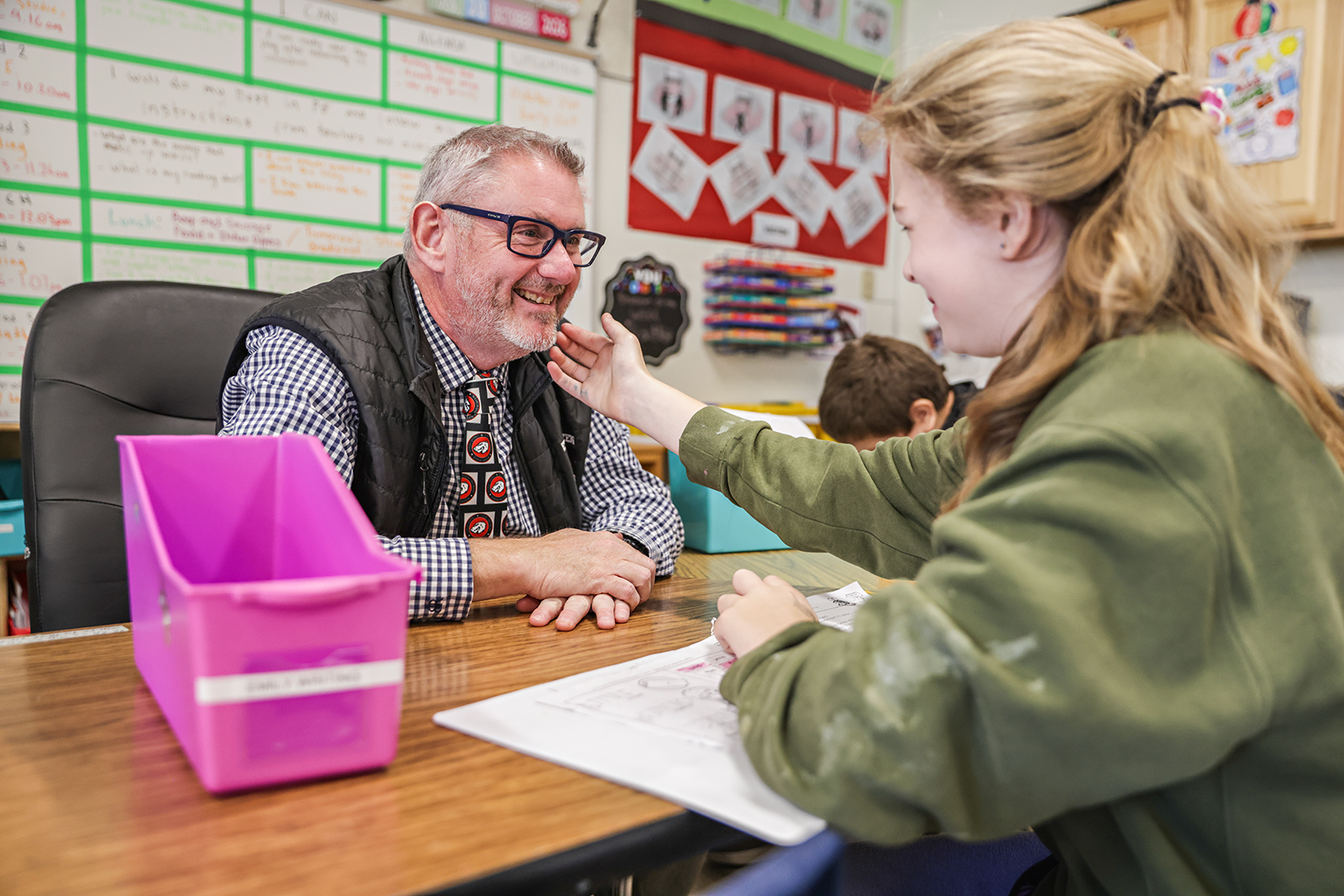
During the Tuesday afternoon writing lesson in Ross’s classroom, the veteran educator explained knowing his students beyond just their challenges is a critical part of his job. With ease, he named off students’ siblings. He remains in touch with their families using the Remind app throughout the school day, telling parents about breakthroughs or difficult moments. Paraprofessional educators took turns working with individual students as well.
Jay Aiken, a paraprofessional with a psychology degree, said he has worked at Evergreen for 10 years. For Aiken, the three years he has worked with Ross have served as his best experience collaborating as a team.
“It’s just important that we’re all on the same page as far as how we’re teaching,” Aiken said. “Every kid’s so different, you know? You have to deal with every kid kind of differently.”
Aiken said Ross excels at facilitating that, bringing paraprofessionals into those discussions and offering them a chance to be creative in helping students succeed. Hillery Eastman, another paraprofessional in Ross’s classroom, explained that hasn’t always been her experience in the role.
Eastman earned a teaching degree but let her certification lapse and picked up long-term subbing instead. She became a paraprofessional three years ago, after a long-term subbing stint in a special education classroom. In her experience, Eastman said working in special education classrooms can lead one of two ways: either a teacher has all authority in the classroom, or paraprofessionals have latitude to act as authorities as well. Ross takes the latter approach, Eastman said.
“His biggest strength, I think, is his ability to pivot. If he sees that something isn’t working for a child, rather than frustrate them and push through it, he’ll find an alternate way of reaching them, and he allows paras in the classroom to do that as well,” Eastman said. “We don’t have to go to him and say, ‘this isn’t working, can we try something else?’ He trusts us to try something else, and he’s given us the extra tools in the classroom to do that.”
Eastman also praised Ross’s sense of humor and patience as valuable skills that set him apart as a teacher.
Ross, for his part, described several ways he aims to be creative in the classroom and bring levity to the learning experience. He laughed about a time he tried to teach students to make toast and set off the smoke alarm in his classroom. He keeps water guns at his desk and will use them to distract students as they’re having an emotional moment. When he couldn’t find his glasses ahead of starting a lesson on Tuesday, with a laugh, he explained one student likes to hide them and went searching for them. Aquariums take up counter space in two separate corners of the classroom, and Ross will let students take breaks during the day to watch the fish, describing it as having a calming effect.
But just because Ross brings humor and fun into the classroom doesn’t mean his students don’t work hard. They learn life skills in addition to typical subjects from math, to writing, to science. Students have behavioral expectations, and receive consequences if those expectations go unmet. He grades students on all of their assignments and keeps the class on a schedule with different periods, the same as a typical school day would run.
“We work them hard academically,” he said. “We work them hard, but we have fun, and the progress that my students have made, it’s phenomenal.”
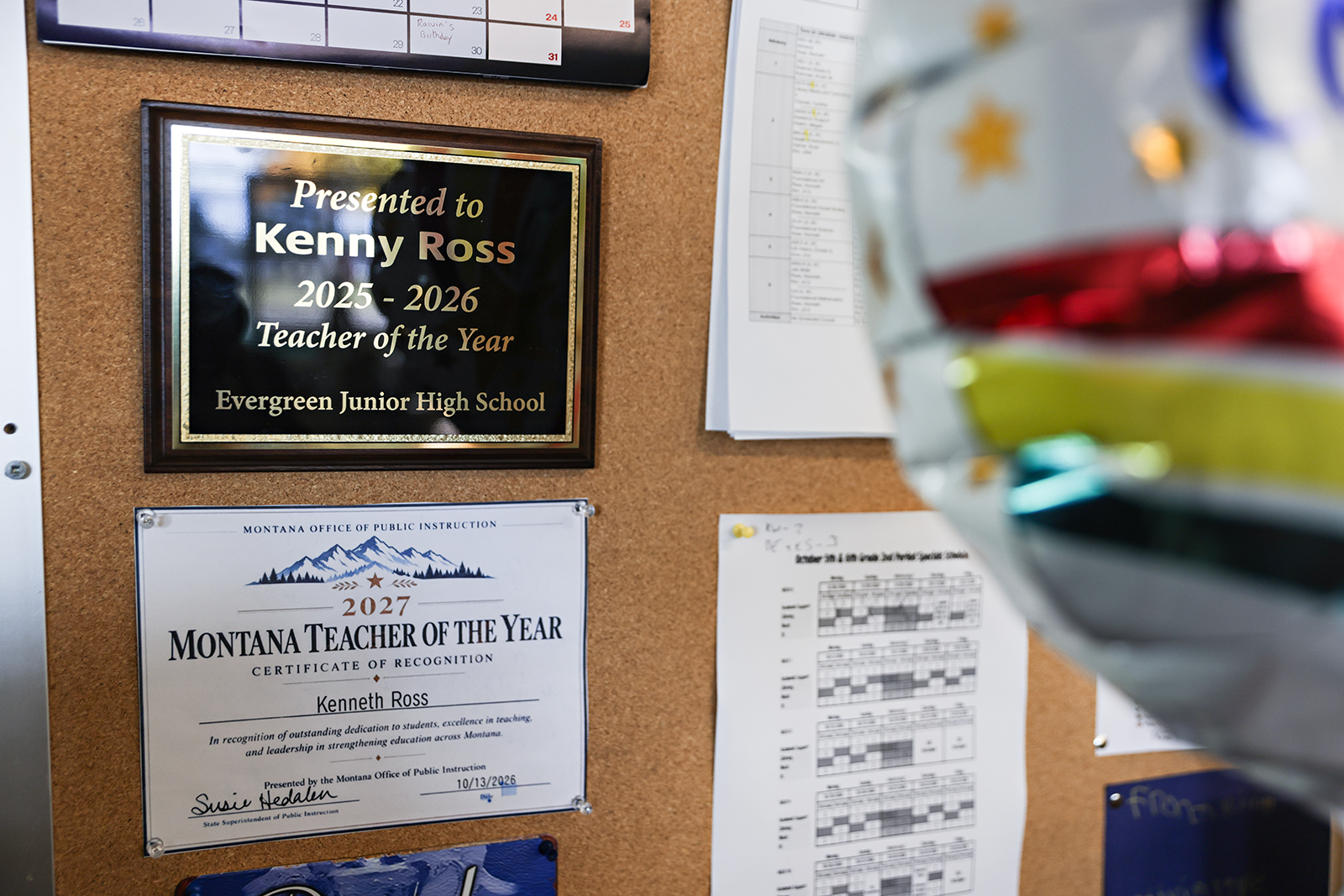
To be selected Montana’s Teacher of the Year, Ross described an intensive process. According to McKenna Gregg, the communications director at OPI, nominees had to complete an application, “which included a headshot, basic biographical information, a professional bio, three letters of recommendation, a resume, and responses to five questions.”
Ross’s letters of recommendation came from Evergreen Junior High building principal Jennifer Doss and school district superintendent Laurie Barron, who both heralded Ross’s contributions in the classroom and to the school’s environment.
“What stands out most is Kenny’s unwavering belief in his students,” Doss wrote in her recommendation. “He celebrates their progress, advocates for their needs, and never loses sight of their potential. His influence extends far beyond his classroom, helping shape a more inclusive and supportive school community for all.”
Then, a review committee evaluated applications and narrowed the pool to four finalists, which included Ross and fellow Flathead County teacher Karen Reece of Lakeside Elementary School. The four finalists went through an interview where they had to present their key message should they be selected as the state’s Teacher of the Year. Ross’s key message is one he has championed in his classroom for years.
“My message, I said, was every student deserves to be seen,” Ross said. “Every student deserves to belong, and every student has something to contribute.”
While that message is one he views as critical for the nine students in his Foundations classroom, it’s also one he described as broader. In education, he said, often teachers focus on either the best students in the classroom, or the ones struggling.
“The kids in the middle, I’ve found in 30 years, are the ones that get left behind sometimes, and so that was kind of my thinking behind that,” Ross said. “Every student deserves to be seen, to belong. I mean, in this day and age, and Montana having the highest teenage suicide [rate] and kids struggling with their sexuality, or with depression and stuff, they deserve to be seen. And every student’s got something to contribute.”
During his year as Montana’s Teacher of the Year, Ross will have the platform to share that message across the state. He will also represent Montana in the National Teacher of the Year program.