On Whitefish Lake, ‘Regulation Rodeo’ Reignites City-County Enforcement Rift
When a rock-blasting operation on a luxury lakeshore home triggered a landslide last year, it became the poster child for regulatory dysfunction on Whitefish Lake. But even as the custom builders responsible for the landslide say they have repaired the damage, which didn't warrant enforcement action, neighbors and citizens' groups argue the lack of local oversight begs the question: Who's in charge of Whitefish Lake?
By Tristan Scott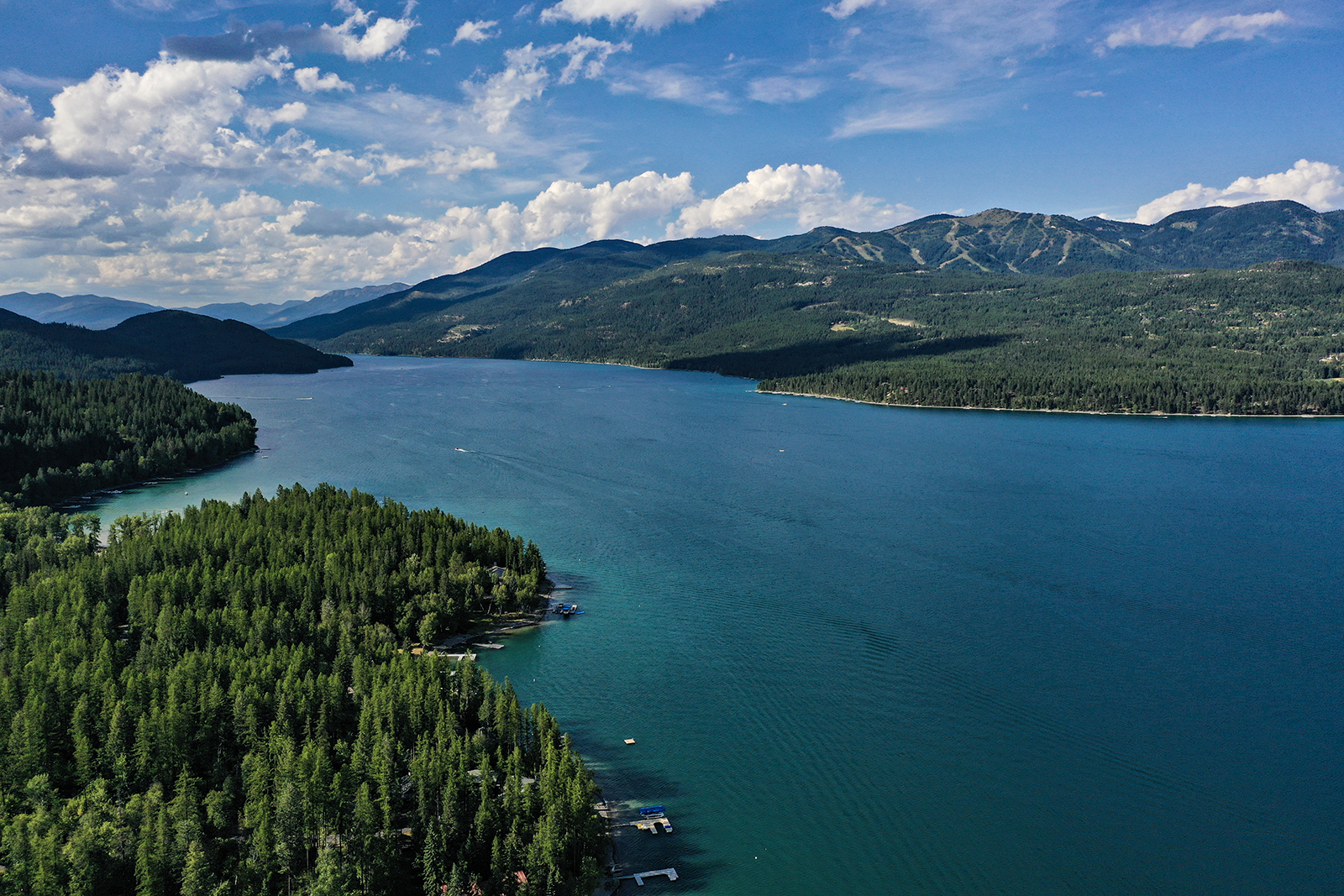
Before giving orders approving the detonation of a rock blast on a lakeshore property in Whitefish in May 2024, longtime custom home builder Walt Landi uttered these prophetic last words: “I don’t want to end up in the newspaper.”
He made headlines the next day.
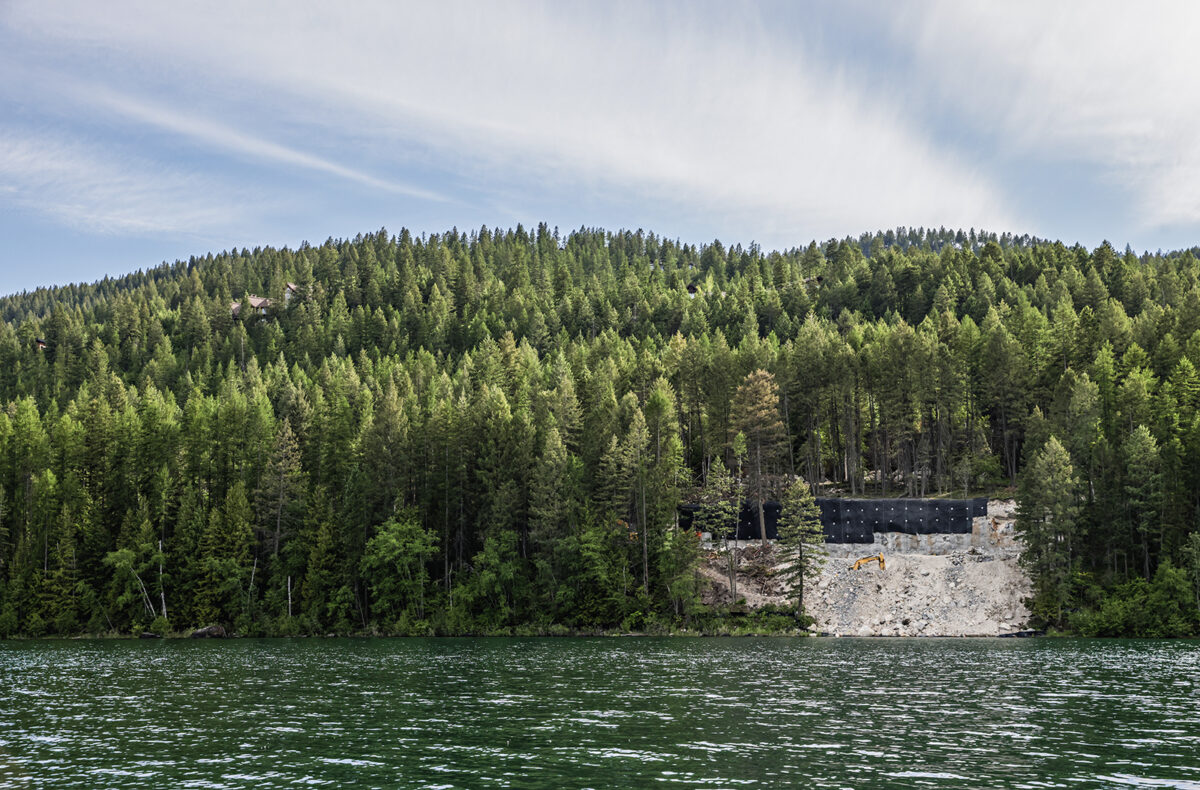
Eighteen months later, Landi still regrets the inadvertent landslide that the blasting operation triggered, sending washing-machine-sized boulders tumbling down the embankment and onto the Whitefish Lake shoreline, a zone governed by the Flathead County Lake and Lakeshore Protection Regulations. But after 18 months cooperating with a multitude of state and county officials to remove the debris, Landi said there’s no indication that the lakebed was damaged or that construction within the Lake and Lakeshore Protection Zone (LPZ) was out of bounds with that authorized by his construction permit, which Flathead County issued before the slide occurred.
“It’s pretty clear that the slide never approached fully into the water, and other agencies working with the county, they were able to see that, too,” Landi, owner of High Country Builders, said. “We had to work with four agencies and we got cleared by every one of them.”
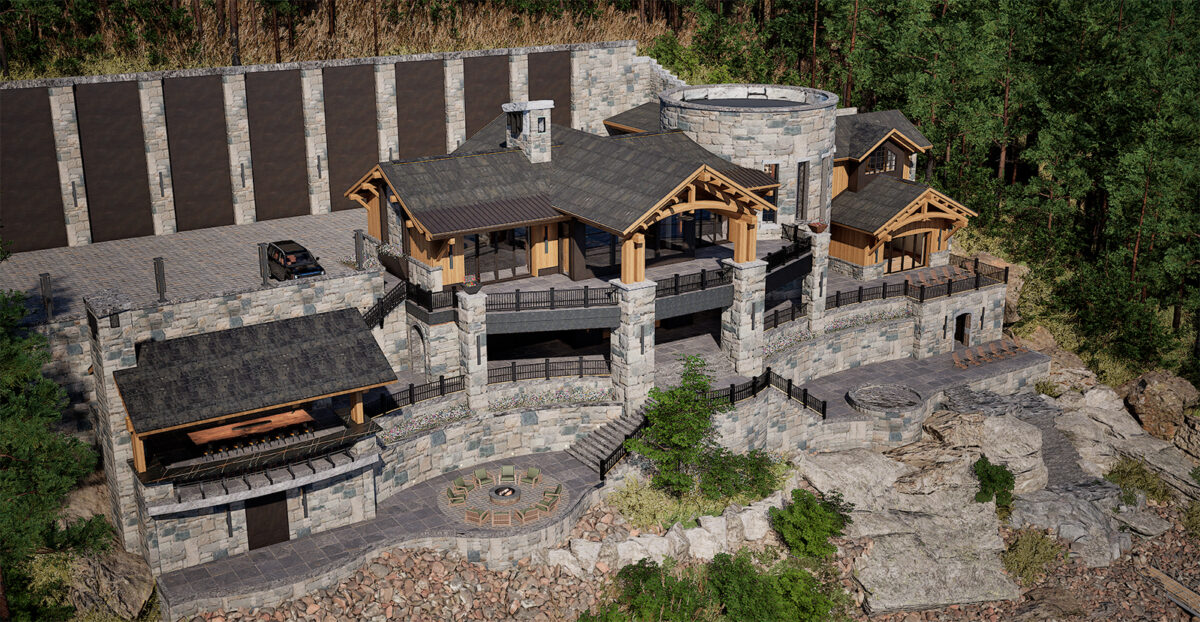
“We are not trying to hide anything,” added Derek Hyland, High Country Builders’ project manager on the “grand” concrete-and-stone lakeshore home that’s drawn complaints from neighbors since construction began two years ago. “After the initial shock-and-awe of what happened, and as we peeled back the layers of the onion, excavated the debris and completed remediation, we realized that no violation actually occurred. All the materials that came down from the slide, which occurred uphill of the Lakeshore Protection Zone, it was all native to the site. Flathead County never revoked our permit and we never received a fine. And whether there was a slide or not, this is exactly how the lakeshore would look today under the scope of our permit. We did not alter the lakeshore one little bit.”
In June 2024, a month after the slide occurred, resulting in an official complaint to the Montana Department of Environmental Quality (DEQ), Hyland contacted DEQ, as well as the Department of Natural Resources and Conservation (DNRC) and the U.S. Army Corps of Engineers (USACE), to determine if additional permits were required for remediation. He received letters from DEQ’s Keenan Storrar, DNRC’s Kari Nielsen and the USACE’s Jade Metzler, each stating that “permits would not be required for the planned scope of work.”
While that work spanned four months and, according to High Country Builders, amounted to a significant setback to the project’s multi-year timeline, its completion in September met the agencies’ standards.
“Based on the information, I will be closing this complaint,” Kristen Trapp, DEQ’s Environmental Enforcement Specialist, wrote in an Oct. 1 letter to High Country Builders. “Thank you for your time and cooperation in this matter.”
Meanwhile, Flathead County’s Planning and Zoning office considers the incident an “open enforcement action” that code compliance technicians are “actively monitoring,” according to the county department’s Jared Schroeder.
“The contractors have been working with Planning and Zoning throughout the remediation process and have made significant progress removing debris and stabilizing the area,” Schroeder, a code compliance technician, said in an email to the Beacon. “The construction of the house is located outside the LPZ and thus out of the jurisdiction of the Lake and Lakeshore Protection Regulations. As such we are not able to place a stop work order on the construction of the house.”
“At this time, the violation from the spring of 2024 … is open and active and will remain open until our office has verified compliance with the Lake and Lakeshore Protection Regulations,” according to Schroeder.
Having founded High Country Builders locally in 1989, Landi said he has taken responsibility for the landslide, calling it an unfortunate incident that occurred after plans laid by a licensed blaster went awry. Landi said his crew had for months been using a hydraulic rock hammer to excavate the foundation, but the strategy was slow and generated daily complaints from a neighboring property owner.
The blasting agent was deployed by contractors building a single-family residence on a 4.7-acre lakeshore parcel. On May 29, 2024, the blast cleaved off a broad segment of the embankment above the LPZ and sent large boulders, rocks and debris onto the lakeshore and into the LPZ, which extends 20 feet from the perimeter of Whitefish Lake’s mean high-water elevation. Landi estimated that approximately 6 cubic yards of material was spread across “close to 100 feet of lakeshore protection zone.”
“There’s very little actual dirt in the lake at all. It’s mostly just rocks,” Landi told members of the city-appointed Whitefish Lake and Lakeshore Protection Committee on June 12, 2024. “This is unfortunate, but it is not going to have any type of lasting impact on the lake whatsoever.”
Sine then, Landi said he’s endured a barrage of threats and complaints, which he believes are unfounded, particularly now that the complaints have, to his mind, been resolved. Moreover, he believes that the custom home he’s building would have galled some members of the community regardless of whether the blast had occurred, and that the accidental landslide gave critics leverage.
To those critics, Landi emphasized that the lakefront property on which he’s building includes 1,100 feet of shoreline and that “only 80 to 100 feet of lakeshore is being disturbed.”
“Most beaches go property line to property line,” Landi said in a recent interview with the Beacon.
“It’s a grand house. There’s no doubt about it. But it’s only a two-bedroom home. There was no egregious violation, the lakeshore itself wasn’t damaged, and we were permitted to do this work long before the slide ever happened.”
Although Landi said he remains contrite, he’s also frustrated about being held up as an archetype of irresponsible building practices.
“I still take full responsibility for it,” he said. “But they’ve been up and down this thing, they’ve dug under every rock and there’s just nothing there. We did a lot of work to get to this point and it’s been restored to pretty pristine conditions. I made the decision to blast, and there’s always the chance that something can go wrong. Was it the right decision? It was certainly a bad PR move.”

City officials and environmental watchdogs in Whitefish, however, say the consequences far exceed bad publicity, with Mayor John Muhlfeld, who served on the Whitefish Lake and Lakeshore Protection Committee between 1999 and 2006, characterizing the landslide as the “most egregious violation that I have observed in the past 25 years” while expressing frustration at the county’s response.
Mike Koopal, executive director of the Whitefish Lake Institute, a nonprofit research organization dedicated to protecting the lake’s health, said minimizing the environmental consequences to the lake sets a bad example and underscores a decades-long jurisdictional dispute on Whitefish Lake.
Without a clear set of regulatory guidelines on Whitefish Lake, Koopal said it’s imperative that members of the building community act with integrity and professionalism while educating homeowners about threats to natural resources. He also said the incident underscores the need for legislative reform and a cooperative agreement between Flathead County and the city of Whitefish, for whom tensions surrounding jurisdictional authority on Whitefish Lake spans decades.
For Jim Stack, a Whitefish resident who for two decades served on the Whitefish Lake and Lakeshore Protection Committee, serving as chairman during the majority of his tenure, the county’s enforcement authority has long limited the city’s oversight, hobbling its ability to enforce its own lakeshore protection zone laws outside city limits. And while he has for years urged the entities to “please work cooperatively” together by jointly issuing permits for Whitefish Lake, he said those efforts have fallen to the wayside.
“What exists today is a travesty of the efforts of all those in the past who worked together for the benefit and protection of Whitefish Lake,” Stack said. “What has occurred at the … property on the east shore of Whitefish Lake — after the so-called accidental blast explosion — would never have been approved or allowed under previous regulation interpretation or application in the 20 years that I served as a county commissioner appointee on the [Committee]. There was virtually no attempt whatsoever at the county planning office level to enforce remediation and restoration of the complete obliteration of vegetation and destruction of natural terrain that existed prior to the blast. And far more importantly, for future generations, is the unacceptable precedent that this creates for the residents of Whitefish who care about protecting Whitefish Lake.”
Today, the Whitefish Lake and Lakeshore Protection Committee continues to try and narrow the gulf dividing its interests from those of the county’s. Last month, the committee’s chairman, Toby Scott, sought direction from city council on a pair of letters its members drafted to the Flathead County Board of Commissioners regarding instances in which the county’s shoreline protection policy doesn’t align with the city’s.
One of the proposed letters referred to the landslide on Whitefish Lake’s Beaver Bay, located just outside the city’s lakeshore jurisdiction, and urged the county to “review this property to ensure that all shoreline development activities are in compliance with applicable regulations and environmental safeguards.”
Mayor Muhlfeld said based on his experience, any effort to extend an olive branch to the county was futile.
Because the county doesn’t have a building department, it cannot and will not regulate any building activity that occurs outside of either the lakeshore protection zone or the floodplain. Flathead County does not administer the Uniform Building Code program, nor does it have a building permit requirement for new construction or remodeling. Its jurisdiction of rural properties on Whitefish Lake, including the one under construction, extends up from the low water mark, while parcels within city limits fall under Whitefish’s building permit jurisdiction.
Even so, Flathead County Commissioner Randy Brodehl defended the county’s enforcement actions and oversight.
“Water quality, whether on Whitefish Lake or Little Bitterroot Lake or any other lake, is paramount in Flathead County. It just absolutely is,” Brodehl said. “And we responded to the incident out at Beaver Bay because I believe we have an obligation to the county to enforce lakeshore regulations. And I think that our compliance officers did exactly that. They looked at the regulations, they got involved and they enforced the county’s regulations. They made sure that the builders worked closely with our compliance officers to meet those obligations.
“We focus on what’s right for the county, and the city focuses on what’s right for the city. Those don’t always blend. But I don’t see any deterioration between us and the city of Whitefish as far as relationships go. We are not going to overstep and tell the city what to do, and they are not going to overstep and tell us what to do. We may have differing opinions, but we are going to do our best to stay in our own lanes. And sometimes, we don’t always share the same lane.”
Deteriorating relationships or no, the shared jurisdictional matrix has begged a persistent question: Who’s in charge of Whitefish Lake?
The answer: It depends.
Under the 1975 Lakeshore Protection Act, the state of Montana requires that local counties implement and enforce regulations to protect lakes and lakeshores. The purpose of the statute and its implementing regulations in Flathead County is to protect the scenic, natural resource, environmental, and private property values attached to Montana’s lakes.
Meanwhile, Whitefish officials have raised concerns about the ineffective administration of lakeshore protection regulations and expressed frustration about the jurisdictional morass.
In the decade since a Montana Supreme Court ruling ceded control of the LPZ from the city of Whitefish to the county following a long-running legal battle over control of the planning “doughnut” ringing Whitefish, both the county and the city of Whitefish have administered lakeshore regulations. In some cases, depending on the proposed action and where a property is located, an individual must obtain a permit from each entity. The city of Whitefish annexed the lakebed to the low-water mark in 2005 and continues to exert planning control of that area by enforcing the Whitefish Area Lake and Lakeshore Protection Regulations, which govern any work that alters Whitefish Lake and the land extending 20 horizontal feet above the mean annual high water mark. For properties along Whitefish Lake located outside of Whitefish city limits, the regulations govern any work or floating structures below the mean low water elevation. The lakebed itself is administered by the DNRC, while DEQ is responsible for water quality. Montana Fish, Wildlife and Parks manages species and enforcement.
“We find ourselves at the Whitefish Lake Institute at the nexus of all the issues and regulatory authorities as we attempt to navigate issues and give Whitefish Lake a voice,” Koopal, of the Whitefish Lake Institute, told members of the lakeshore protection committee after the blast occurred. “If Flathead County isn’t interested in adequately administering the lakeshore protection regulations on Whitefish Lake, they should consider an interlocal agreement with the city of Whitefish to do so.”
To establish a clearer framework for development and other activities on Whitefish Lake, as well as other lakes in Montana, state Sen. Dave Fern, D-Whitefish, in 2025 introduced Senate Bill 304, “An Act Revising the Lakeshore Protection Act,” which provides for stop-work orders, surety bonds and liens for unauthorized lakeshore work. The bill was tabled in Senate Natural Resources Committee.
“Right now, it’s a regulation rodeo,” Fern said of lakeshore development in Whitefish. “The dots aren’t being connected, and it’s left everyone to wonder: who’s in charge? And since the days of the doughnut controversy, it’s been difficult to hold any single entity accountable for land-use responsibility and ownership.”
“I think the reason committee members were uncomfortable with the Lakeshore Protection Act was because they didn’t want that kind of universal approach to all lakes,” Fern continued, explaining that Whitefish is unique in that the city derives 10% to 20% of its annual water supply from Whitefish Lake, with the balance coming from Haskill Basin, which was protected with a conservation easement. “We really tried to make it particular to Whitefish Lake’s needs, tried to make it so that if you’re supplying water for your community that it would apply. I think that’s the strategy next session. But for now, we’ve got to try and make it work across jurisdictions.”
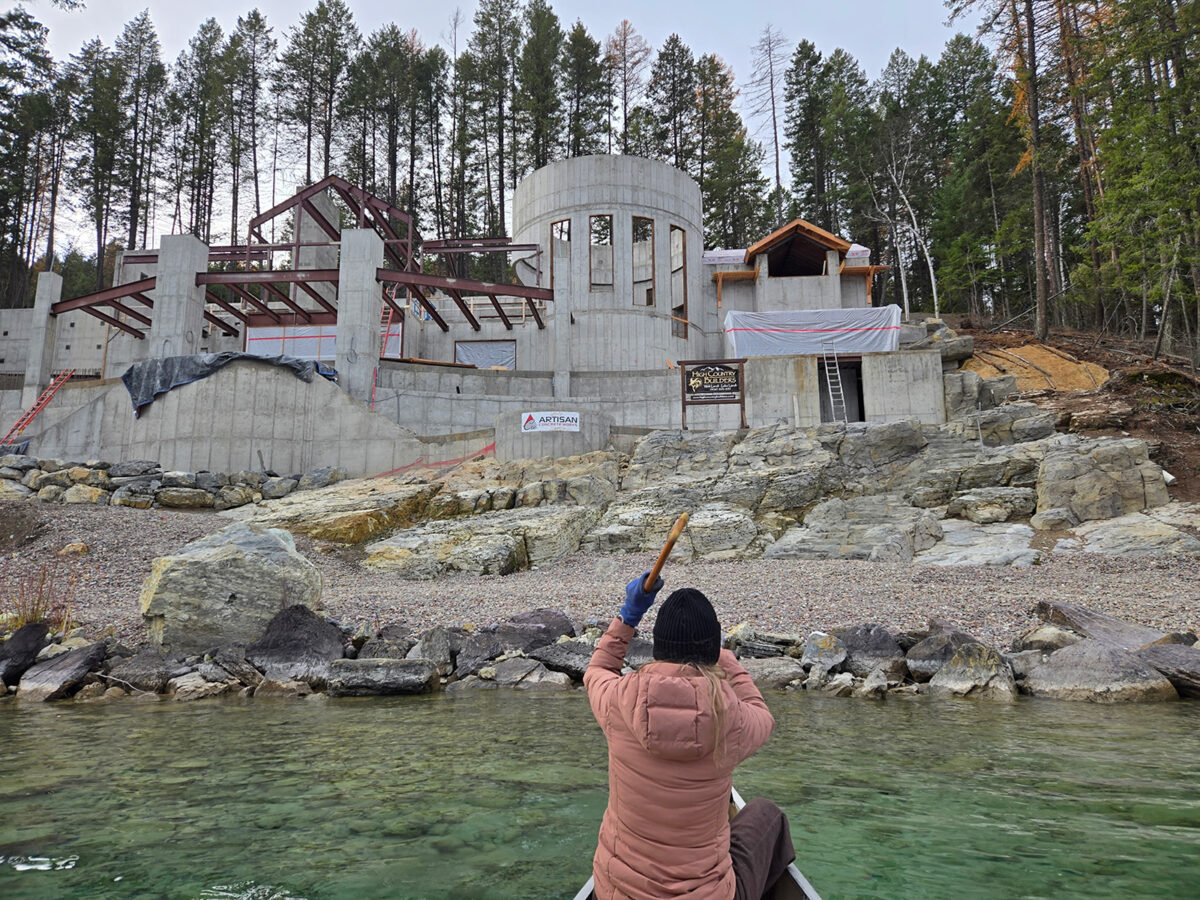
For those who hoped to see the city and county find a cooperative way to administer regulations on Whitefish Lake, the incident betrays deficiencies in the county’s complaint-driven code enforcement system.
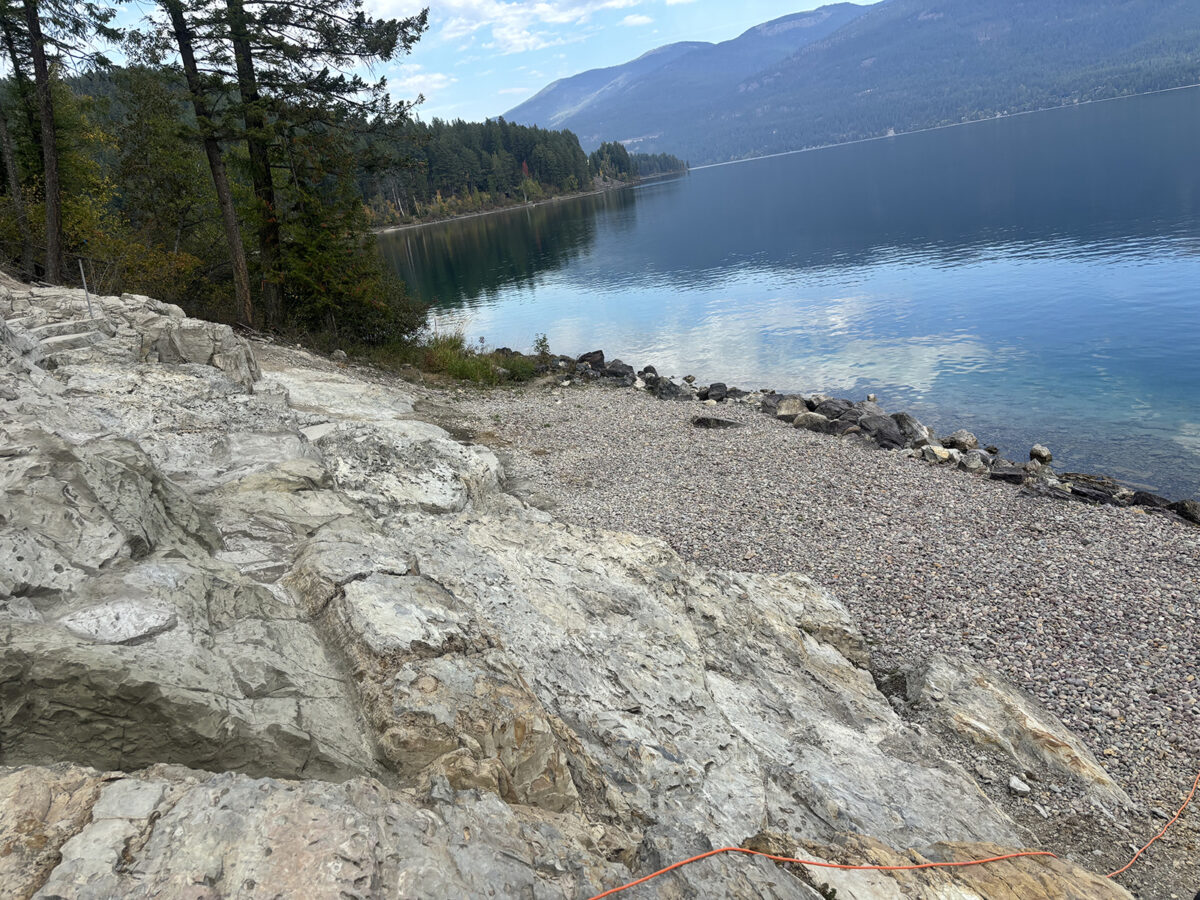
In September, Citizens for a Better Flathead (CBF) filed a formal appeal with Flathead County, challenging its “rejection” of a complaint against the Beaver Bay property for placing “large, artificial boulders, an artificial swim beach, and other structures” within the LPZ, in violation of the county’s Lake and Lakeshore Protection Regulations, and for not affording the public an opportunity to comment and participate in the process.
“These serious violations follow a pattern of prior violations on the same property,” according to Mayre Flowers, CBF’s executive director, citing earlier complaints in 2023 when “a concerned citizen notified the county that the property owner had stripped a steep section of lakeshore of multiple trees,” as well as those stemming from the blasting incident that triggered the landslide.
“Disturbingly, the county has not afforded the public a meaningful opportunity to participate in decisions concerning permitting and enforcement on the property, instead issuing ‘after-the-fact’ permits behind closed doors and denying CBF an opportunity to have its appeal heard,” according to Flowers.
Brodehl said he even visited the property after Flathead County officials received a complaint (separate from the one it received following the blasting) that construction of the home and the beach was occurring inside of the LPZ.
“I was there when they measured it. It wasn’t,” Brodehl said. “The builders have worked with all the agencies to mitigate everything that they could.”
According to Schroeder, the code compliance technician for Flathead County’s planning and zoning office, the Lake and Lakeshore Protection Regulations dictate that an administrative appeal may only be filed in response to an “administrative decision involving the granting, denial or conditioning of a lakeshore permit or an interpretation of the regulations as applied to a permit application or variance.”
“The request for an administrative appeal was denied because no administrative decisions existed to appeal,” Schroeder said.
Nobody has followed the construction activity above Beaver Bay as closely as Beth Sobba, who lives next door to the property at the center of the controversy. Indeed, it was Sobba’s complaints about the “constant jackhammering” that prompted Landi to hire a contractor to detonate the blast.
“Since the jackhammering stopped it’s been much more tolerable for obvious reasons, but that in and of itself was one of the most egregious and heinous experiences I have had to endure as a citizen anywhere,” Sobba said.
Even though the noise pollution has subsided, Sobba said the lack of regulatory oversight amounts to a “dereliction of duty” by the county.
“We don’t have a building department in Flathead County and yet we are one of the fastest growing counties in the state with massive projects going on and no oversight,” Sobba said. “And that means there’s no place that a person like myself can go to and say, ‘hey, this is not OK. Having a construction project running in excess of six to eight years right in my backyard with all the noise and access issues and the scope of the whole thing — no neighborhood should have to endure this.”