‘Downright Nerve-racking’ Snowpack Prompts Steady Stream of Human-triggered Avalanches as Danger Remains Heightened
Flathead Avalanche Center officials say an unusually unstable snowpack has caused a slew of accidents and near misses in recent weeks following a long dry spell that weakened the snowpack
By Maggie Dresser
After an atmospheric river in December brought a record-breaking volume of rain to valley floors in the Northern Rockies, causing destructive flooding in the northwest corner of Montana and boosting snowpack levels well above normal in the high country, the winter was already off to a strange start as 2025 closed out.
But the faucet shut off the first week of 2026. Cold air and clouds plummeted to the valley floor while sunshine baked the Swan, Flathead and Whitefish ranges above prolonged inversions that grounded flights at Glacier Park International Airport.
It wouldn’t snow again until the end of January, capping of a roughly three-week period of drought that slowly weakened the snowpack. Left exposed, the snowpack developed a surface hoar (a snow-science term for frost), creating a weak layer combined with a separate faceted layer of fragile snow that’s caused by cold temperatures.
As the precipitation valve slowly began opening in February, the new snow buried surface hoar and weak layers, and Flathead Avalanche Center (FAC) Director Blase Reardon started receiving a steady stream of avalanche reports.
“While December was really strange in terms of all the warming and rain and all of that, what we’re dealing with now is effectively the result of the January drought,” Reardon said.
Since Valentine’s Day, there have been six avalanche accidents involving riders who were caught and carried, according to FAC, which recorded roughly the same volume of “near misses” — defined as an unintentionally triggered slide with high potential consequences, but in which no one was caught.
“That’s about the level of incidents and accidents we typically get in a season,” Reardon said.
While none of these incidents have been fatal or caused injuries, a rider in a group of snowmobilers on the west side of the Whitefish Range in recent days was “partially buried critical,” meaning the head and chest are submerged, but managed to punch a hand through the snow before his party unburied him.
Forecasters say riders are remotely triggering slides hundreds of yards away from flat or low-angle slopes — terrain that typically wouldn’t contain the ingredients for avalanches.
“People are surprised,” Reardon said. “They are triggered remotely and they’re going big. They are surprised it’s happening on terrain that doesn’t feel steep. That’s the common theme.”
Avalanche experts, too, are surprised by the large remote triggers.
FAC forecasters Cam Johnson and Josh Lipkowitz described the snowpack as “downright nerve-racking” after remotely triggering an avalanche from 100 yards away, propagating 1,500 feet wide and failing 2 to 3 feet deep on weak layers in Kimmerly Basin in the Whitefish Range on Feb. 21. The avalanche was rated D3 on the Destructive Force Scale, which is large enough to bury a car or house.
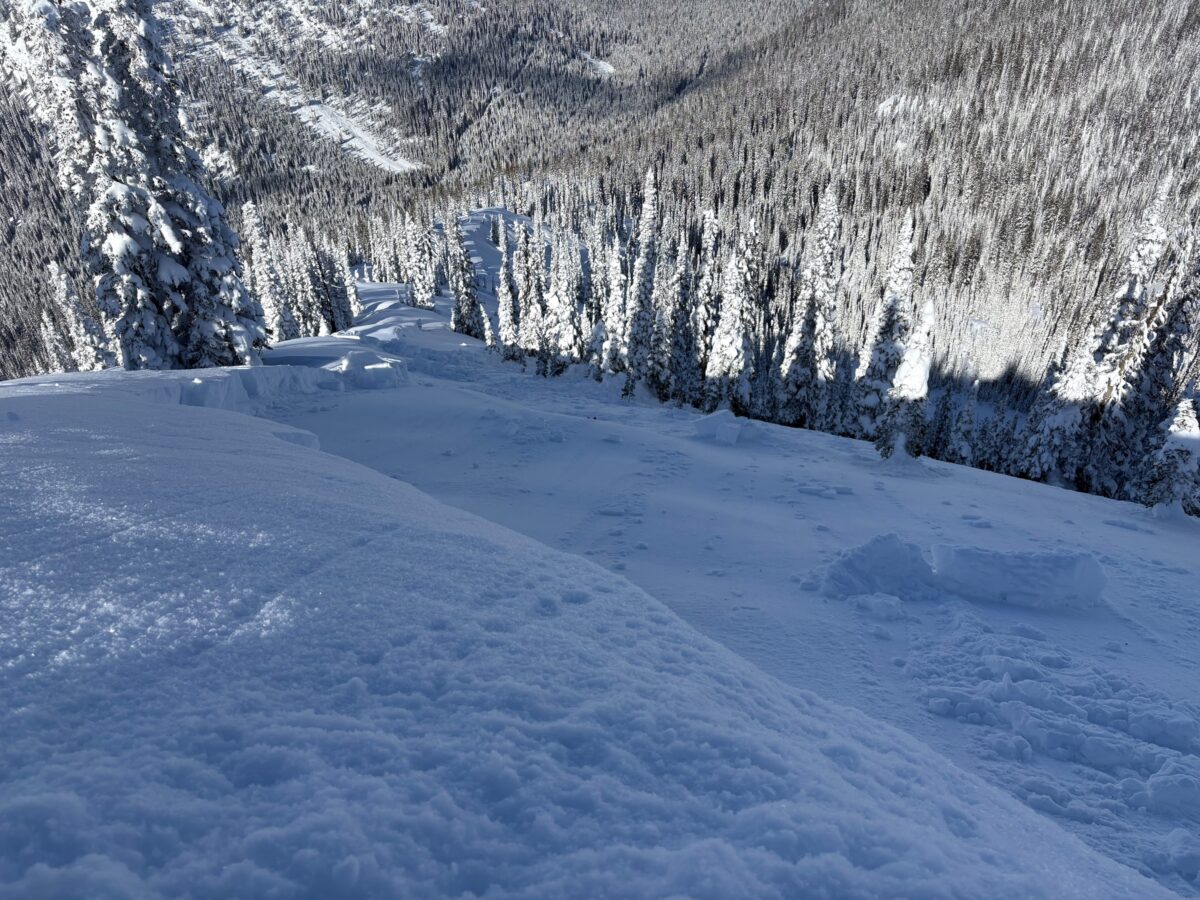
Reardon described the touchy avalanche conditions as a “rather intense” time for the forecast team.
“They are really concerned about people in the backcountry and hoping everybody comes home safe,” Reardon said. “When it started raining Monday morning, there was a collective exhale because they know nobody wants to go out in the rain.”
“They know everybody wants to get out; they want to ski and snowmobile as much as anybody,” he said of the forecast team. “They just really want people to come home.”
Reardon compares this winter’s unstable snowpack to a similar season in 2021 when rain fell in mid-January, creating a crust that was compounded by surface hoar following a dry spell that formed a persistent slab.
Like this year’s snowpack, remote triggers and avalanches in atypical locations were widespread in 2021. But Reardon said the dangerous conditions didn’t last as long as they have this year, which has seen an unusually weak snowpack over the past month with no signs of strengthening.

In 2021, that unusual snowpack was also the culprit of the forecast region’s most recent fatality when 59-year-old Dave Cano was killed after his party of snowmobilers remotely triggered a slide in the northern Swan Range.
Cano and his four partners were riding in the low-angle trees of Wounded Buck Creek and remotely triggered an avalanche from an estimated 200 feet below, knocking all five riders off their sleds. While four of the snowmobilers were able to dig themselves out after they were partially buried, the remaining rider was “partially buried critical,” with his deployed airbag poking out of the snow while his airway was beneath the surface.
By the time Cano’s partners unburied him, he was already dead. A helicopter recovered his body the next morning.
As forecasters warn the public of dangerous conditions five years later, the avalanche death toll across the West has grown in recent weeks as other states face similar snowpack scenarios characterized by a January drought, a weak snow structure and the added weight of new snow.
A slide on Feb. 17 made nationwide headlines when nine people were killed in the Central Sierra Nevada near Lake Tahoe, marking the deadliest avalanche in modern California history.
Since December, there have been 18 avalanche fatalities nationwide, according to the Colorado Avalanche Information Center, with deaths in California, Wyoming, Washington, Utah and Idaho near Montana’s southwest border.
While there have been no fatal avalanches in northwest Montana this year, nor incidents requiring rescues, Flathead County Sheriff Brian Heino said search and rescue (SAR) crews have been refreshing their training skills as avalanche warnings remain on their radar.
“When the avalanche danger increases, we communicate with search and rescue groups and train for these types of events,” Heino said.
SAR teams saw minimal activity last month, but Heino said missions have picked up in the last 30 days with incidents like injured snowmobilers and stuck recreationists.
The sheriff’s office this season has been reliant on ground teams as Two Bear Air crews wait for their new rescue helicopter to be outfitted, temporarily sidelining a resource that has assisted on dozens of avalanche victim recoveries over the past decade.
“We are looking forward to having that resource back in the coming months,” Heino said.