Conservation Groups Sue to Stop Cabinet Mountains Mining Project
The federal lawsuit claims that Hecla's Libby Exploration Project south of Libby threatens water quality and protected species, including those in a federally designated wilderness area
By Tristan Scott
A coalition of environmental groups filed a lawsuit Tuesday challenging federal agencies’ decision to approve an underground copper-and-silver exploration project in the Cabinet Mountains south of Libby. The groups say the U.S. Forest Service and the U.S. Fish and Wildlife Service rushed the environmental review process and did not adequately assess the threats that a potential future mine poses to protected grizzly bears and bull trout.
The plaintiff groups also called attention to the project’s impacts on a federally protected wilderness area, and have long called for a more rigorous form of environmental analysis.
“The Cabinet Mountains Wilderness, one of the first ten wilderness areas receiving protection under the 1964 Wilderness Act, is treasured by locals and visitors alike, and should not be exploited by mining companies for profit,” Mary Costello, director of Save Our Cabinets, one of the plaintiffs. “We are fighting to preserve the integrity of this special place for generations of people and wildlife to come.”
The U.S. Forest Service, which released an Environmental Assessment (EA) on the project in June 2025, approved the Libby Exploration Project last October. If the project moves forward, the Montanore Minerals Corporation would be able to explore and expand the existing 7,000-foot tunnel opening at the Libby Adit site in the Kootenai National Forest. The Idaho-based Hecla Mining Company, which purchased Montanore a decade ago, said the 16-year-long future exploration project aims to determine the value of the site’s minerals and whether mining them would be practical and profitable in the future.
The lawsuit seeking declaratory and injunctive relief was filed March 31 in U.S. District Court in Missoula. It names as plaintiffs the Cabinet Resource Group; Clark Fork Coalition; Earthworks; the Montana Environmental Information Center; Save Our Cabinets; and Yaak Valley Forest Council. It names as defendants the U.S. Forest Service; USFS Chief Tom Schultz; Kootenai National Forest Supervisor Chad Benson; the U.S. Fish and Wildlife Service; and FWS Director Brian Nesvik.
Plaintiffs in the lawsuit are represented by the nonprofit environmental law firm Earthjustice. The defendants have not yet responded to the complaint. Federal agencies typically do not comment on pending litigation. A USFS spokesperson did not respond to an emailed request for comment before publication deadline.
The Cabinet Mountains hold vast reserves of valuable metals — an estimated 500 million ounces of silver and 4 billion pounds of copper. Advocates say that the project could bring opportunity to Lincoln County, which has a long history of mining as its predominant economic driver.
Critics warn the exploration project and potential future mine will have a detrimental impact on wildlife habitat, including the vulnerable Cabinet-Yaak population of grizzly bears, which has teetered on the brink of collapse, as well as threatened bull trout, and on water sources and cultural sites in the area.
“Road density and illegal road use in the Cabinet-Yaak Grizzly Bear Recovery Zone are two of the biggest factors affecting grizzly bear habitat security and recovery in the Cabinet-Yaak Ecosystem,” said Chris Bachman, conservation director at the Yaak Valley Forest Council, in a prepared statement. “Unfortunately, when approving the Libby Mine project, the Forest Service has failed to account for illegal road use and increased road density caused by user-created roads, which fragment habitat and continue to hinder grizzly bear recovery.”
Miners have been exploring the site since the 1980s, when a series of small companies first began the Montanore Mine project, which involved constructing an exploratory shaft to access the mineral deposits. In 2022, Hecla withdrew the plans it inherited when it purchased Montanore and launched the Libby Exploration Project from scratch.
If the project is approved, Montanore will dewater and rehabilitate that existing Libby exploration site, according to Hecla’s operation plan. The company also proposes extending the tunnel by 4,200 feet and constructing additional tunnels for exploration. To manage increased waste rock, Hecla plans to expand the existing storage area and build a second site.
Hecla said in its operation plan that the project currently only includes exploration with no guarantee of future mining. It said that potential mineral extraction will depend on the findings and “ability to meet environmental and regulation standards.”
The U.S. Forest Service released its EA on the proposal in June, which reviewed potential risks of the project. The agency concluded the plan did not require a full Environmental Impact Statement (EIS) — the more detailed level of review under federal law — because, with safeguards in place, the impacts were not expected to be significant.
The report noted that the exploration “may affect but is not likely to adversely affect” several native species, including bull trout, grizzly bears, and wolverines — a finding with which the U.S. Fish and Wildlife Service concurred.
To limit impacts, Hecla plans to implement seasonal road closures to reduce grizzly disturbances, equip the site with bear-resistant dumpsters, and install fencing to keep wildlife out. The agency also noted it expects noise in the Cabinet Mountains to increase, but that it anticipates the impacts of the noise on wildlife to be minor.
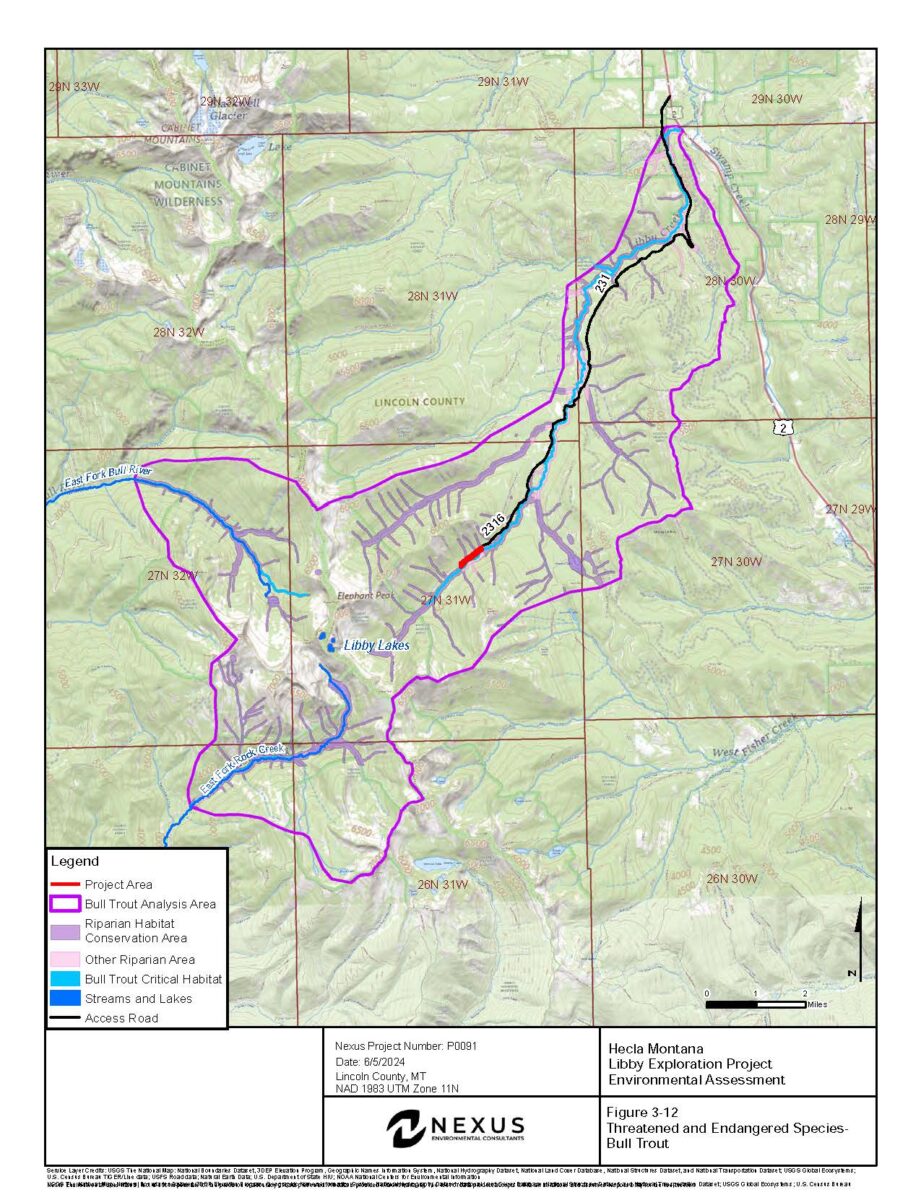
The Forest Service also described impacts to groundwater flow as “negligible,” predicting only minor streamflow reductions in Libby Creek, East Fork Rock Creek, and the East Fork Bull River. All water pumped from the site would be treated and monitored, with the agency concluding that effects on the endangered bull trout and other aquatic species would also be “negligible.”
However, the Forest Service stressed that if Hecla pursues full-scale mining in the future, the company will need to submit a new proposal and undergo additional environmental review.
As a prelude to this week’s litigation, Earthjustice last August submitted an objection on behalf of the Confederated Salish and Kootenai Tribes (CSKT) and the nonprofit conservation groups who joined Tuesday’s lawsuit as plaintiffs.
Plaintiffs condemned the Forest Service’s Finding of No Significant Impact and argued the proposal warranted the more rigorous standard of review required by an EIS.
Costello, a plaintiff in the lawsuit who was also one of the objection authors, called the Libby Exploration “a major project with serious, significant impacts” that requires an EIS.
“The proposal impacts a federally protected wilderness area, and that alone requires a really thorough analysis,” Costello said. “The project may have been rebranded as an exploration, but in essence it’s just a smaller mining operation with the same potential impacts to wilderness waters and endangered species.”
Costello pointed to groundwater modeling and hydrology reports that raised questions about the accuracy of the EA’s calibration. She said a University of Montana hydrologist was particularly worried about modeling accuracy in the upper stream reaches, including stream segments located in the wilderness.
The lawsuit also noted that the Cabinet Mountain grizzly bear population is among the “most vulnerable” in the country due to its small population size and low genetic diversity. The complaint warns that the project could lead to habitat loss and increased food conditioning, which often results in the lethal removal of bears. They also worry that increased habituation to human activities will make grizzlies more likely to be misidentified by hunters.
Costello said that while the Forest Service often relies on gated roads like those proposed by Hecla as a protection for grizzlies, such measures have historically been ineffective.
“People always go around those gates and there aren’t a lot of eyes on them,” she said. “We’re talking about a very small population of grizzly bears that is barely holding on as it is, and it simply can’t sustain any more impacts.”
Plaintiffs also say the proposal fails to adequately address risks to bull trout, a threatened species under the Endangered Species Act. They assert that there is “no way to protect the species” from the risks posed by increased sediment and potential pollution in the water.
In a 2018 lawsuit, the state of Montana attempted to label former Hecla CEO Phillips Baker a “bad actor” for his involvement in a failed mine cleanup in north-central Montana.
The lawsuit would have banned Hecla from any mining activity until the state was compensated $32 million for mines owned by Pegasus Gold Corp., where Baker was previously an executive. The Montana First Judicial District Court ultimately dismissed the case in 2024.
While Baker stepped down in 2024, Montana Environmental Information Center Deputy Director Derf Johnson said his organization’s objection to the Libby Exploration Project remains, both due to Hecla’s checkered past and its location in a protected wilderness area.
“It’s truly remarkable that we are seriously talking about issuing a permit for a mine that will intrude upon designated wilderness,” Johnson said. “There are some places you just should not permit a mine, and this is one of them. Some of the cleanest waters in the lower 48, a refuge for endangered species such as grizzly bears and bull trout, and one of the first wilderness areas ever created. It’s just a terrible spot for opening a mine.”
