As Montana Prepares to Roll Out Medicaid Work Requirements in July, Health Care Advocates Propose Best Practices
The state is planning to start checking eligibility of Medicaid enrollees starting July 1, six months ahead of federal guidelines. Health care advocates are concerned the accelerated implementation will result in eligible patients losing their coverage.
By Zoë Buhrmaster
As the state’s Department of Public Health and Human Services (DPHHS) gears up to begin checking for Medicaid work requirements this summer, department officials this week announced the launch of a new government webpage designed to help patients navigate the upcoming changes.
“Our priority is to ensure that Montanans covered by Medicaid Expansion have the information they need to make decisions about their health care,” DPHHS Director Charlie Brereton said in a prepared statement. “This new website serves as a single source of truth for our members as we begin requiring them to engage in work or work-related activities to be eligible for health coverage.”
President Donald Trump signed H.R. 1, known as the One Big Beautiful Bill Act, into law last year, bringing new eligibility standards for Medicaid expansion enrollees including “community engagement requirements.” The standards require low-income adults on Medicaid to work, volunteer, or attend school for at least 80 hours each month. Enrollees will also be required to redetermine their eligibility every six months.
The new federal law requires states to begin implementing the changes by the beginning of 2027, with the option to begin checking early. Pending approval from the Centers for Medicare and Medicaid Services (CMS), Montana is aiming to start July 1.
DPHHS officials say the new requirements will help “encourage self-sufficiency, drive workforce participation, and reduce reliance on public assistance programs.”
Meanwhile, health care policy groups are cautioning the state to take time mapping out how it will check applicants’ eligibility, warning that a confusing and complex application process could result in those who are eligible losing coverage.
The Montana Healthcare Foundation pointed to what happened to Medicaid enrollees during the state’s redetermination process after the COVID-19 pandemic. At the time, about two-thirds of the roughly 90,000 Montanans disenrolled from Medicaid lost coverage due to procedural reasons such as incomplete paperwork.
The new requirements apply specifically to low-income adults between ages 19 and 64 who are enrolled in the state’s Medicaid expansion program. At the end of 2025, there were approximately 76,000 Montanans enrolled in the expansion program. In Flathead County, which has the third highest number of enrollees of all Montana counties, 7,173 adults were enrolled in the program.
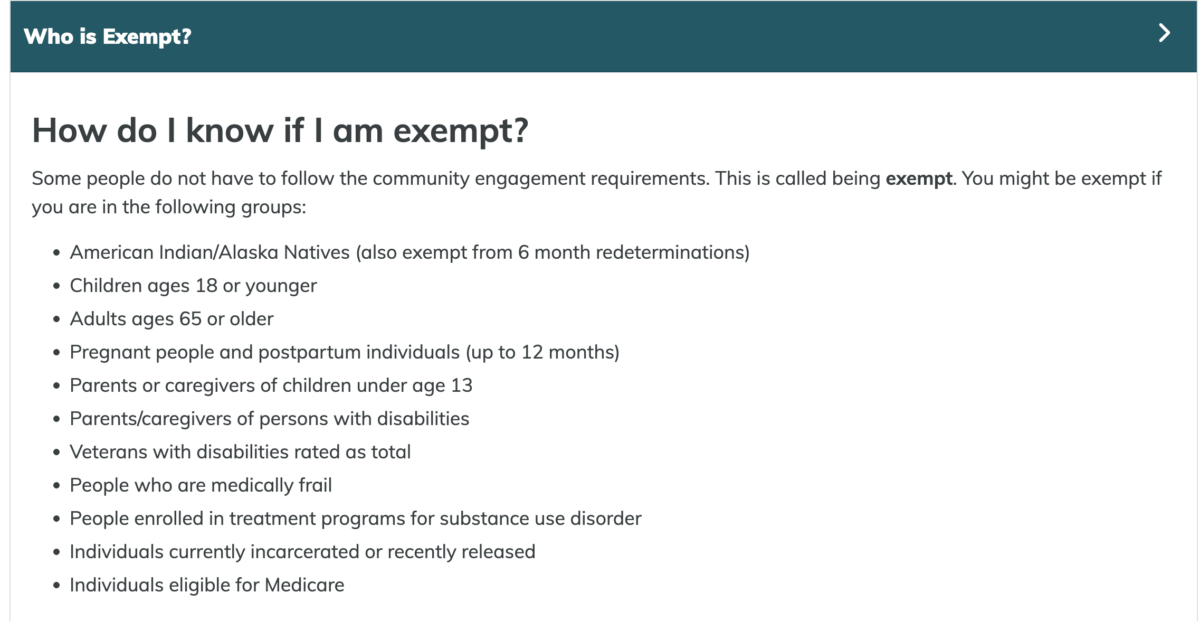
The DPHHS website features a list of people who are exempt from the requirements, including Native Americans, children, parents of young kids, caretakers of people with disabilities, people who are “medically frail,” and others.
Last week, the Montana Healthcare Foundation released a report with six strategies the state could use to ensure that eligible enrollees don’t fall through the cracks. The first strategy on the list cautions the state to carefully assess medical frailty.
“As a doctor, when I think about serious or complex medical illness, it’s just a very large bag of potential diagnoses that could be included in that,” the foundation’s CEO Dr. Aaron Wernham said.
DPHHS’ new website currently defines medically frail as someone who may be “blind or have a disability, have a serious mental health struggle, have problems with drugs or alcohol, have a hard time doing daily tasks (like getting dressed or eating) because of a physical or learning problem, have a very serious or complex illness.”
CMS is expected to give states additional guidance on the work requirements and provide a clearer definition of medical frailty sometime in June.
The foundation also suggests the state prioritize using available data, such as state income data, to help determine enrollees’ eligibility. The new federal law requires that states check existing databases to verify a person’s eligibility before requiring them to provide documentation. Wernham said he was concerned that the state website currently seems “to imply that the burden would be on both applicants and enrollees to demonstrate all of this.”
Another strategy recommends the state health department train existing staff on the new standards in addition to hiring more staff.
DPHHS spokesperson Jon Ebelt said that the state added 43 new client service coordinator positions to help with community engagement and six-month redeterminations. As of April 2, he said the department had filled 30 of those positions.
To implement the work requirements in advance of next year’s federal deadline, the state must submit a Medicaid State Plan Amendment to CMS. Health department officials said it’s something they’re working on, but have not yet confirmed whether they’ve sent it to to CMS.
In accordance with H.R.1, Montana must begin outreach to enrollees four months ahead of implementing the work requirements. According to the new DPHHS website, Montana is requiring applicants to show that they met the community engagement standards the month before applying for coverage.
Ebelt said that DPHHS sent letters to “all Medicaid members” in March, directing them to the website.
In February, the nonprofit Montana Budget & Policy Center released a similar report, citing other options to improve the redetermination process, such as strengthening the appeals process and partnering with health care providers to inform patients.
“Communicating with providers about which patients are on Medicaid Expansion and allowing them to inform patients whether they are exempt and what documentation they need could be a crucial step in reducing harm and interruptions in critical health care treatment,” the report said.
As the state waits for guidance from CMS to arrive sometime in June, many details of how the state health department plans to enforce the new requirements remain fuzzy.
“It’s a good thing DPHHS have created the site,” Wernham said. “I assume they’ll be updating it as they develop enrollment forms and definitions of the exemptions, but at this point it does leave some important questions open.”