Buttigieg Rallies for Montana Election Initiative, Stays Mum on Political Plans
Endorsing Initiative 194, Buttigieg criticized corporate influence on politics
By Tom Lutey, Montana Free Press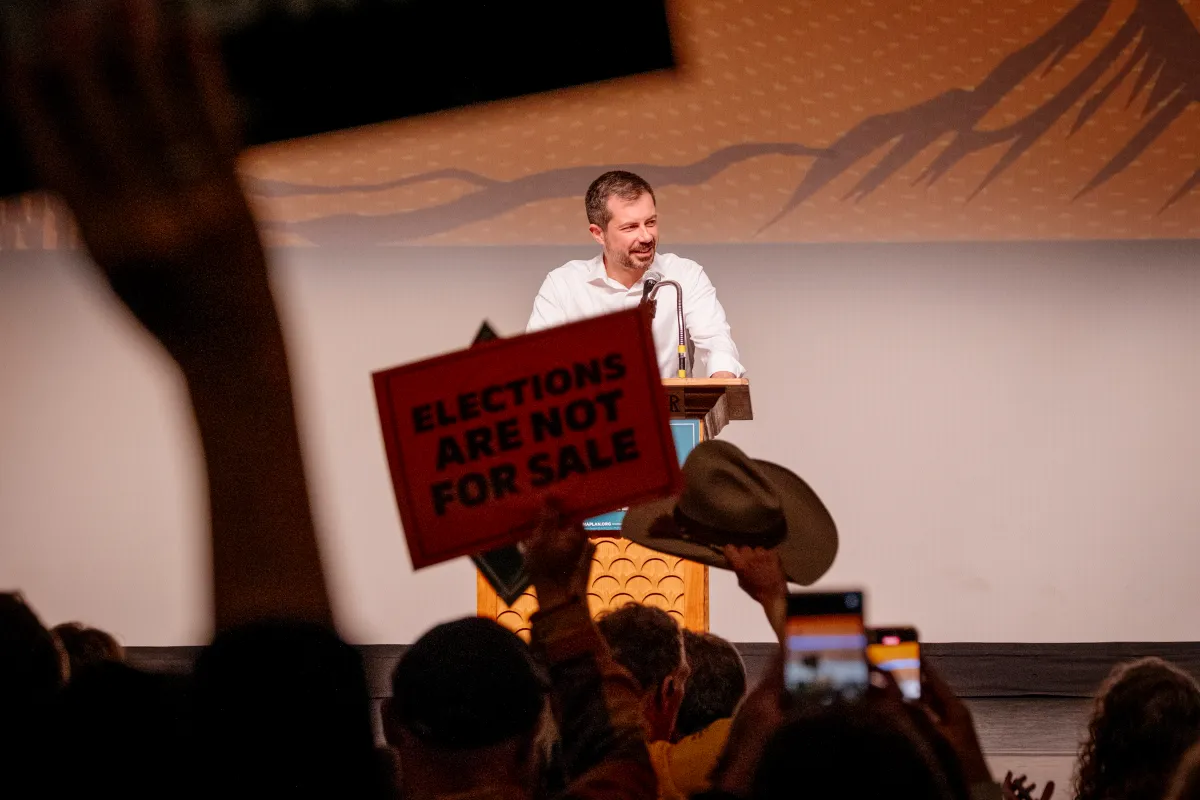
BUTTE — During an hour-long speech in a packed Mother Lode Theatre, Pete Buttigieg made a rousing plea to ban corporate money from Montana politics while repeatedly sidestepping talk of a 2028 presidential run.
The 2020 Democratic presidential candidate and former U.S. transportation secretary drew cheers from the audience of 1,200 in Butte as he suggested that special interests and corporate spending in campaigns had drowned out the concerns of average voters.
“Our system is broken. The question isn’t that it’s failing — it’s why we keep acting like it isn’t,” Buttigieg told the audience, many of whom spent hours in a line that wrapped around the block waiting to get in.
Roughly 3,500 sent RSVPs to attend the event, said Jeff Mangan, lead organizer of the Transparent Election Initiative, the political group that contacted Buttigieg just three weeks earlier about making an appearance in support of proposed Montana ballot Initiative 194. If placed on the November ballot and approved by voters, the initiative would ban corporations from contributing anything of value to candidates, political parties or ballot issues.
Buttigieg rattled off a litany of concerns — ranging from Iran-war-related high gasoline costs to the inflationary effect of tariffs on grocery prices and medical costs — that he said have been backburnered by a Congress focused more on keeping political control than addressing voter concerns.
“We see it in particular in how most of the energy in national politics is suddenly going into gerrymandering rather than into policy,” Buttigieg said. “When you encounter voters who aren’t so sure they want to support you anymore, usually that’s a sign you might want to change some of our policies … We’ve got politicians picking their voters rather than the other way around.”
Montanans know a few things about what happens when corporate influence grows strong, Buttigieg said, citing a period of corporate influence between the late 1800s and early 1900s when the biggest players in Montana’s copper industry controlled state government and many newspapers. What stopped that influence was the Montana Corrupt Practices Act of 1912, which started as a ballot initiative.
But those limits set in 1912 on corporate spending were overturned in 2010 when the U.S. Supreme Court equated money spent on political campaigns with free speech protected by the First Amendment.
What followed that 2010 court ruling, Citizens United v. Federal Election Commission, was a rapid escalation of PAC spending nationally and in Montana’s elections. Spending in Montana’s 2024 U.S. Senate race totaled $300 million, with PACs doing the majority of the spending.
Buttigieg cited the 370,000 TV ad spots in Montana’s 2024 election cycle as proof that new reforms were needed.
“How do you even have that much TV time for ads to begin with,” he said, expressing disbelief. “Are there any minutes left for the ball game, or the news? The last Senate race here cost $487 per voter. Imagine if the money went to something. Imagine if it went to making health care more affordable.”
The text of the Montana initiative bans spending by “artificial persons” — nonprofits, trusts, partnerships, corporations, trade associations or unincorporated associations. The penalty for violating the ban is being refused a license to do business in Montana.
Similar reforms have been proposed in Pennsylvania and Hawaii, with the governor of the latter state signing a restriction on corporate campaign spending into law on Thursday. Mangan, a former state legislator and commissioner of political practices, which oversees election compliance, has characterized the initiative as a way to return Montana corporate spending to how it was before 2010.
Advocates for I-194 capitalized on the Sunday event as a way to gather signatures, chipping away at the statewide goal of more than 30,000 before June 19. Petitioners for other campaigns and ballot proposals did the same in the Mother Lode lobby and throughout the line of attendees waiting outside. One worker held out a clipboard and walked the long line calling out “Seth Bodnar, Seth Bodnar” — the name of an independent U.S. Senate candidate still gathering signatures to make the November ballot.
Attendee Denise Roth Barbor signed the I-194 petition weeks ago. She used to work for Follow the Money, a nonprofit watchdog of campaign donations, and said she sees the need for finance reform.
“I’m very glad the organizers were smart enough to bring in a superpower like Pete Buttigieg to talk about it,” she said.
The campaign season is full of reminders about the obscure entities seeking to sway voters, Roth Barbor said. She expressed surprise about the amount of mail she’s receiving from a D.C.-based group called the School Freedom Fund that is attempting to influence a Republican state legislative race in her area. Roth Barbor noted the mailers she’s seen don’t say much about schools.
Speaking to reporters after his speech, Buttigieg reiterated that he isn’t discussing a 2028 presidential run, though national polls show him as a high pick among voters.
An Atlas National Poll earlier this month had Buttigieg behind Rep. Alexandria Ocasio-Cortez, D-New York, as an early popular pick among 12 candidates for likely voters. Ocasio-Cortez is slated to appear in Missoula later this week to stump for Democratic Western District U.S. House candidate Sam Forstag. Roughly 26% of voters polled identified Ocasio-Cortez as their top pick. Buttigieg got support from 22.4%.
Speaking to the Mother Lode audience about healthcare, Buttigieg, who currently lives in Michigan, spoke future tense when pledging to defend the Affordable Care Act, the landmark 2010 legislation that expanded public health coverage through Medicaid and set foundational rules for what coverage private insurers offer to the public.
“I will defend the Affordable Care Act, Medicaid, Medicare,” Buttigieg said in response to a mother talking about the suffocating costs of insulin and other drugs.
Afterward, Buttigieg said he was not campaigning this year.
“I’m not here to make news on that front,” Buttigieg said. “I can tell you I’m going to spend this year defending and supporting candidates and causes that I care about. That’s part of why I’m here.”
This story originally appeared in the Montana Free Press, which can be found online at montanafreepress.org.