Report Spotlights Nexus of Conservation and Forest Management on Wild and Scenic Flathead River
Citing evidence that protection doesn't preclude timber management on the three forks of the Flathead River, American Rivers report aims to destigmatize Wild and Scenic designations
By Tristan Scott
As a fisheries biologist with the Flathead National Forest, Pat Van Eimeren spent much of his 30-year career evaluating logging projects to ensure they didn’t jeopardize native fish habitat.
Today, Van Eimeren is retired, which means he spends more time in his own natural habitat, hunting and fishing in remote corners of northwest Montana while floating the three forks of the Flathead River.
In that capacity, he’s noticed a growing reluctance by Montana’s elected leaders to support new environmental safeguards — protections afforded through Wild and Scenic River Act eligibility determinations, for example, or recommended wilderness classifications, or roadless area designations. That’s due in large part to the perception that preservation precludes active forest management, he said, which, in an era defined by growing wildfire risk and a hobbled timber economy, is a political flashpoint.
To that end, Van Eimeren hopes a new study by the nonprofit organization American Rivers can help shift that perception, which he says is misguided, in both politics and among the outdoor-recreating public.
“The protections we’ve been lobbying for, they do not mean a hands-off approach to forest management,” Van Eimeren said. “But we need to demonstrate that these values — management on the land and conservation of the resource — can coexist.
“I think most of our forest supervisors understand that. It’s our elected officials that don’t seem to get it.”
In an effort to demonstrate that idea to federal lawmakers from Montana, Van Eimeren visited Washington, D.C. in April, converging on the capitol with other river advocates to promote the conservation of free-flowing rivers and, in Van Eimeren’s case, to share examples of stewardship and management coexisting on the Flathead National Forest and beyond.
In his heyday as a biologist, Van Eimeren said project proposals on the Flathead’s protected woods and watersheds ranged from fuels reduction activities to commercial thinning. Working with an interdisciplinary team of resource specialists, including biologists, soil scientists, silviculturists, foresters and engineers, Van Eimeren’s site analysis helped determine whether a new logging road cut into a steep hillside would trigger sediment runoff in a tributary where bull trout spawn; if it would, he’d suggest an alternative. Likewise, if the placement of a culvert was going to disrupt the passage of migratory fish, or if the removal of shade trees and woody debris might lead to increased water temperatures and diminished refuge, he’d identify the impact and present a backup plan.
“Honestly, I was pretty gun shy as a biologist and probably took more of a hands-off or conservative approach than other specialists when assessing projects in Wild and Scenic or Roadless areas,” Van Eimeren said. “But we still found opportunities to get a lot of work done in those protected zones. I don’t know how many times we went into Roadless areas. It doesn’t have to be hands off; you can still do fuels reduction, you can still do harvesting, you can have forest management inside of Roadless, inside of Wild and Scenic. I hope this report gives that concept more traction so our elected leaders don’t just turn their noses at new protections.”
The new report by American Rivers, titled “Protecting Rivers While Managing Forests: Forest stewardship on Montana’s Flathead Wild and Scenic River,” was published this spring. It examines 50 years of management activities on the Flathead National Forest to evaluate whether the concerns by federal delegates — that protection precludes management — are supported by the forest’s management history.
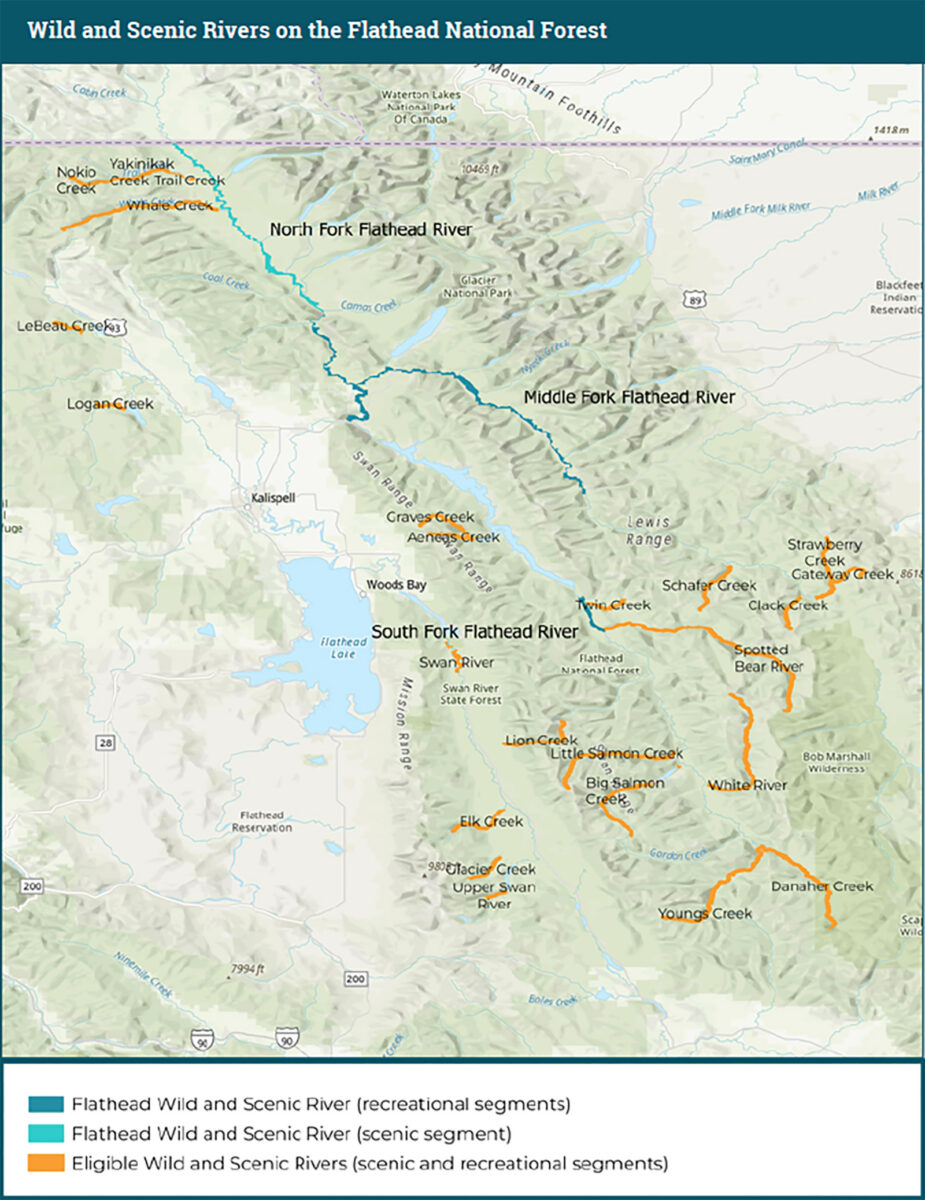
Lisa Ronald, the northern Rockies associate conservation director at American Rivers who prepared the report, said she selected the Flathead because it is home to 219 miles of Wild and Scenic Rivers that have been designated for a half century, and 284 additional miles of eligible rivers that were identified in the 2018 Forest Plan.
“Consequently, it provides a long-term, real-world case study of how the Wild and Scenic River Act operates within a multiple-use national forest,” she said.
The genesis for the report dates back a few years, when Ronald and other river advocates watched in disappointment as the Nez Perce-Clearwater National Forest eliminated protections for 86% of its Wild and Scenic eligible rivers in its new forest plan, removing protections from nearly 700 stream miles. Among the waterways that lost protections are tributaries to the Lochsa River and the North and South Forks of the Clearwater River.
“As debate over forest management heats up, there’s a tendency for the no-touch approach prescribed by wilderness into other forms of protection, like Wild and Scenic designations. There’s more confusion about that,” Ronald said. “And we recognize that a no-touch mentality is not appropriate for all landscapes. But since the Flathead is one of the flagship rivers in the Wild and Scenic River system, and because it has so many examples of on-the-ground management occurring in designated corridors, we started looking at it as a case study to remove negative associations with conservation and protection.”
For context, on the Flathead National Forest, Wild and Scenic Rivers Act protections apply to 219 miles of the Flathead Wild and Scenic River totaling 42,161 acres of riverside land, and 284 miles of eligible Wild and Scenic Rivers totaling 90,880 acres of riverside land. Of the 219 miles designated Wild and Scenic, 98 miles are classified as wild (mostly flowing within wilderness); 80 miles are classified as recreational (mostly along U.S. Highway 2, but also on the South Fork above Hungry Horse Reservoir) and 41 miles are classified as scenic.
Since 1976, the Flathead National Forest has actively managed these riverside lands in a variety of ways.
The Flathead Forest Plan assigns every acre of the forest into management areas. For example, 637,000 acres are identified as “general forest,” and are grouped into Management Area (MA) 6. About a million acres of wilderness are categorized as MA 1. Wild and Scenic River corridors represent a unique land management category in the Flathead Forest Plan. Categorized as MA 2a, these 42,161 acres include the quarter mile buffer on each side of the congressionally protected Flathead Wild and Scenic River and represent less than half of 1% of the entire Flathead National Forest.
Using Forest Service project data, Ronald identified vegetation and fuels management projects that occurred within recreational and scenic classified segments of the Flathead Wild and Scenic River, and within the areas of six of the Flathead National Forest’s eligible rivers: Lion Creek, Logan Creek, Spotted Bear River, Twin Creek, Upper Swan River, and Whale Creek.
She found that the following projects represent examples representing the nexus of river protection and forest management — how river protection under the Wild and Scenic Rivers Act has been compatible with efforts to manage the Flathead National Forest: Belton Hills Fuels Reduction Project (2007-2015); Crystal Cedar Project (2020-2024); Lake Five Project (2022); Round Star Project (2024); Granite Moccasin Project (2026).
“We reviewed spatial data and National Environmental Policy Act records for 16 projects that occurred on the Flathead Wild and Scenic River after 1976, and on eligible Wild and Scenic Rivers after 2018,” the report states. “Consultation with former and current Forest Service staff informed the selection of representative projects for more detailed investigation. Overall, we found a variety of management actions that not only have maintained river values, but at times enhanced them.”
For every formal management action, the Forest Service is legally required to protect the Outstandingly Remarkable Values (ORVs) that have been identified for each river segment, including recreation, scenery, fish, wildlife, and others. The Flathead National Forest has identified 10 ORVs across the three forks of the Flathead River, including fisheries, geology, water quality, wildlife, botany, recreation, scenery, history, culture, and ethnography.
“The Wild and Scenic Rivers Act tempers, though does not prevent, forest management within protected river corridors, due to the law’s mandate to maintain or enhance Outstandingly Remarkable Values,” according to the report. “Although Wild and Scenic River designation does not preclude forest management, as shown previously, it may restrain or refine treatments to ensure Outstandingly Remarkable Values are preserved. Within practical application, this means that treatments can be different inside the Wild and Scenic River corridor when compared to outside it.”
With the report published, Ronald said she hopes it will serve as a tool to “start moving some decision-makers more toward having an appetite for Wild and Scenic Rivers,” and that it will clear up the sense among lawmakers that protections impede active forest management in an era dominated by wildland fire risk and a struggling timber economy.
For Van Eimeren, it’s an opportunity to showcase examples of stewardship and management occurring in tandem, and it’s an opportunity to designate more miles of rivers as eligible under the Wild and Scenic Rivers Act.
“For me, it’s a question of where are we today and where do we want to be tomorrow? We have a warming climate and people want to be near the water, on the river or on the lake,” Van Eimeren said. “And if we are going to have more people on those waterbodies, let’s educate those users and protect those outstandingly remarkable values that bring people to the places in the first place. Otherwise they get overrun and abused.”