Glacier Park Ends September About 10,000 Visits Shy of Annual Record
A September that drew 643,543 visits leaves the park less than 1% short of 2017's overall mark of 3.34 million, with the final quarter of the year still to come
By Tristan Scott
Glacier National Park ended September 10,365 visits short of the busiest year in its history, according to preliminary visitation estimates released this week.
A month that drew 643,543 visits, up 16.5% from a year ago, brought the park’s 2026 total to 3,295,147, which is 11.3% ahead of last year’s pace and less than a third of 1% shy of the record of 3,305,512 set in 2017.
Breaking the record will take very little. Last year, the park logged about 176,870 visits from October through December, an average of roughly 1,920 people a day, based on 2025’s full-year total of 3,136,557 and the 2,959,687 visits it had recorded through September.
Surpassing 2017 would take about 113 people a day over those three months, or roughly 6% of last fall’s traffic. Merely matching last year’s October-through-December visitation would push 2026 to about 3.47 million visits, roughly 5% above the record.
The alpine section of Going-to-the-Sun Road closed for the season on Oct. 19, the third Monday of the month, by which the park typically closes it. The West Entrance, the park’s busiest gateway, remains open year-round, as does the St. Mary Entrance on the east side.
This is the first summer since 2021 that the park has operated without a vehicle reservation requirement on Going-to-the-Sun Road. Officials scrapped the pilot program ahead of this season in favor of a reservation-only shuttle system and a three-hour parking limit at Logan Pass. Since July 1, visitors have needed a reservation to ride the shuttle.
Park spokesperson Autumn Sifuentes said in written responses to Beacon questions that the park “anticipated that visitation could be higher this summer with the vehicle reservation system no longer in place.” She cautioned that weather, travel trends and broader tourism patterns also influence visitation, making it “difficult to attribute the increase to any single factor.”
Asked whether the shuttle and parking limit have eased pressure on the park, Sifuentes said the goal “is not to limit visitation” and identified limited parking capacity at popular destinations as one of the park’s biggest challenges. The shuttle and timed parking at Logan Pass, she said, have helped the park manage that capacity and reduce some congestion while giving visitors more ways to get around.
Superintendent Dave Roemer has described the shift as “a deliberate pivot” and has unveiled a long-range proposal to expand the park’s 36-vehicle shuttle fleet and add up to 600 parking spaces, growing both “in lockstep.”
September drew an average of about 21,450 visits a day, down from roughly 26,700 on an average August day but well above the 552,557 visits the park logged in September 2025. The month widened the park’s lead over last year, with year-to-date growth climbing from 10.16% through August to 11.33%.
As it has all season, Many Glacier drove much of the growth. The area drew 86,821 visitors in September, up 179.1% from 31,104 a year earlier, when the Swiftcurrent area was closed for a rebuild of its roads, parking lots and water system. For the year, Many Glacier is up 155.2% to 380,023 visits. That gain of about 231,000 visits is equivalent to roughly two-thirds of the park’s 335,000-visit increase, though counts at individual areas overlap and don’t sum to the park total.
The St. Mary entrance grew 31.1% in September to 171,305 visitors (774,528 year to date, up 18.2%). The West Entrance rose 7.9% to 300,645 and is up 6% for the year at 1,599,293. Polebridge climbed 10.5% to 13,579.
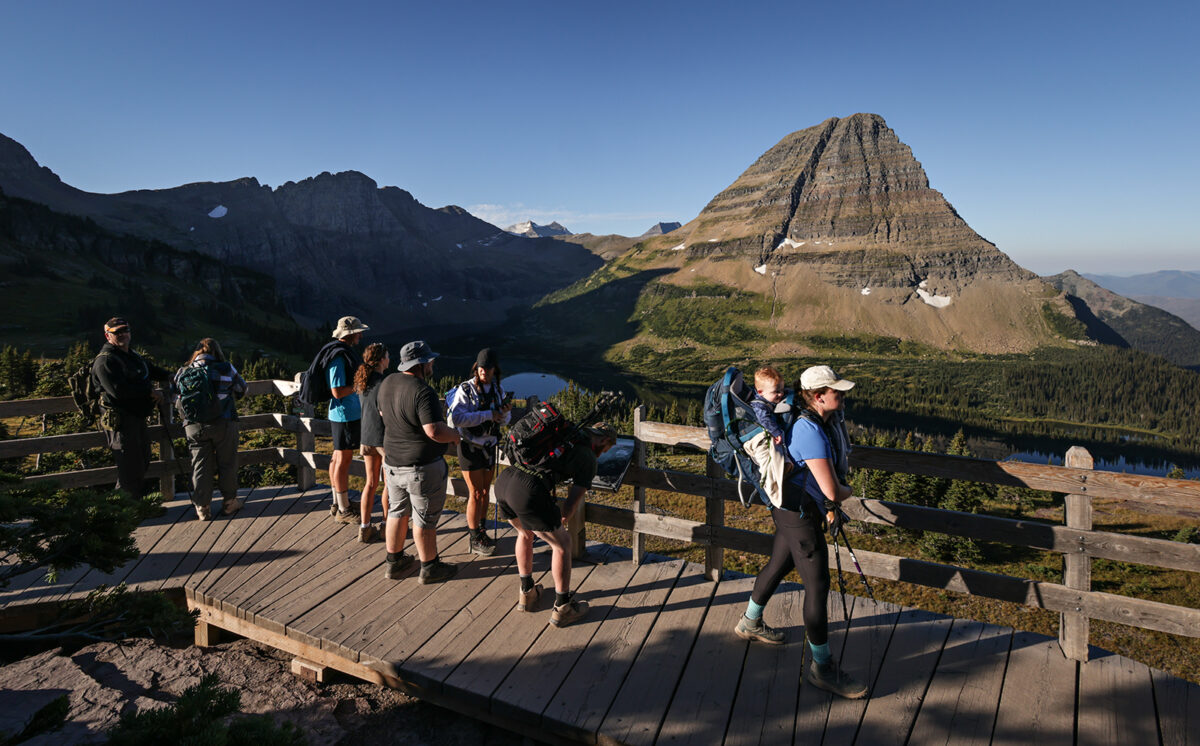
Other areas moved the opposite direction. Two Medicine drew 19,273 visitors, down 57.7% from 45,528, and is down 31.2% for the year to 183,294, as a utility project and road rehabilitation keep its campground closed in 2026. Camas fell 9.8% to 19,839 and Goat Haunt slipped 18.5% to 2,504. Walton/Goat Lick edged up 1.1% to 23,040 for the month but is down 9% for the year.
Overnight stays again lagged far behind overall visits. They fell 7.8% in September to 61,493, leaving the year-to-date total at 386,193, essentially flat from last year’s 386,422. Through August, overnights had been running 1.5% ahead. Concession lodging held steady for the month, down 0.1% to 21,762, and is up 14.2% for the year to 121,725. Tent stays dropped 19.4% to 12,266, backcountry stays fell 24.6% to 5,901, and group camping slipped 13.2% to 1,509. RV stays were flat, down 0.2% to 20,055.
The National Park Service cautions that current calendar-year figures are preliminary and subject to revision. The data won’t be finalized until the end of the first quarter of 2027.